Budding splits the colony
Multi-queen species - Argentine ants and several house ants among them - react to a repellent by splitting. A queen and a few hundred workers relocate, and one colony becomes two.

Ant Control in Horningsea Park 2171 — local technicians, fixed prices and a written report. Ant treatment starts from $89.
Real, verified feedback from people we've helped — straight from Google.
Local technicians, fixed prices and a written report for every job in Horningsea Park.
We treat ants right across 2171. Horningsea Park is roughly 34.7 km west of the city, which puts it well inside the South West Sydney run our technicians work. We cover Horningsea Park on scheduled runs through the South West Sydney, and we will give you a firm time rather than a window.
Most weeks we are somewhere between Lyons Park and Carnes Hill Marketplace in Horningsea Park, and Percy Rabett Park is close enough to be on the same run.
Under Liverpool, Fairfield and Cumberland, we cover Horningsea Park and Carnes Hill, Hoxton Park and West Hoxton alike. On a newer estate the houses are near-identical and tightly spaced, which means a problem in one tends to turn up in the ones either side.
The ant calls we take from Horningsea Park are mostly newer homes on small blocks where next door has the same problem. If yours is one of them, mention it when you ring 1300 313 373 - it changes what the technician brings.
Every part of 2171 is covered as standard.
Your appointment is confirmed the day before with a real arrival time. Because Carnes Hill and Hoxton Park are covered on the same round, 2171 often has an earlier slot available.
A colony can occupy a garden bed, a paving slab and a wall cavity at once. That is why a single treated nest in Horningsea Park changes very little on its own.
If there are ants running up a shrub beside a Horningsea Park house, look for scale or aphids on it. They are farming, and that food source is what sustains the colony.
The reason the trail returns to the same spot in a Horningsea Park kitchen is that it is marked chemically. Wiping it buys hours. Treating the colony that maintains it is the only thing that ends it.
Each of these behaves differently, so the bait and the placement change too. Two photos come from our own jobs.
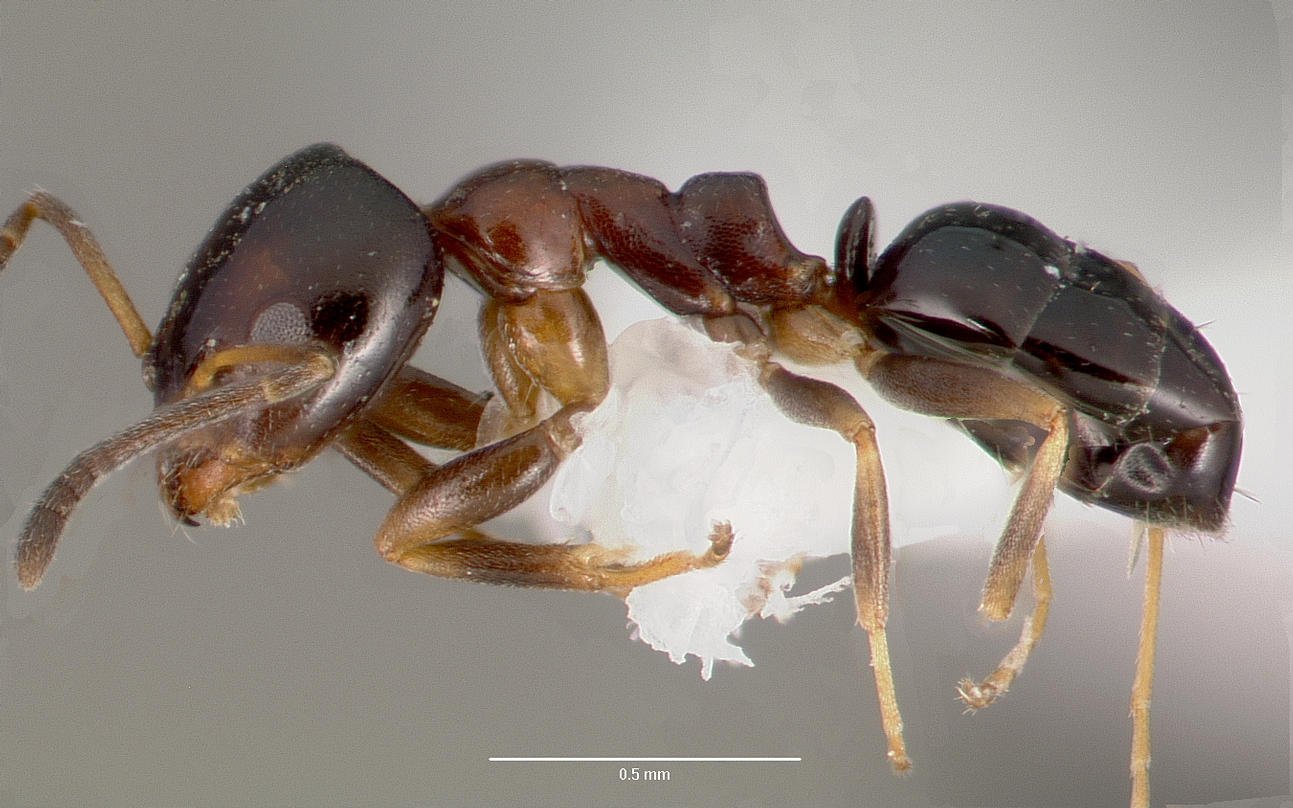
Small, shiny and black, and one of the most common kitchen ants in Sydney. It trails along skirting boards, window frames and power cables, and nests in wall voids, roof spaces and garden edges. It readily takes sweet baits.
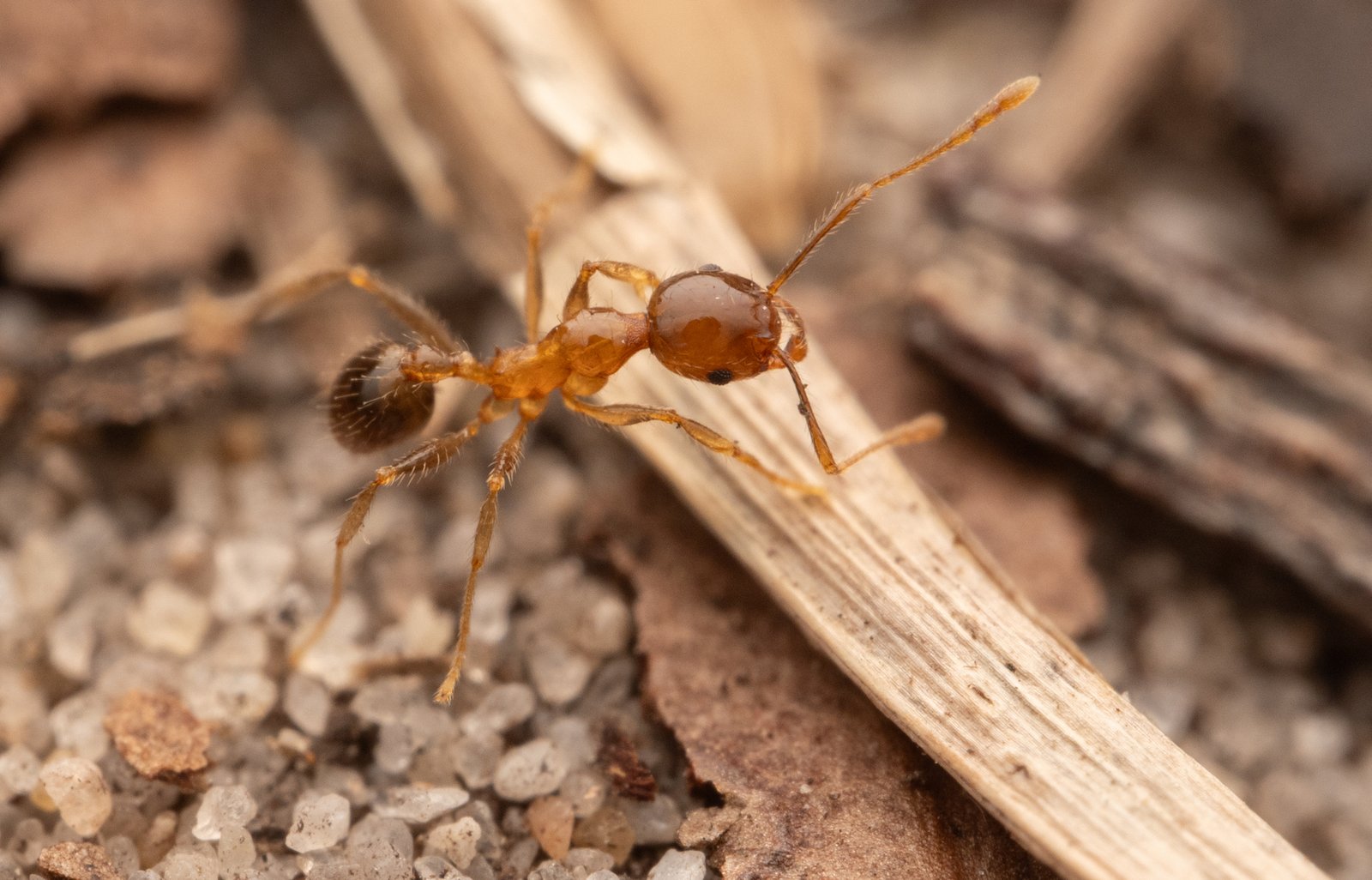
Tiny and brown, with a distinct large-headed soldier. The sign is loose sand appearing between pavers, along the slab edge and in grout lines. Many nests to a colony, which is why we use oil-based granular baits.
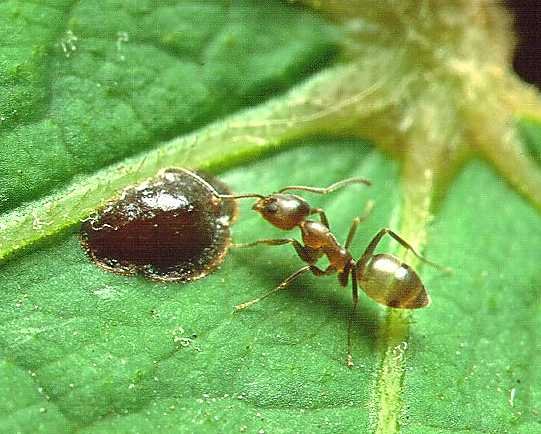
A small, matt brown ant that moves quickly in heavy trails. Its nests have multiple queens and link up with others nearby, so the problem often spans several properties. Repellent spray is the worst thing to use on it.
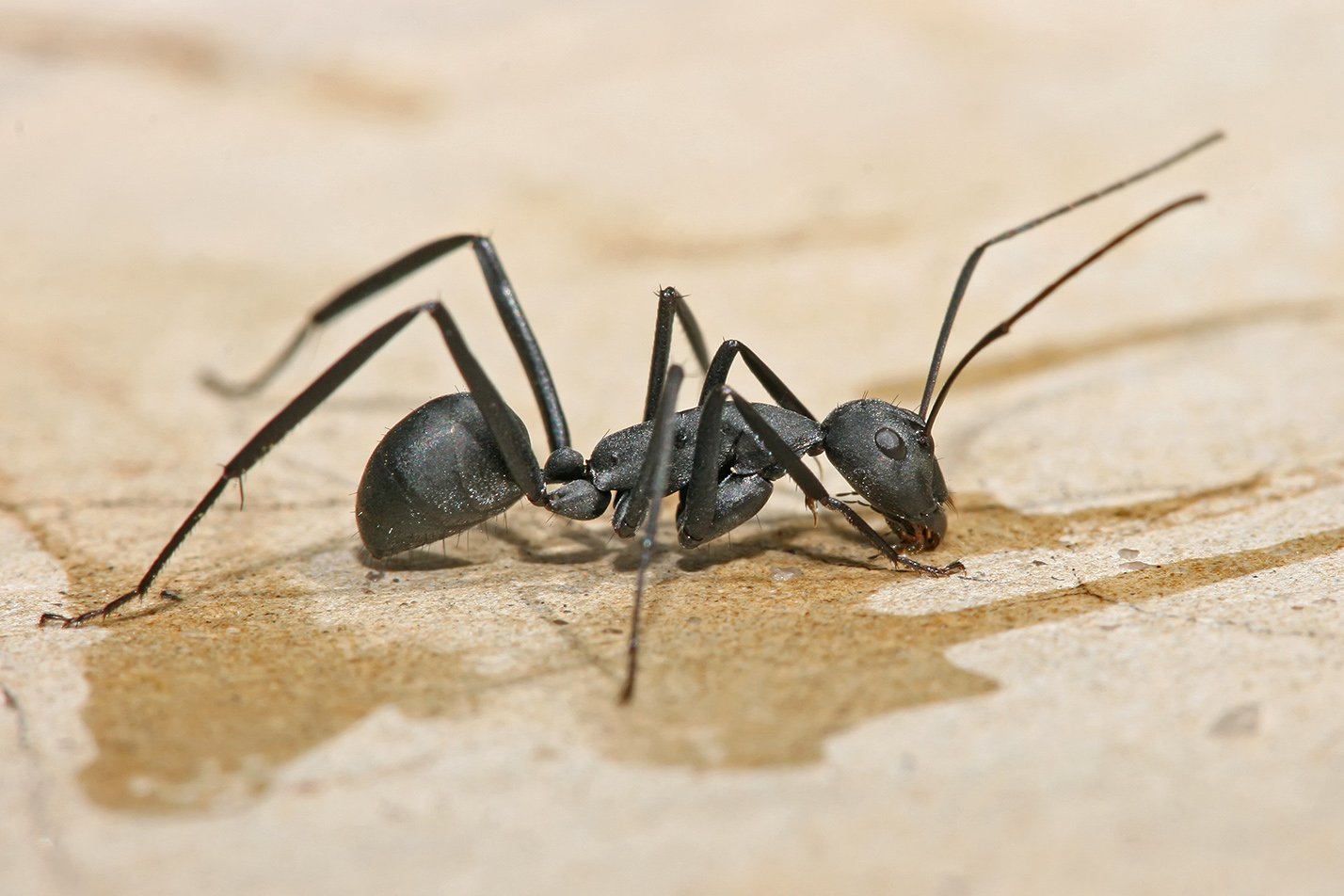
These are the large night-active ants that nest in soil, hollow trees and timber that has softened with damp. Structural damage is uncommon in Australia, but a wall nest points to a leak worth chasing.
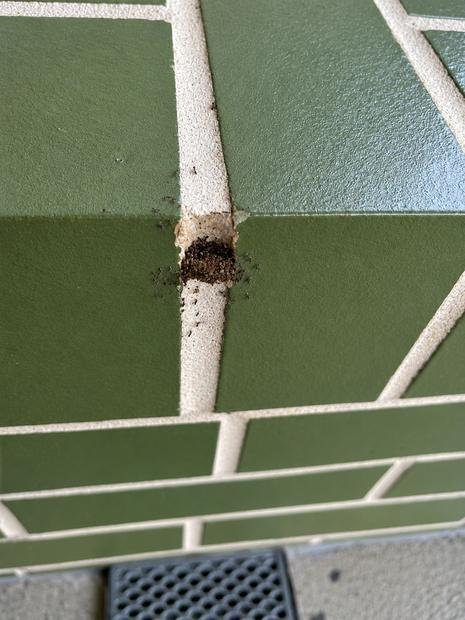
An Elite photo of ants emerging from mortar. The route runs through weep holes and cracked joints straight into the wall cavity, which is the usual home for a black house ant colony.
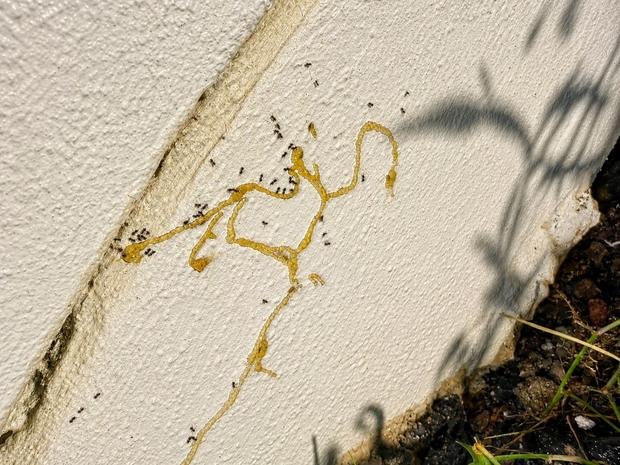
Photo from an Elite job: gel bait placed along an active trail. The ants are left to feed and carry the bait home, so we ask customers not to wipe or spray the trail afterwards.
Where ants appear usually tells us where the nest is and which species we are dealing with.
When they come in from the outside wall, the nest is usually in the cavity or just outside in the garden. We work back from the entry point.
Loose fine soil along paving, driveway joints and the slab edge means coastal brown ants have nested underneath.
Ants nesting in switches and electrical fittings are drawn to the warmth. Do not spray into power points; tell us so we can treat safely.
Mating flights produce the winged swarms you see in spring and summer. Finding them indoors suggests a mature colony inside rather than outside.
When trails appear around the shower, vanity or toilet, moisture is the reason - often a slow leak the colony is drinking from.
Lawns and garden beds are where bull ants and jumper ants nest. Their stings are painful and can trigger severe allergic reactions.
A licensed Sydney technician will talk it through and give you a fixed quote within half an hour.
Multi-queen species - Argentine ants and several house ants among them - react to a repellent by splitting. A queen and a few hundred workers relocate, and one colony becomes two.
Ants can detect a supermarket spray and will simply route around it. A professional non-repellent is undetectable, so they walk through it and carry the active home to the colony.
A colony only takes bait if it wants that food at that moment. Ants switch between sugar and protein as their brood needs change, so we test preferences and change baits when needed.
It takes days for bait to move through a colony. Spraying the trail the day after our visit kills the very ants delivering it - our blog explains budding in more detail.
Tracing first, then baits and non-repellent products that do the work after we leave.
Species confirmed, then trails traced to entry points and to the nests - walls, paving, garden edges, roof space.
Small amounts of sweet, protein and oil-based bait show what the colony is feeding on right now.
Gel bait goes along trails, window frames and skirting where ants travel, out of reach of children and pets.
Outside, a non-repellent goes around the foundation, weep holes, door frames and paths, so ants coming in pick it up on the way.
Under-paver and lawn-edge nests are handled with granular bait, or treated directly where that is better.
You receive the job summary in writing, guidance on what to leave alone, and 6 months of warranty on the general treatment.
The same bait does not suit every ant. This is how we choose.
| Species | Usually feeding on | Treatment approach | Common mistake |
|---|---|---|---|
| Black house ant | Mostly sweet liquids and honeydew, with protein demand during brood rearing | Gel bait along the trail, plus non-repellent treatment to weep holes and door frames | Daily detergent wiping of trails - it moves the foraging rather than stopping it |
| Coastal brown ant | Protein and oil | Oil-based granular bait applied to paving and lawn edges | Pouring insecticide into one pile and assuming that was the colony |
| Argentine ant | Chiefly sugars, with protein at intervals | Slow-release baits plus a non-repellent treatment along the property line | Repellent sprays at the boundary, which make a multi-queen colony bud |
| Sugar ants (Camponotus) | Sweet foods and insects, foraging after dark | Inspecting trails at night, baiting close to the nest, and fixing damp timber | Working only in daylight hours, when these ants are not out |
| Bull ants and jumper ants | Insects and nectar, always outside | The nest itself is treated directly, in lawn or garden bed | Hand-digging a nest, which reliably ends in stings |
| Time of year | What is happening | What to watch for |
|---|---|---|
| Early spring (Sept to Oct) | Colonies become active and start on brood, which shifts them onto protein | Early indoor trails, and sand piles returning to the paving |
| Late spring to summer (Nov to Feb) | Peak activity, with swarming flights triggered by warm humid conditions | Flying ants, and trails that thicken noticeably after storms and heat |
| Autumn (Mar to May) | The colony is at its largest and laying in stores before winter | Trails running into pantries and to pet food |
| Winter (Jun to Aug) | Outside activity drops away, though nests in warm wall cavities carry on | Ants near heaters, hot water units and in the kitchen |
Most failed ant treatments come down to what happens in the week after.
Honeydew is a sugar supply the colony will defend. We point out the plant on a Horningsea Park job because otherwise the trail simply re-establishes.
Brick cavities are dry, warm and undisturbed, which makes them ideal nesting. The weep hole is the doorway and it is usually where we start on a Horningsea Park job.
Winter does not kill the colony, it just slows it. The nest under a Horningsea Park path in July is the same nest that produces the trail in October.
Finding the nest is the job - following the trail to it, not treating the visible end of it.
Which bait we use depends on the ant and the season: sweet, protein or oil-based.
Sprays that scatter a colony are avoided entirely in favour of non-repellents the ants deliver themselves.
A general ant treatment carries 6 months of cover - if they return inside it, so do we.
Everything you need to know before you book. Still unsure? Call us — we're happy to help.
Get a Free QuoteAnt treatment starts from $89. The fixed price depends on the size of the property and how far the problem has spread, and we confirm it before we start - there is no call-out fee in Horningsea Park 2171. Every general treatment carries a 6-month warranty.
We cover it on scheduled runs, so a day's notice gets you the best slot. Horningsea Park is about 34.7 km west of the CBD in the South West Sydney, and we give you a firm arrival time rather than an all-day window.
The ground here was cleared and rebuilt recently, which displaced whatever lived in it, and the blocks are close enough that ants move between them along the fence lines.
Modern detached homes on compact lots, usually slab on ground, so the perimeter and the entry points do most of the work.
Yes. We work in houses, units, strata blocks, rentals and commercial premises across Horningsea Park 2171, and we provide the written report agents and strata managers ask for.
It is, provided the instructions are followed. We will tell you what to keep clear of and for how long before we leave. Let us know about children, pets or fish tanks when you book.
You do not normally need to leave. Anything requiring an empty room is short, and you will know about it before the work starts.
Typically one to two hours on site. What extends it is size, access and how far the problem has gone, all of which are accounted for in the quote.
Every general treatment carries a 6-month warranty. If activity continues past the expected period, call us and we will come back.
We do. Horningsea Park and Carnes Hill, Hoxton Park, West Hoxton and Prestons are all on the same route, which helps if you own more than one property in the area.
Photographs from Elite jobs across Sydney — not stock imagery.
Fast and fully insured, with a no-obligation quote back to you within 30 minutes.