Budding splits the colony
A repellent does not kill a multi-queen colony, it divides it. A queen and several hundred workers shift to a new site, leaving you with two nests instead of one.

Ant Control in Seven Hills 2147 — local technicians, fixed prices and a written report. Ant treatment starts from $89.
Real, verified feedback from people we've helped — straight from Google.
Where Seven Hills sits, who covers it and what it costs.
If you are in Seven Hills or anywhere else in 2147, you are in our Blacktown & Mount Druitt patch, 27.5 km west of the CBD. We cover Seven Hills on scheduled runs through the Blacktown & Mount Druitt, and we will give you a firm time rather than a window.
Around Seven Hills we work the pockets near Grantham Heritage Park, Landen Stadium and Seven Hills Plaza most often, so the van is rarely far away when a job comes in.
Seven Hills is in the Blacktown City area, and we cover Lalor Park, Toongabbie and Prospect on the same runs - handy if you own more than one property or your ant problem has come from next door. Newer estate housing sits close together on small blocks, so what happens next door matters. We check the boundary and the fence line, not just the house.
The ant calls we take from Seven Hills are mostly estate houses with narrow side access and a shared fence line. If yours is one of them, mention it when you ring 1300 313 373 - it changes what the technician brings.
The whole of 2147 is covered, Seven Hills station included.
The 2147 run is set the day before and you are given an arrival time. Where Lalor Park and Toongabbie fall on the same round, we can usually bring the visit forward.
Ants lay a pheromone trail that other workers follow, which is why the line is so precise and why it reappears in exactly the same place after you wipe it. Cleaning a Seven Hills kitchen removes the smell for a few hours, not the colony that laid it.
Many ants get most of their sugar from honeydew - the secretion of aphids and scale insects they actively protect on garden plants. A Seven Hills garden with a scale problem is feeding the ant colony that then comes indoors.
In a dry spell ants move indoors looking for moisture, which is why a spotless Seven Hills kitchen still gets trails in January. The sink, the pet bowl and the shower recess are the attractions.
Each of these behaves differently, so the bait and the placement change too. Two photos come from our own jobs.
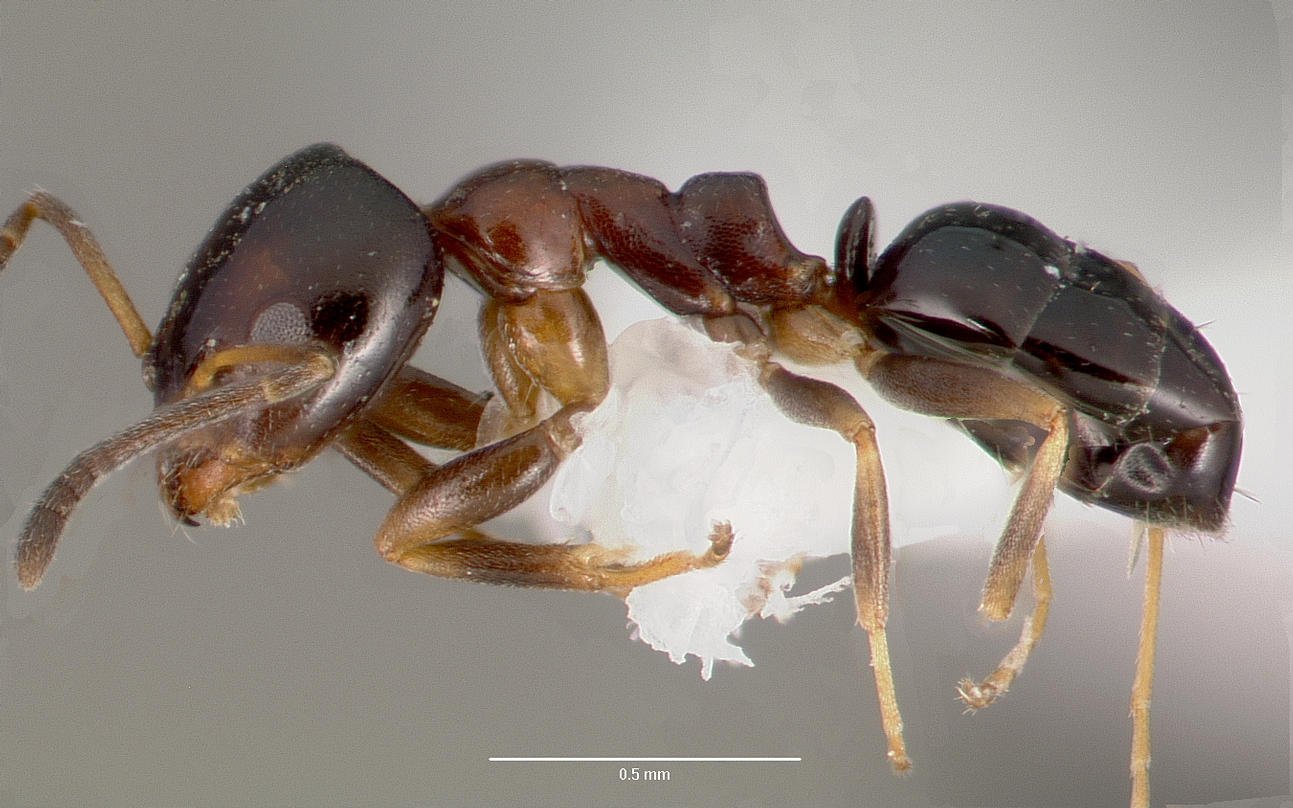
Shiny, black and small - Sydney's most common indoor ant. Trails follow skirting boards, window frames and power cables back to nests in wall voids, roof spaces or garden edges. Sweet baits work well on it.
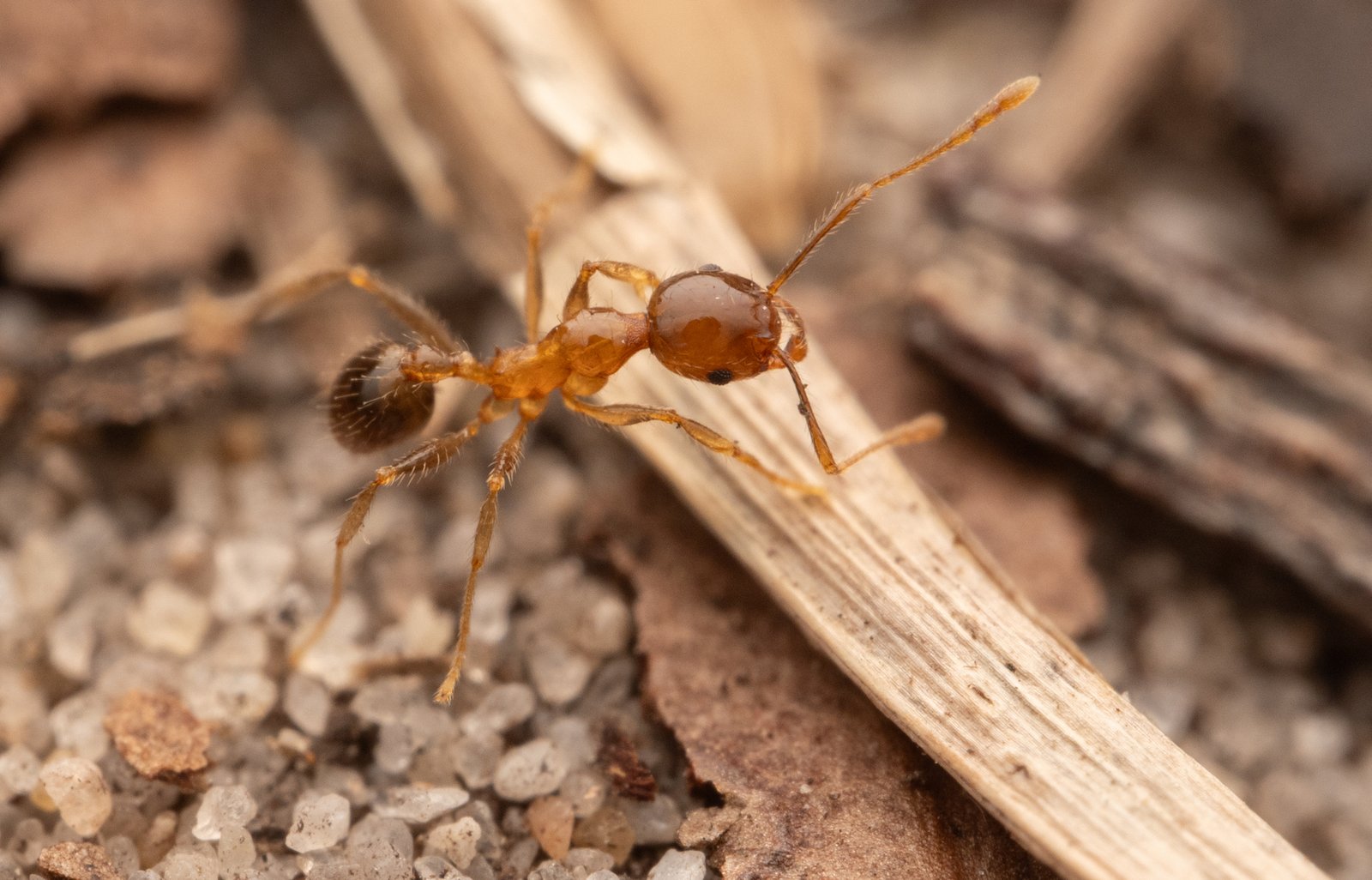
Minute brown ants with larger-headed soldiers among them. Fine sand in paving joints, at slab edges and in grout is the tell. Because a colony holds many nests, oil-based granular baits are the right approach.
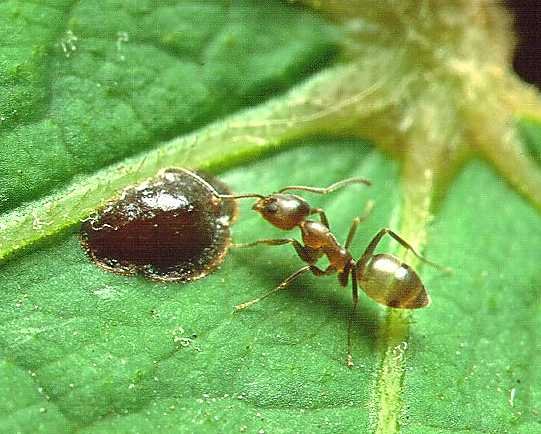
Dull brown, small, and noticeable for the thickness and speed of its trails. Multi-queen nests connect to neighbouring ones, which is how an infestation covers several properties. Repellents make it markedly worse.
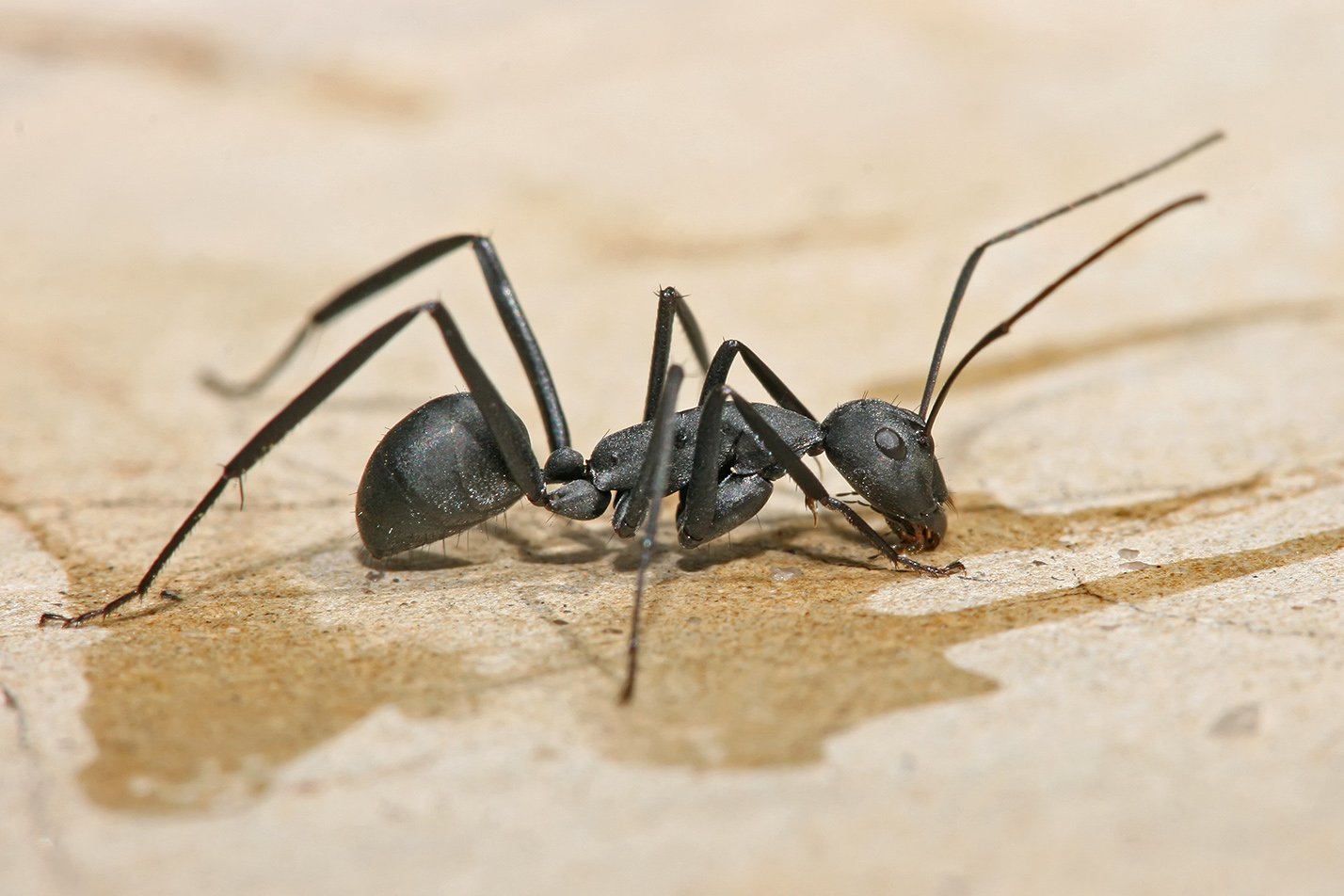
Large ants that come out at night and nest in soil, hollow trees or damp timber. Unlike the overseas carpenter ants they seldom threaten structure - but a nest in a wall tells you there is moisture there.
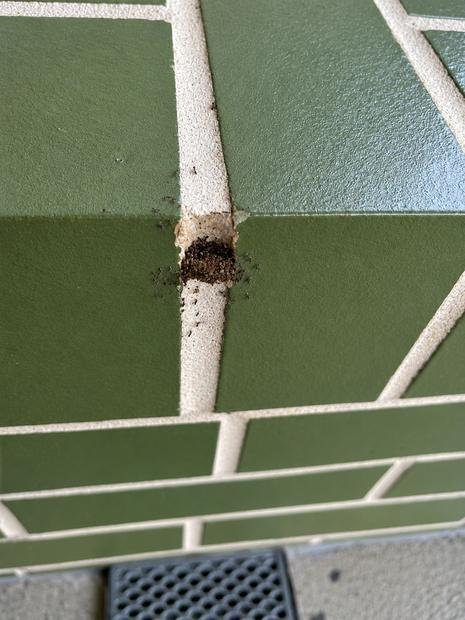
From an Elite job - a nest coming out of a mortar joint. Cracked mortar and weep holes open directly into the wall cavity, and that cavity is where a lot of black house ant colonies sit.
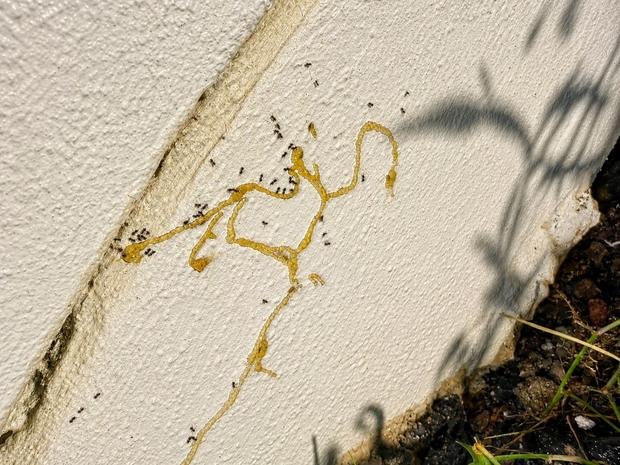
An Elite photo of gel bait on an active trail. The whole point is letting them feed and take it home, so the trail must be left alone once we have treated it.
Where ants appear usually tells us where the nest is and which species we are dealing with.
When they come in from the outside wall, the nest is usually in the cavity or just outside in the garden. We work back from the entry point.
Loose fine soil along paving, driveway joints and the slab edge means coastal brown ants have nested underneath.
A nest in a power point or appliance is about warmth. Spraying into electrical fittings is dangerous - tell us and we will treat it the right way.
Those spring and summer swarms of winged ants are mating flights. If they are coming out inside the house, there may be a mature colony in the building.
Trails around the shower, vanity or toilet often mean moisture in the wall or a colony drinking from a slow leak.
Bull ants and jumper ants nest in the lawn and garden beds. The sting is genuinely painful and in some people causes a serious allergic reaction.
Talk to a licensed Sydney technician today - honest advice and a fixed quote within 30 minutes.
A repellent does not kill a multi-queen colony, it divides it. A queen and several hundred workers shift to a new site, leaving you with two nests instead of one.
Repellent means detectable, and detectable means avoided. Non-repellent products let foragers walk through and transfer the active to the rest of the nest.
If the bait is not what they want today, they will walk past it. Preference moves between sugar and protein with brood demand, so we test and change as needed.
Give it days, not hours. Bait has to be carried through the colony, and spraying the trail afterwards destroys the couriers doing that work. Our blog covers budding in more detail.
Tracing first, then baits and non-repellent products that do the work after we leave.
Species confirmed, then trails traced to entry points and to the nests - walls, paving, garden edges, roof space.
A test with small amounts of each bait type - sweet, protein, oil-based - tells us what the colony wants at this point in its cycle.
Inside, gel bait follows the trails: window frames, skirting, the routes they already use, always placed where children and pets cannot get to it.
The perimeter gets a non-repellent product - foundation, weep holes, door frames, paths - which intercepts ants before they are inside.
Coastal brown ant nests under paving and along lawn edges get granular bait or direct treatment.
Written summary, instructions on what not to spray, and a 6-month warranty covering the general treatment.
The same bait does not suit every ant. This is how we choose.
| Species | Usually feeding on | Treatment approach | Common mistake |
|---|---|---|---|
| Black house ant | Honeydew and sugary liquids, switching to protein when there is brood | Sweet gel on active trails and a non-repellent perimeter at frames and weep holes | Washing the trail down each day, which only relocates the foraging route |
| Coastal brown ant | Oils and protein | Granular oil-based bait across the paving and along lawn edges | Treating one sand pile with boiling water or insecticide when there are dozens more |
| Argentine ant | Mainly sugars, protein at some points in the cycle | Slow-acting bait with a non-repellent treatment right across the boundary | Spraying a repellent barrier, which causes a multi-queen nest to bud |
| Sugar ants (Camponotus) | Sweet foods and insects, mostly at night | Night-time trail inspection, bait near the nest, fix moisture in timber | Treating only in daylight when the ants are not active |
| Bull ants and jumper ants | Insects and nectar, always outside | The nest itself is treated directly, in lawn or garden bed | Hand-digging a nest, which reliably ends in stings |
| Time of year | What is happening | What to watch for |
|---|---|---|
| Early spring (Sept to Oct) | Activity resumes and brood rearing starts, so the colony wants protein | Trails appearing indoors again, and fresh sand piles in the paving |
| Late spring to summer (Nov to Feb) | The busiest foraging period, with mating flights after warm humid weather | Winged ants on the wing, and thick trails after a storm or a hot spell |
| Autumn (Mar to May) | Colonies are at full size and stock up before cooler weather | Trails into pantries and pet food |
| Winter (Jun to Aug) | Outside activity drops away, though nests in warm wall cavities carry on | Ants near heaters, hot water units and in the kitchen |
Most failed ant treatments come down to what happens in the week after.
Brick cavities are dry, warm and undisturbed, which makes them ideal nesting. The weep hole is the doorway and it is usually where we start on a Seven Hills job.
Winter does not kill the colony, it just slows it. The nest under a Seven Hills path in July is the same nest that produces the trail in October.
A storm is the most reliable trigger for an indoor ant problem. Nests in soil and paving flood, and the colony relocates somewhere dry, meaning your building.
Trails lead somewhere, so we follow them to the colony instead of spraying the sighting.
The bait is chosen for the species and the time of year - sweet, protein or oil-based.
We use non-repellents the foragers carry back, not sprays that split the colony up.
General ant treatments are covered. If ants come back within 6 months, so do we.
Everything you need to know before you book. Still unsure? Call us — we're happy to help.
Get a Free QuoteAnt treatment starts from $89. Two things move it: how big the place is, and how far it has already spread. We work that out on the phone or on site and tell you the figure before anything starts in Seven Hills. Every general treatment carries a 6-month warranty.
We cover it on scheduled runs, so a day's notice gets you the best slot. Seven Hills is about 27.5 km west of the CBD in the Blacktown & Mount Druitt, and we give you a firm arrival time rather than an all-day window.
The ground here was cleared and rebuilt recently, which displaced whatever lived in it, and the blocks are close enough that ants move between them along the fence lines.
Newer homes, tightly spaced, usually slab on ground - so the treatment concentrates on the perimeter and entry points.
We do all of those. A good share of the Seven Hills jobs we run are tenanted or strata properties, so the written record comes as standard.
Yes, applied correctly. Products are registered for this use, placed out of reach rather than across open surfaces, and you will know what to stay off and for how long.
In the great majority of jobs, no. If one area needs to be left for an hour or two we say so before we start rather than after.
Allow one to two hours for a typical Seven Hills property. Larger homes, or ones where the problem has spread, take longer and we will say so when we quote.
Every general treatment carries a 6-month warranty. Call us if activity picks up again and we will arrange the return visit.
All of them. Seven Hills sits alongside Lalor Park, Toongabbie, Prospect and Blacktown in our coverage, and they are serviced on the same schedule.
Photographs from Elite jobs across Sydney — not stock imagery.
Friendly, fully insured technicians and a no-obligation quote inside 30 minutes.