Budding splits the colony
Argentine ants and a number of house ants carry multiple queens. Spray them with a repellent and a queen plus a few hundred workers simply moves out and starts again nearby.

Ant Control in Shalvey 2770 — local technicians, fixed prices and a written report. Ant treatment starts from $89.
Real, verified feedback from people we've helped — straight from Google.
Where Shalvey sits, who covers it and what it costs.
Our Blacktown & Mount Druitt technicians cover Shalvey and the rest of 2770 as a matter of course - it is only about 40.5 km north-west of the city. We travel out to Shalvey on planned runs through the Blacktown & Mount Druitt, so booking a day ahead gets you the best slot.
A lot of our Shalvey jobs are in the streets around Tandarra Park and Van Diemen Park, and we are out near Yiraaldiya National Park regularly enough that the technician usually knows the access before they arrive.
Under Blacktown City, we cover Shalvey and Lethbridge Park, Willmot and Blackett alike. Newer estate housing sits close together on small blocks, so what happens next door matters. We check the boundary and the fence line, not just the house.
The ant calls we take from Shalvey are mostly estate houses with narrow side access and a shared fence line. If yours is one of them, mention it when you ring 1300 313 373 - it changes what the technician brings.
The whole of 2770 is covered, Emerton Village included.
Bookings for 2770 are confirmed the day before with a set arrival time, not an all-day window. Jobs at Lethbridge Park and Willmot often share the same run, which is how earlier slots come up.
Ants will defend aphids and scale from predators because that honeydew is their sugar supply. Deal with the scale on the plants near the house and the ant pressure drops with it.
If trails appear in winter, or in a first-floor bathroom with no outdoor route, the nest is probably inside the building.
Coastal brown ants, black house ants and odorous house ants all behave differently and all turn up around Shalvey. We identify before we bait rather than putting down a general-purpose product and hoping.
Each of these behaves differently, so the bait and the placement change too. Two photos come from our own jobs.
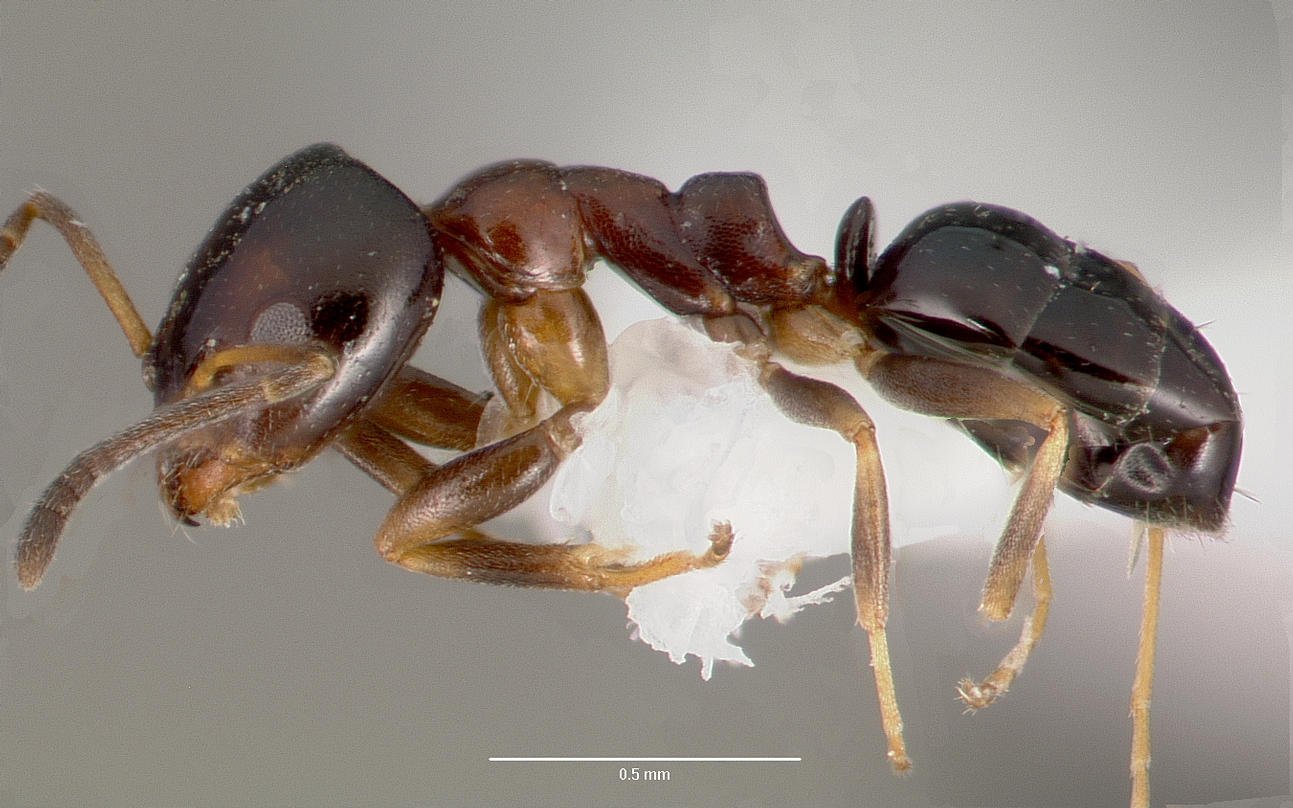
Small, shiny and black, and one of the most common kitchen ants in Sydney. It trails along skirting boards, window frames and power cables, and nests in wall voids, roof spaces and garden edges. It readily takes sweet baits.
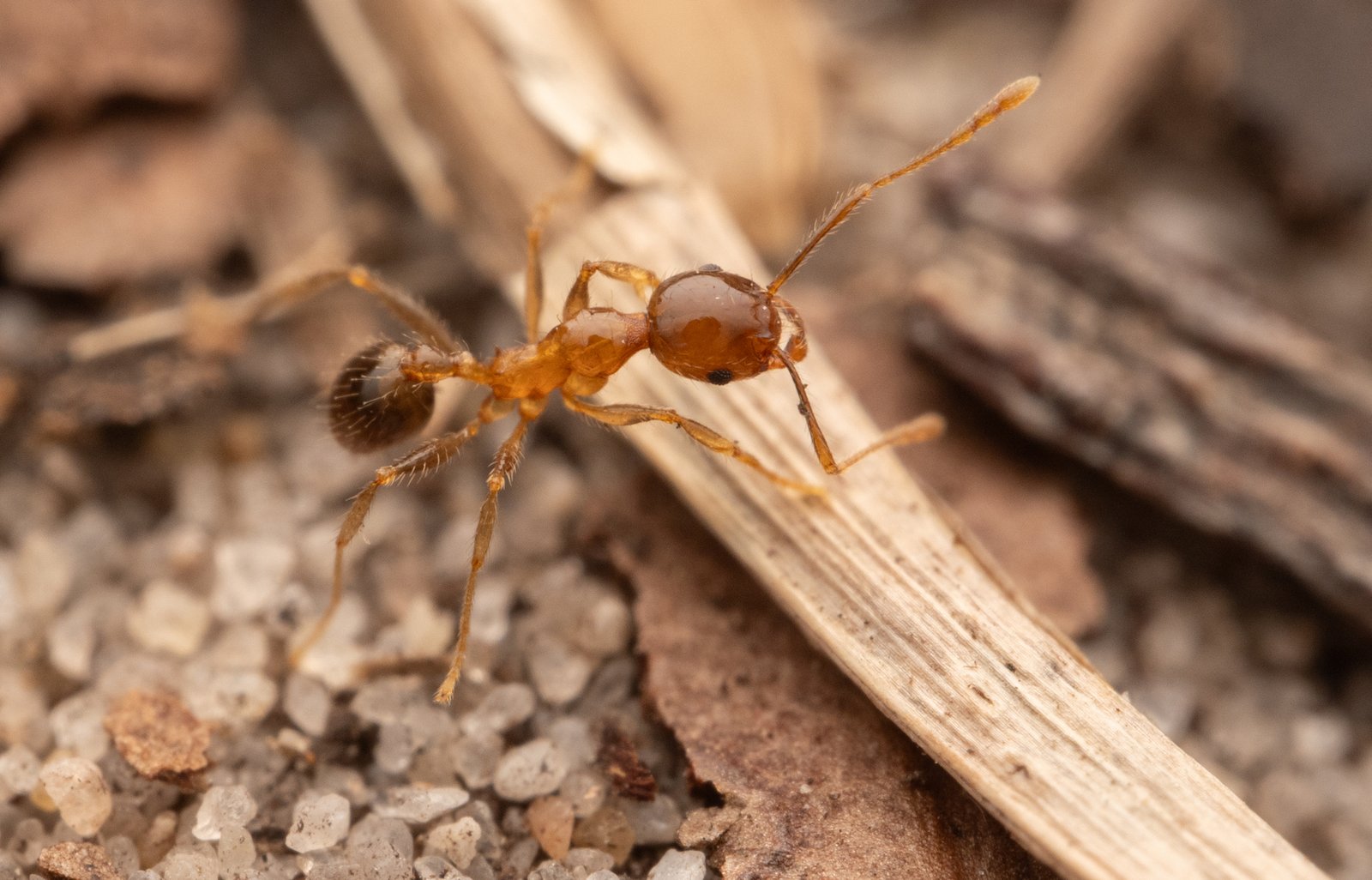
Tiny brown ants with a larger-headed soldier caste. The giveaway is loose sandy soil pushed up between pavers, along slab edges and in grout. Colonies are large with many nests, and oil-based granular baits work well.
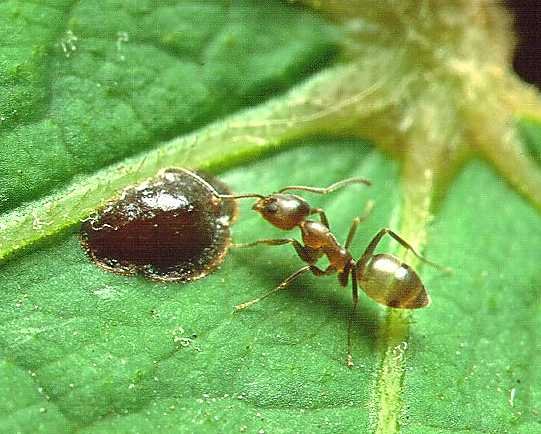
A small, matt brown ant that moves quickly in heavy trails. Its nests have multiple queens and link up with others nearby, so the problem often spans several properties. Repellent spray is the worst thing to use on it.
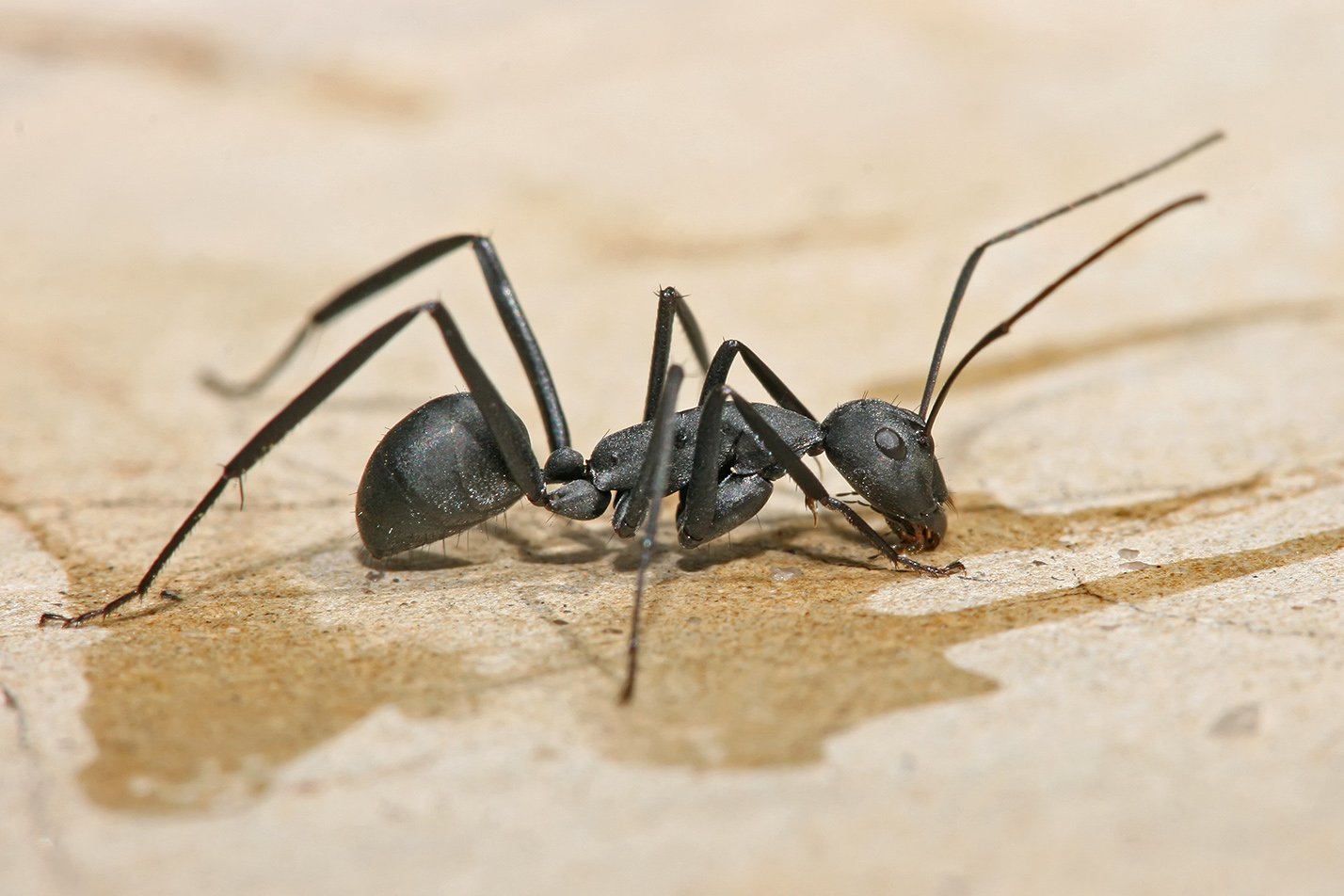
Large and mostly nocturnal, nesting in soil, hollow trees and damp or softened timber. They rarely damage structure here, though a nest inside a wall is a reliable sign of moisture that needs attention.
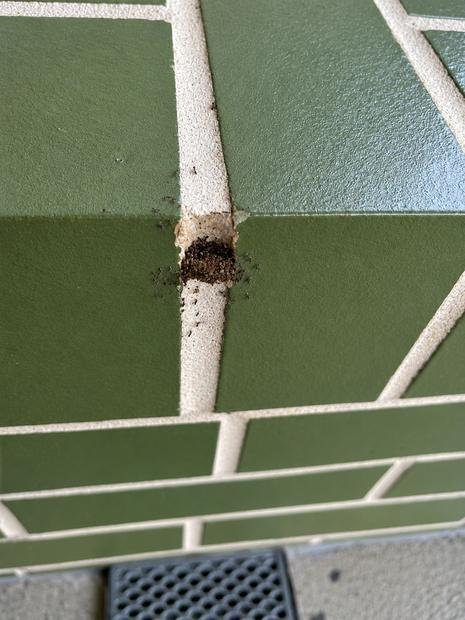
An Elite photo of ants emerging from mortar. The route runs through weep holes and cracked joints straight into the wall cavity, which is the usual home for a black house ant colony.
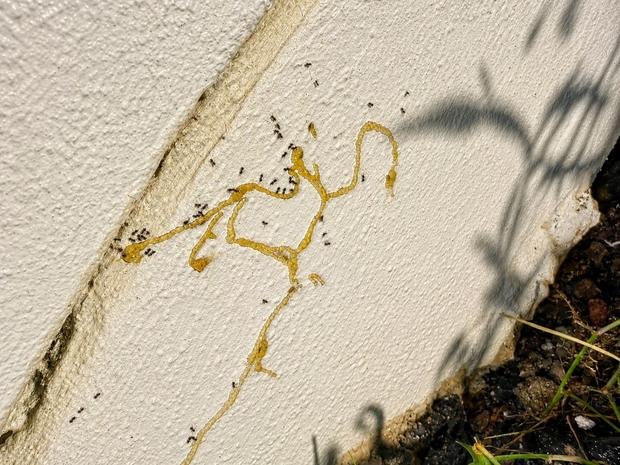
An Elite photo of gel bait on an active trail. The whole point is letting them feed and take it home, so the trail must be left alone once we have treated it.
Where ants appear usually tells us where the nest is and which species we are dealing with.
When they come in from the outside wall, the nest is usually in the cavity or just outside in the garden. We work back from the entry point.
Fine sand pushed up through paving, driveway and slab joints is coastal brown ants underneath, almost without exception.
A nest in a power point or appliance is about warmth. Spraying into electrical fittings is dangerous - tell us and we will treat it the right way.
Swarms of winged ants in spring and summer are mating flights. Seen indoors, they can mean a mature colony inside the building.
Trails around the shower, vanity or toilet often mean moisture in the wall or a colony drinking from a slow leak.
These are the bull ants and jumper ants nesting in lawns and beds - a painful sting, and a risk of serious allergic reaction for some.
Talk to a licensed Sydney technician today - honest advice and a fixed quote within 30 minutes.
Argentine ants and a number of house ants carry multiple queens. Spray them with a repellent and a queen plus a few hundred workers simply moves out and starts again nearby.
Repellent means detectable, and detectable means avoided. Non-repellent products let foragers walk through and transfer the active to the rest of the nest.
Bait is only taken if it matches what the colony wants right now. Their preference moves between sugar and protein as the brood changes, so we test and switch baits accordingly.
Bait takes days to work through a colony. If you spray the trail the day after we leave, you kill the couriers. Our blog explains budding in more detail.
Tracing first, then baits and non-repellent products that do the work after we leave.
Identification comes first. Then we trace the trails to the entry points and the nests themselves, whether those are in walls, paving, garden edges or the roof.
We put out small quantities of sweet, protein and oil-based bait to see which the colony is actually taking today.
Gel bait goes along trails, window frames and skirting where ants travel, out of reach of children and pets.
A non-repellent band around the footings, weep holes, door frames and paths catches ants as they come in.
For nests beneath pavers and in lawn edges - typically coastal brown ants - we use granular bait or treat the nest directly.
The job ends with a written summary, advice on what to avoid spraying, and a 6-month warranty.
The same bait does not suit every ant. This is how we choose.
| Species | Usually feeding on | Treatment approach | Common mistake |
|---|---|---|---|
| Black house ant | Mostly sweet liquids and honeydew, with protein demand during brood rearing | Gel bait along the trail, plus non-repellent treatment to weep holes and door frames | Daily detergent wiping of trails - it moves the foraging rather than stopping it |
| Coastal brown ant | Oils and protein | Granular oil-based bait across the paving and along lawn edges | Treating one sand pile with boiling water or insecticide when there are dozens more |
| Argentine ant | Sugar for the most part, with periodic protein demand | Slow baits and a non-repellent applied along the property line | Using a repellent barrier spray - it divides the multi-queen colony |
| Sugar ants (Camponotus) | Sweet foods and insects, foraging after dark | Inspecting trails at night, baiting close to the nest, and fixing damp timber | Working only in daylight hours, when these ants are not out |
| Bull ants and jumper ants | Outdoor feeders on insects and nectar | Direct treatment of the nest in the lawn or garden bed | Opening the nest up by hand and being stung for it |
| Time of year | What is happening | What to watch for |
|---|---|---|
| Early spring (Sept to Oct) | Activity resumes and brood rearing starts, so the colony wants protein | Trails appearing indoors again, and fresh sand piles in the paving |
| Late spring to summer (Nov to Feb) | Peak activity, with swarming flights triggered by warm humid conditions | Flying ants, and trails that thicken noticeably after storms and heat |
| Autumn (Mar to May) | Full colony size, and foraging to build stores before it cools | Pantry trails, and ants on the pet food |
| Winter (Jun to Aug) | Outdoor activity slows, but nests in heated walls keep going | Ants around heaters, hot water units and kitchens |
Most failed ant treatments come down to what happens in the week after.
Heavy rain floods shallow nests, and the colony moves to the nearest dry cavity - which is usually a wall, a subfloor or under a slab. A sudden indoor trail in Shalvey after a storm is almost always this.
Mulch against the wall, a shrub touching the eaves and a damp garden bed along the footings all put ants within reach of the building. In Shalvey we routinely find the colony is in the garden, not the house.
Our Shalvey runs take in Emerton Village and continue across to the Lethbridge Park boundary - all the same service area.
The trail gets traced to its source. Spraying where you saw ants achieves very little.
Which bait we use depends on the ant and the season: sweet, protein or oil-based.
Non-repellent products that foragers carry home, instead of sprays that scatter the colony.
If ants return within 6 months of a general treatment, we return at no charge.
Everything you need to know before you book. Still unsure? Call us — we're happy to help.
Get a Free QuoteAnt treatment starts from $89. What changes the figure is the size of the building, how many areas are affected and the access. You get that number up front for Shalvey 2770, with no call-out fee. Every general treatment carries a 6-month warranty.
We cover it on scheduled runs, so a day's notice gets you the best slot. Shalvey is about 40.5 km north-west of the CBD in the Blacktown & Mount Druitt, and we give you a firm arrival time rather than an all-day window.
Two things drive it on an estate: compact blocks with narrow side passages, and ground that was cleared and rebuilt recently, which displaces whatever was living in it.
Newer homes, tightly spaced, usually slab on ground - so the treatment concentrates on the perimeter and entry points.
We do all of those. A good share of the Shalvey jobs we run are tenanted or strata properties, so the written record comes as standard.
Yes. The products are registered for this use and applied at label rates, and placement keeps them away from where children and animals go. Let us know at booking about pets, fish tanks or anyone with asthma and we will plan the visit around it.
Most of the time you can carry on as normal. If a particular area needs to be empty we will flag it when we arrive and it is rarely more than a couple of hours.
Usually between one and two hours on site. Bigger properties and heavier infestations take more, and that is included in the quote rather than added afterwards.
Every general treatment carries a 6-month warranty. That is the point of the warranty - you do not pay twice for the same problem.
We cover the whole of Shalvey, from the streets around Emerton Village out to the suburb boundary and on into Lethbridge Park.
Photographs from Elite jobs across Sydney — not stock imagery.
Fast, friendly, fully insured technicians. No-obligation quote within 30 minutes.