Budding splits the colony
Where a species has many queens, a repellent spray causes budding rather than death. Part of the colony, queen included, moves elsewhere, and you have doubled the problem.

Ant Control in South Granville 2142 — local technicians, fixed prices and a written report. Ant treatment starts from $89.
Real, verified feedback from people we've helped — straight from Google.
Local technicians, fixed prices and a written report for every job in South Granville.
South Granville sits about 18.4 km west of the CBD in the Greater Parramatta & Cumberland, and postcode 2142 is one we are in most weeks. We run South Granville on a regular route, and same-day attendance is usually available.
A lot of our South Granville jobs are in the streets around Guildford station and William Lamb Park, and we are out near Progress Park regularly enough that the technician usually knows the access before they arrive.
This is the City of Parramatta and Cumberland area, and our runs here also take in Guildford, Auburn and Chester Hill. The building stock is close-packed, so we look at what the property adjoins before deciding where product goes.
What we see in South Granville is terraces and semis where the problem has come through a shared wall. Describing it accurately when you book saves a second visit.
We also work the streets near Primewest Auburn Megamall and across toward Granville Place Shopping Centre - the whole of 2142 is covered.
We confirm your slot the day before and arrive at a stated time. Guildford and Auburn sit on the same run, so earlier appointments in 2142 come up regularly.
A colony can occupy a garden bed, a paving slab and a wall cavity at once. That is why a single treated nest in South Granville changes very little on its own.
A colony's preference also shifts with the season. Spring brood-rearing wants protein; later in summer the same South Granville colony wants sugars.
What you are looking at is a supply line, not a population. Treat the line and the colony sends another one tomorrow along a slightly different route.
Each of these behaves differently, so the bait and the placement change too. Two photos come from our own jobs.
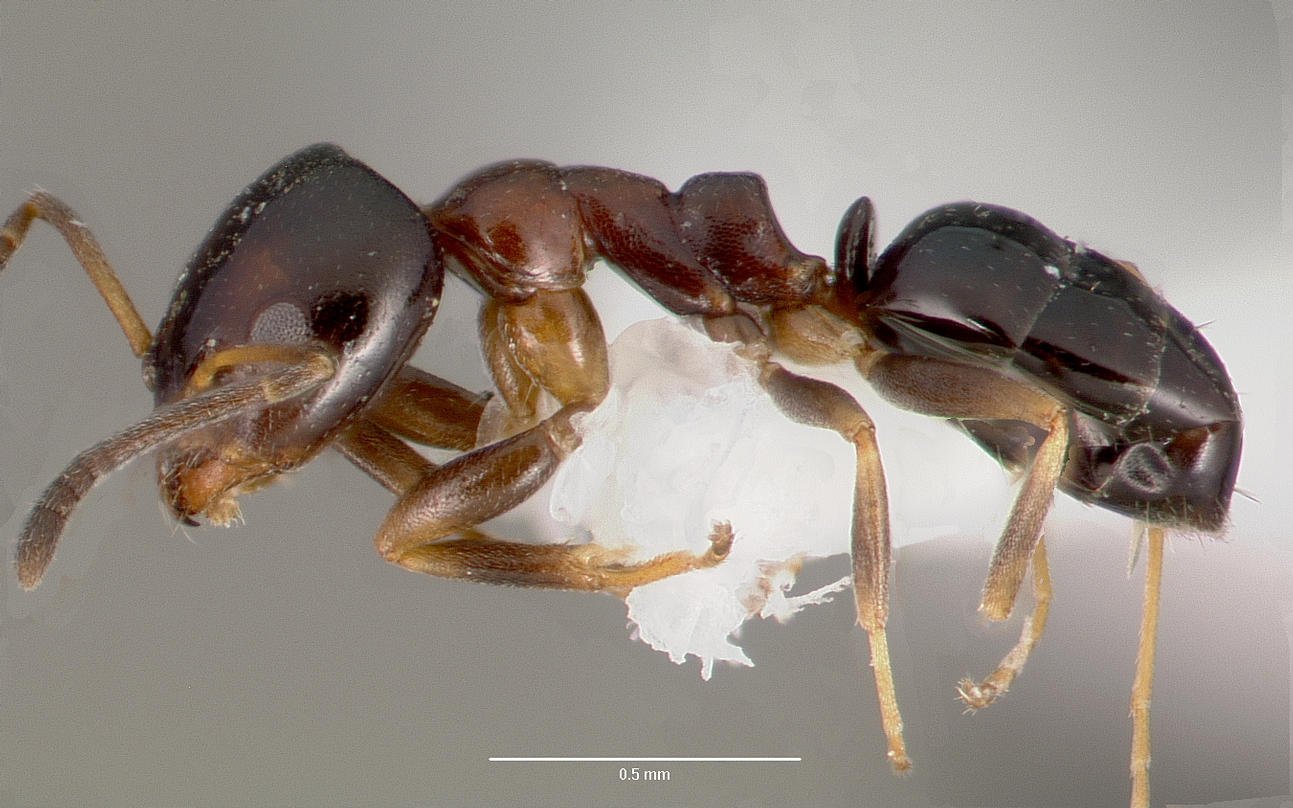
A small black ant with a glossy body, and the one most often in Sydney kitchens. It nests in wall cavities, the roof void and garden edges, trails along skirtings and cabling, and feeds readily on sweet bait.
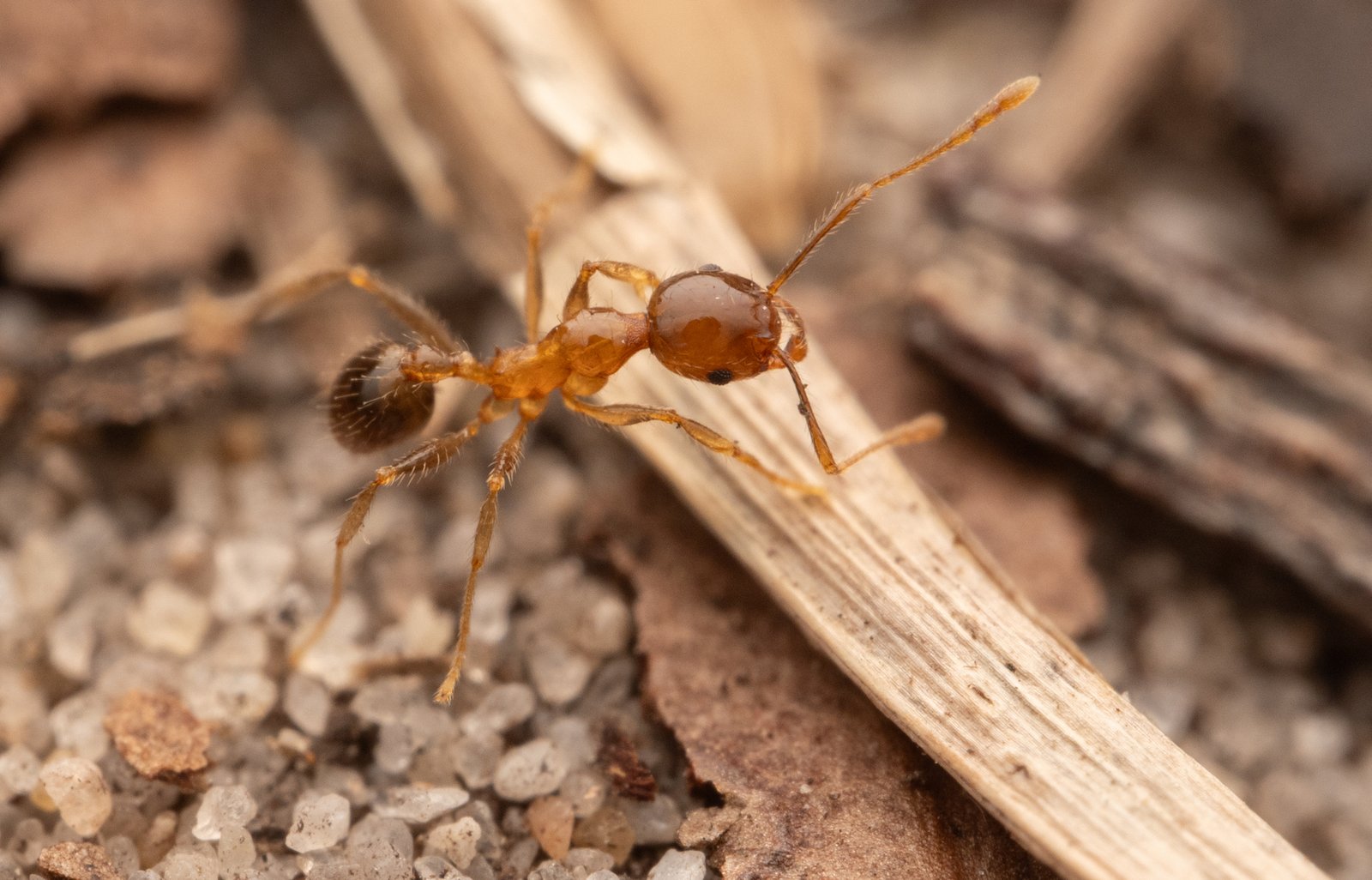
Tiny and brown, with a distinct large-headed soldier. The sign is loose sand appearing between pavers, along the slab edge and in grout lines. Many nests to a colony, which is why we use oil-based granular baits.
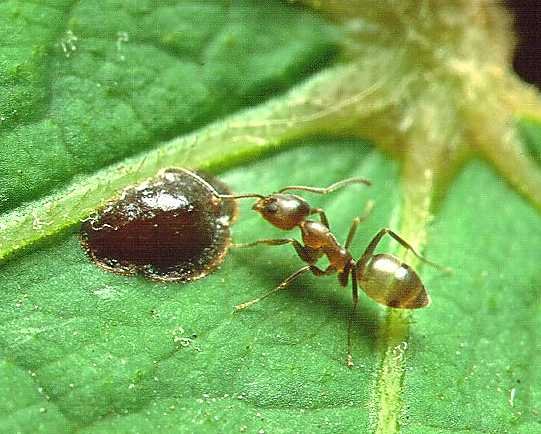
A small, matt brown ant that moves quickly in heavy trails. Its nests have multiple queens and link up with others nearby, so the problem often spans several properties. Repellent spray is the worst thing to use on it.
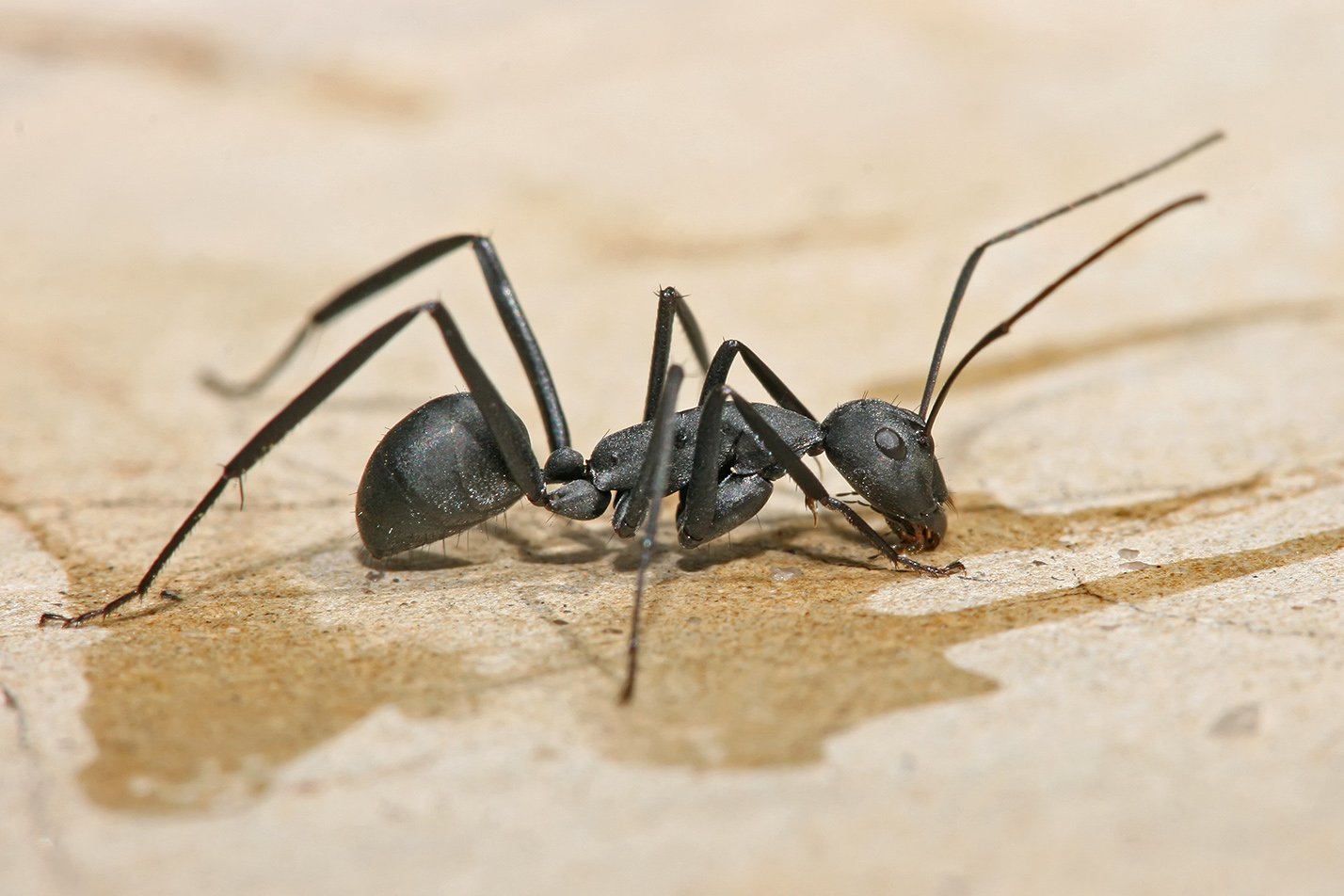
Big ants, usually out after dark, nesting in soil, hollow trees and timber that has gone soft or damp. They are not the structural threat their overseas relatives are, but finding one in a wall usually means there is a leak behind it.
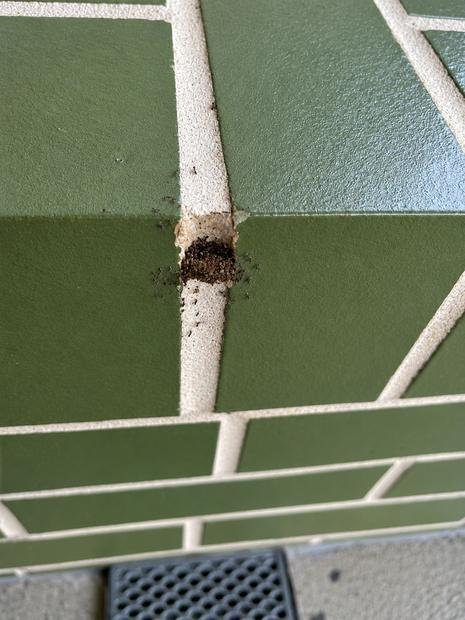
Photo from an Elite job: an ant nest emerging from a mortar joint. Weep holes and cracked mortar lead straight into the wall cavity, which is where many black house ant colonies live.
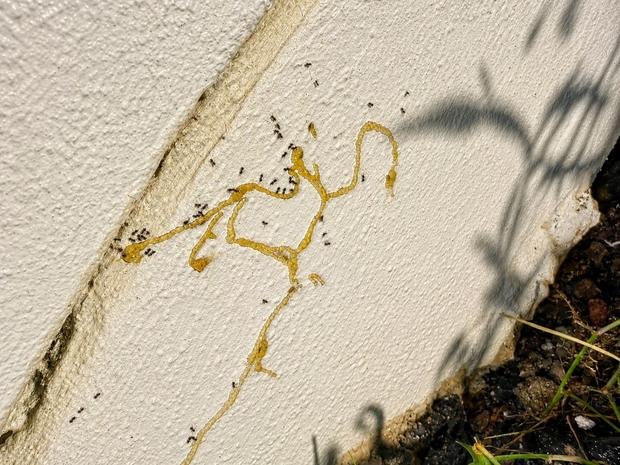
An Elite job photo: gel placed directly on an active trail. Leave it be - the ants feeding there are the ones delivering it to the colony.
Where ants appear usually tells us where the nest is and which species we are dealing with.
A trail coming in from the external wall normally means a nest in the cavity or at the garden edge, and that entry point is where the tracing begins.
Loose fine soil along paving, driveway joints and the slab edge means coastal brown ants have nested underneath.
Warmth is what draws them into switches and electrical fittings. Never spray into a power point - tell us instead and we will treat it safely.
Swarming winged ants in spring or summer are a mating flight. Seen inside the house, it often means the colony is mature and in the building.
Trails in the bathroom point to water in the wall or a slow leak the ants have found.
Bull ants and jumper ants nest in the lawn and garden beds. The sting is genuinely painful and in some people causes a serious allergic reaction.
A licensed Sydney technician will talk it through and give you a fixed quote within half an hour.
Where a species has many queens, a repellent spray causes budding rather than death. Part of the colony, queen included, moves elsewhere, and you have doubled the problem.
Supermarket sprays are repellent: ants detect them and walk around them. Professional non-repellent products are not detected, so foragers walk through, pick up the active and carry it back to nest mates.
A colony's appetite shifts between sugar and protein with the brood cycle. Bait only works when it matches, which is why we test preferences on site.
A bait program works over days. The worst thing you can do is spray the trail once we have gone - those ants are the delivery system. See our blog on budding in more detail.
Tracing first, then baits and non-repellent products that do the work after we leave.
Species confirmed, then trails traced to entry points and to the nests - walls, paving, garden edges, roof space.
Sweet, protein and oil-based baits are offered in small amounts so the colony shows us its current preference.
We run gel along the active trails, window frames and skirting, keeping every placement out of reach of children and animals.
A non-repellent band around the footings, weep holes, door frames and paths catches ants as they come in.
Coastal brown ant nests under paving and along lawn edges get granular bait or direct treatment.
You get a summary, advice on what not to spray, and a 6-month warranty on the general treatment.
The same bait does not suit every ant. This is how we choose.
| Species | Usually feeding on | Treatment approach | Common mistake |
|---|---|---|---|
| Black house ant | Honeydew and sugary liquids, switching to protein when there is brood | Sweet gel on active trails and a non-repellent perimeter at frames and weep holes | Washing the trail down each day, which only relocates the foraging route |
| Coastal brown ant | Protein and oil | Oil-based granular bait applied to paving and lawn edges | Pouring insecticide into one pile and assuming that was the colony |
| Argentine ant | Sugars primarily, sometimes protein | Slow-acting baits combined with non-repellent treatment across the boundary | A repellent barrier, which splits nests that hold many queens |
| Sugar ants (Camponotus) | Sweet foods and insects, mostly at night | Night-time trail inspection, bait near the nest, fix moisture in timber | Treating only in daylight when the ants are not active |
| Bull ants and jumper ants | Nectar and insects, outdoors | Treating the nest directly where it sits in lawn or garden bed | Digging the nest out by hand, which is how people get stung |
| Time of year | What is happening | What to watch for |
|---|---|---|
| Early spring (Sept to Oct) | Colonies wake up and start raising new brood, so protein demand rises | First trails indoors, sand piles reappearing in paving |
| Late spring to summer (Nov to Feb) | The busiest foraging period, with mating flights after warm humid weather | Winged ants on the wing, and thick trails after a storm or a hot spell |
| Autumn (Mar to May) | Full colony size, and foraging to build stores before it cools | Pantry trails, and ants on the pet food |
| Winter (Jun to Aug) | Little happening outdoors, but a nest in a heated wall stays active | Activity around heaters, the hot water unit and kitchen areas |
Most failed ant treatments come down to what happens in the week after.
A branch touching the roof is a bridge. Mulch banked against brickwork is harbourage. Most of what brings ants inside a South Granville home is in the garden immediately around it.
We are around Primewest Auburn Megamall most weeks and cover every street in 2142, including the ones off the main roads.
Activity climbs from early spring as colonies start brood-rearing, peaks through the hot months and tails off in autumn. Treating in early spring around South Granville gets ahead of it rather than chasing it.
Finding the nest is the job - following the trail to it, not treating the visible end of it.
Baits are matched to the species and the season rather than used as a default.
Non-repellent products only - they are taken back to the nest rather than scattering it.
Six months of warranty on a general ant treatment, and a return visit if they come back inside it.
Everything you need to know before you book. Still unsure? Call us — we're happy to help.
Get a Free QuoteAnt treatment starts from $89. The fixed price depends on the size of the property and how far the problem has spread, and we confirm it before we start - there is no call-out fee in South Granville 2142. Every general treatment carries a 6-month warranty.
Same-day attendance is usually available. South Granville sits roughly 18.4 km west of the CBD, inside our Greater Parramatta & Cumberland run, so we book a time and keep to it.
Most of this area is terrace, semi and converted block, and those share more than people realise - cavities, roof spaces, drainage. ants use all of it.
Terraces and semis that share walls, roof voids and drainage - so we look at what the property adjoins before deciding where product goes.
We do. A lot of our South Granville work is rentals and strata, so the report, the products used and the areas treated are all recorded in writing for whoever needs them.
Yes, applied correctly. Products are registered for this use, placed out of reach rather than across open surfaces, and you will know what to stay off and for how long.
In most cases you can stay. Where an area does need to be left clear it is for a couple of hours at most, and we say so before we start.
An hour to two hours covers most jobs. The size of the building and the extent of the problem are what change it.
Every general treatment carries a 6-month warranty. If it is not holding, call us - that is exactly what the warranty is for.
We do. South Granville and Guildford, Auburn, Chester Hill and Granville are all on the same route, which helps if you own more than one property in the area.
Photographs from Elite jobs across Sydney — not stock imagery.
Fast, friendly, fully insured technicians. No-obligation quote within 30 minutes.