Budding splits the colony
Argentine ants and a number of house ants carry multiple queens. Spray them with a repellent and a queen plus a few hundred workers simply moves out and starts again nearby.

Ant Control in Alfords Point 2234 — local technicians, fixed prices and a written report. Ant treatment starts from $89.
Real, verified feedback from people we've helped — straight from Google.
What we cover in Alfords Point, and how quickly we can get there.
Alfords Point sits about 21.6 km south-west of the CBD in the Sutherland Shire, and postcode 2234 is one we are in most weeks. We run Alfords Point on a regular route, and same-day attendance is usually available.
The Alfords Point jobs we attend tend to sit between Georges River National Park and Casuarina Oval.
Under Sutherland Shire, we cover Alfords Point and Lugarno, Peakhurst Heights and Menai alike. Bush edges keep re-supplying the problem, which is why we treat the boundary rather than only the interior.
Alfords Point jobs tend to be properties where the fence line matters as much as the kitchen. Let us know which when you ring and we will plan the visit around it.
Wherever you are in 2234, you are inside the area our technicians cover.
Your appointment is confirmed the day before with a real arrival time. Because Lugarno and Peakhurst Heights are covered on the same round, 2234 often has an earlier slot available.
Indoor nests sit in wall cavities, behind splashbacks, under baths and in roof insulation. Finding them is most of the work on a Alfords Point job.
In a dry spell ants move indoors looking for moisture, which is why a spotless Alfords Point kitchen still gets trails in January. The sink, the pet bowl and the shower recess are the attractions.
If there are ants running up a shrub beside a Alfords Point house, look for scale or aphids on it. They are farming, and that food source is what sustains the colony.
Each of these behaves differently, so the bait and the placement change too. Two photos come from our own jobs.
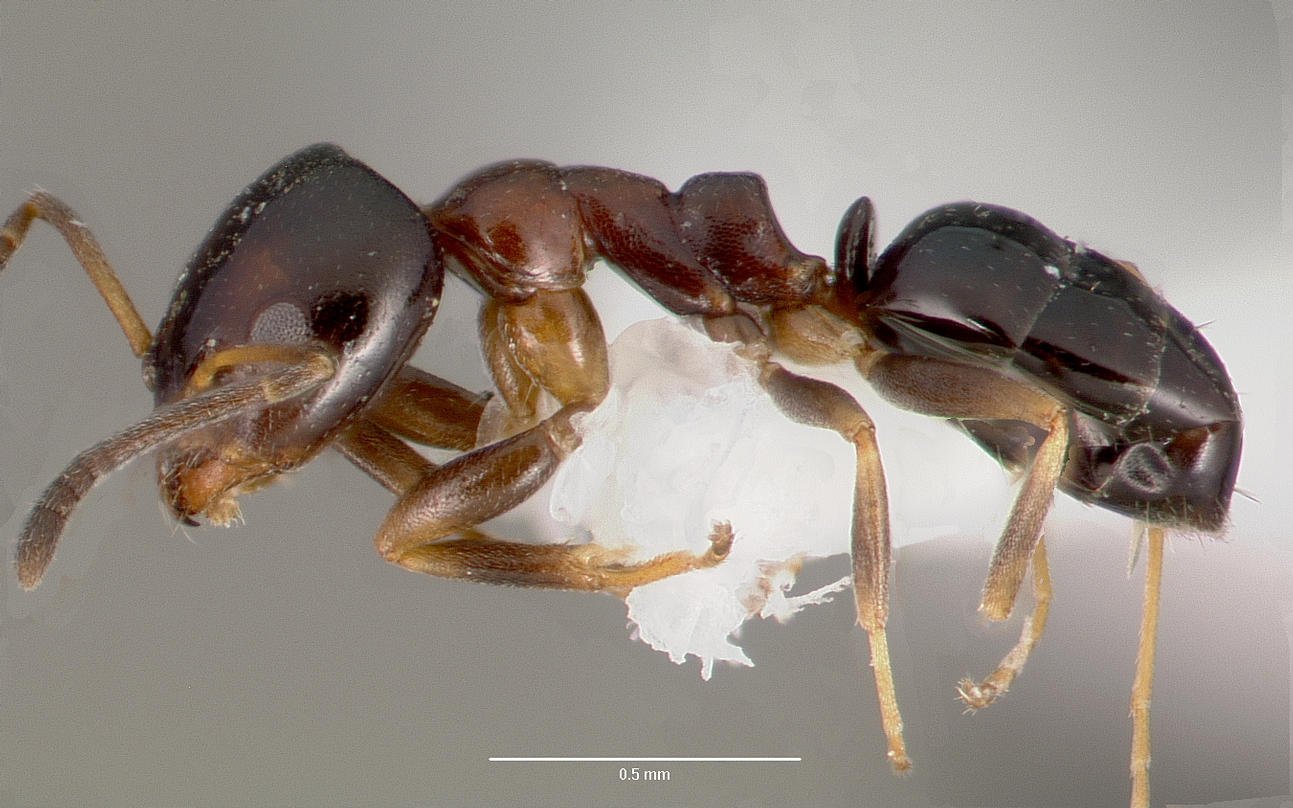
The small glossy black one you find in the kitchen. It runs along skirtings, window frames and cabling, nesting in wall cavities, roof voids and the edges of garden beds, and it takes sweet bait without much persuading.
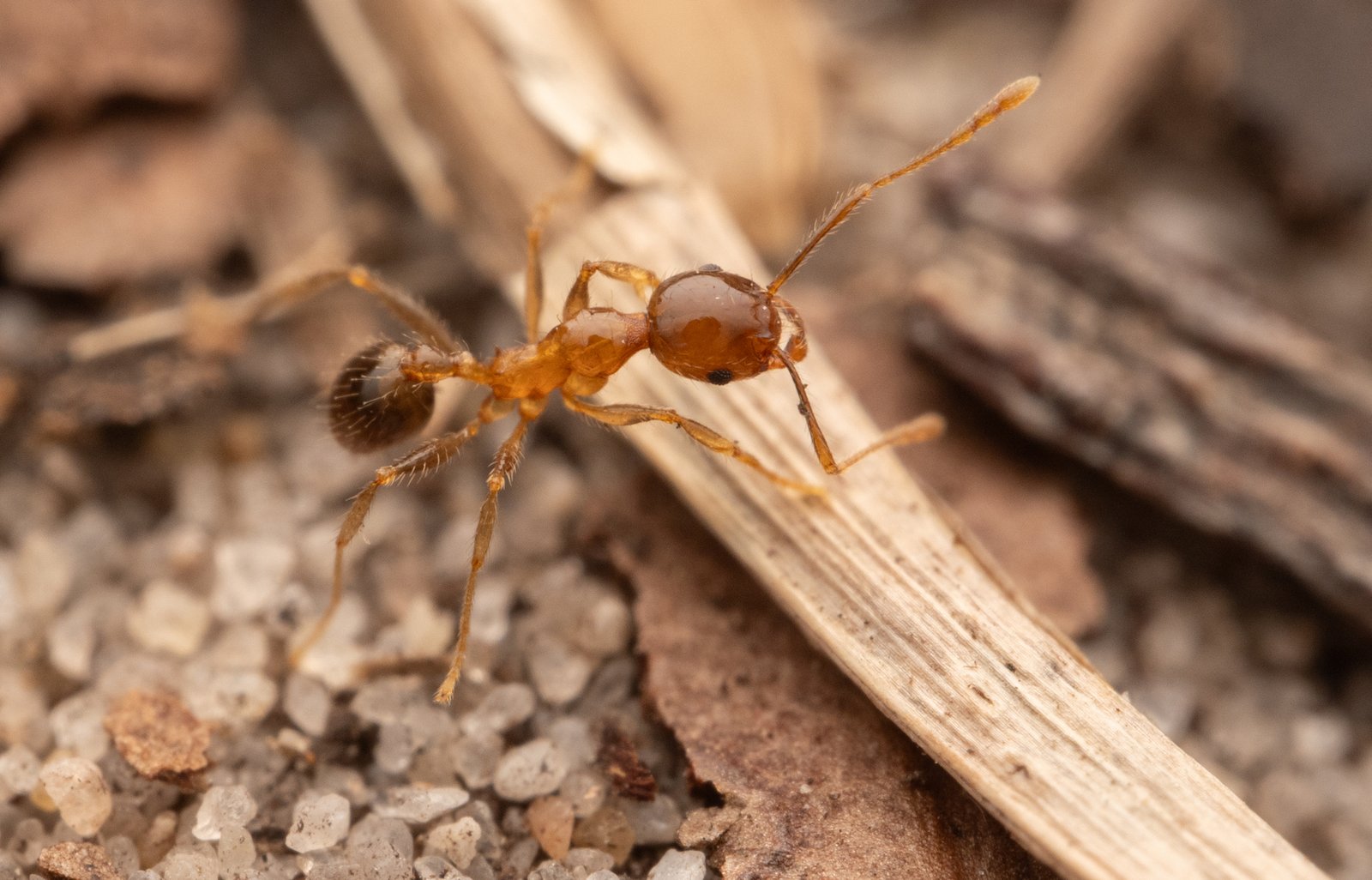
Very small brown ants, with soldiers that have noticeably bigger heads. You spot them by the fine sandy soil pushed up through paving joints, slab edges and grout. The colonies are big and multi-nested, so oil-based granular bait is the tool.
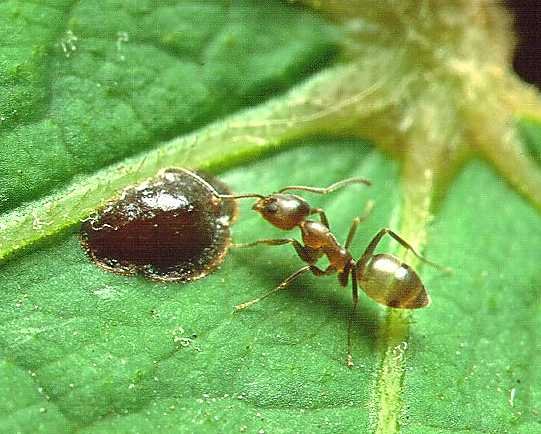
Small, dull brown and fast-moving in thick trails. Nests hold many queens and connect with neighbouring nests, so infestations can stretch across several properties. Repellent sprays are especially counter-productive with this species.
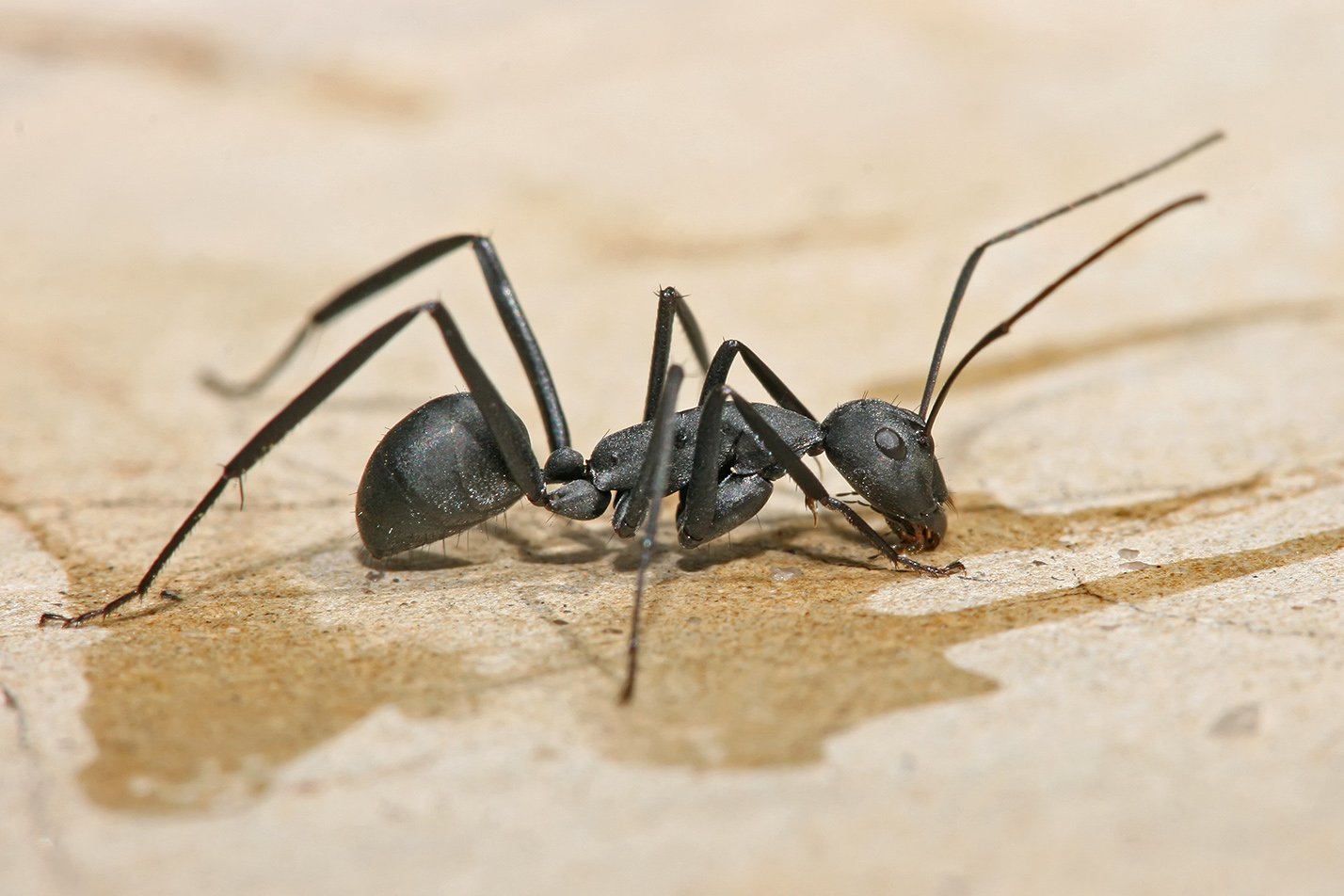
Large and mostly nocturnal, nesting in soil, hollow trees and damp or softened timber. They rarely damage structure here, though a nest inside a wall is a reliable sign of moisture that needs attention.
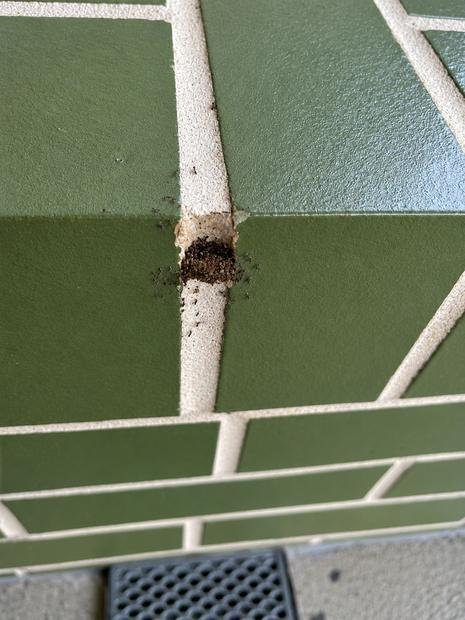
Taken on an Elite job: a mortar joint with a nest behind it. Weep holes and failed mortar are a direct path into the cavity, where many black house ant colonies establish.
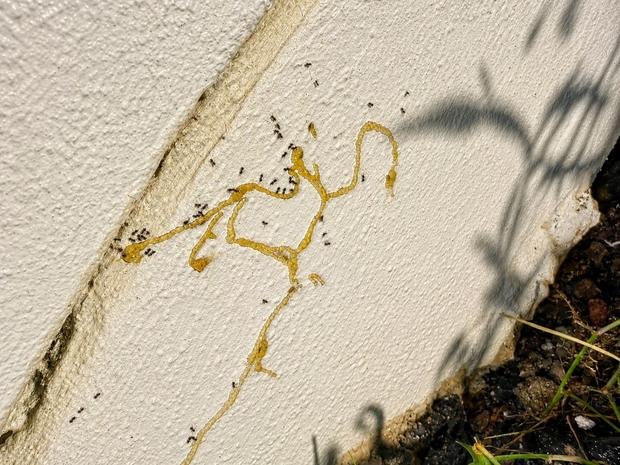
Gel bait on a working trail, from one of our jobs. Ants feed and carry it to the nest, so wiping or spraying the trail afterwards undoes the treatment.
Where ants appear usually tells us where the nest is and which species we are dealing with.
When they come in from the outside wall, the nest is usually in the cavity or just outside in the garden. We work back from the entry point.
Fine soil pushed up along paving, driveways and slab joints is the classic sign of coastal brown ants nesting underneath.
Warmth is what draws them into switches and electrical fittings. Never spray into a power point - tell us instead and we will treat it safely.
Mating flights produce the winged swarms you see in spring and summer. Finding them indoors suggests a mature colony inside rather than outside.
Trails in the bathroom point to water in the wall or a slow leak the ants have found.
Lawns and garden beds are where bull ants and jumper ants nest. Their stings are painful and can trigger severe allergic reactions.
A licensed Sydney technician will talk it through and give you a fixed quote within half an hour.
Argentine ants and a number of house ants carry multiple queens. Spray them with a repellent and a queen plus a few hundred workers simply moves out and starts again nearby.
Supermarket sprays are repellent: ants detect them and walk around them. Professional non-repellent products are not detected, so foragers walk through, pick up the active and carry it back to nest mates.
A colony's appetite shifts between sugar and protein with the brood cycle. Bait only works when it matches, which is why we test preferences on site.
It takes days for bait to move through a colony. Spraying the trail the day after our visit kills the very ants delivering it - our blog explains budding in more detail.
Tracing first, then baits and non-repellent products that do the work after we leave.
Species confirmed, then trails traced to entry points and to the nests - walls, paving, garden edges, roof space.
Before committing, we offer a little of each bait type and let the colony tell us which one it is on.
We run gel along the active trails, window frames and skirting, keeping every placement out of reach of children and animals.
A non-repellent treatment around the foundation, weep holes, door frames and paths intercepts ants coming in.
Granular bait, or direct nest treatment, for the coastal brown ant nests under paving and at lawn edges.
You get a summary, advice on what not to spray, and a 6-month warranty on the general treatment.
The same bait does not suit every ant. This is how we choose.
| Species | Usually feeding on | Treatment approach | Common mistake |
|---|---|---|---|
| Black house ant | Sugars and honeydew, turning to protein while brood is being raised | Sweet gel on the trails themselves, with a non-repellent at weep holes and frames | Cleaning the trail off every day, which just sends them foraging somewhere else |
| Coastal brown ant | Oils and protein rather than sugars | Granular bait with an oil base, spread on paving and at the lawn edge | Boiling water down one hole - there are dozens of other nests |
| Argentine ant | Sugars primarily, sometimes protein | Slow-acting baits combined with non-repellent treatment across the boundary | A repellent barrier, which splits nests that hold many queens |
| Sugar ants (Camponotus) | Sweet foods and insects, active after dark | Night trail inspection, baiting near the nest, and dealing with damp timber | Inspecting in daylight when the colony is not foraging |
| Bull ants and jumper ants | Nectar and insects, outdoors | Treating the nest directly where it sits in lawn or garden bed | Digging the nest out by hand, which is how people get stung |
| Time of year | What is happening | What to watch for |
|---|---|---|
| Early spring (Sept to Oct) | Colonies wake up and start raising new brood, so protein demand rises | First trails indoors, sand piles reappearing in paving |
| Late spring to summer (Nov to Feb) | Foraging at its height, and mating flights whenever it turns warm and humid | Winged ants indoors, and much heavier trails after storms and heatwaves |
| Autumn (Mar to May) | Colonies are at full size and stock up before cooler weather | Trails into pantries and pet food |
| Winter (Jun to Aug) | Outside activity drops away, though nests in warm wall cavities carry on | Ants near heaters, hot water units and in the kitchen |
Most failed ant treatments come down to what happens in the week after.
Heavy rain floods shallow nests, and the colony moves to the nearest dry cavity - which is usually a wall, a subfloor or under a slab. A sudden indoor trail in Alfords Point after a storm is almost always this.
Mulch against the wall, a shrub touching the eaves and a damp garden bed along the footings all put ants within reach of the building. In Alfords Point we routinely find the colony is in the garden, not the house.
For a Alfords Point cafe or kitchen, ants are a compliance finding. We run a documented program with monitoring points and reports your auditor will accept rather than a one-off spray.
Trails lead somewhere, so we follow them to the colony instead of spraying the sighting.
The bait is chosen for the species and the time of year - sweet, protein or oil-based.
Non-repellent products only - they are taken back to the nest rather than scattering it.
If ants return within 6 months of a general treatment, we return at no charge.
Everything you need to know before you book. Still unsure? Call us — we're happy to help.
Get a Free QuoteAnt treatment starts from $89. There is no call-out charge in Alfords Point 2234. The final number comes down to the property itself, and it is fixed before we begin. Every general treatment carries a 6-month warranty.
Same-day attendance is usually available. Alfords Point is about 21.6 km south-west of the CBD in the Sutherland Shire, and we give you a firm arrival time rather than an all-day window.
Where bushland adjoins the block, the question is not how ants got in but how often. The perimeter is what decides that.
Mostly detached housing backing onto reserve. Proofing and the perimeter are what actually hold here.
Yes. Houses, townhouses, units, strata common property, rentals and commercial sites in Alfords Point 2234 are all part of what we do, and the paperwork is the kind agents accept.
It is, provided the instructions are followed. We will tell you what to keep clear of and for how long before we leave. Let us know about children, pets or fish tanks when you book.
Usually not. Most of the work is done with you in the house, and where a room does need to be clear it is for a short period we will tell you about on arrival.
For a standard Alfords Point home, one to two hours. We would rather tell you it will take longer up front than rush it.
Every general treatment carries a 6-month warranty. Ring us if activity picks up again inside that period and we will arrange the return.
Yes - we work right across the Sutherland Shire area, which takes in Alfords Point and the suburbs around it.
Photographs from Elite jobs across Sydney — not stock imagery.
Fast and fully insured, with a no-obligation quote back to you within 30 minutes.