What we need to quote
Architectural plans or a slab plan, slab type (raft, waffle pod, suspended), the site address, approximate pour date and any engineering details for retaining walls or step-downs.

AS 3660.1-compliant termite management systems installed during construction, with the durable notice and certificate your builder and certifier need for sign-off.
Real, verified feedback from people we've helped — straight from Google.
Termite damage is generally not covered by home insurance, and Sydney is a high-risk area for subterranean termites. The cheapest and most reliable time to protect a building is before the slab is poured, while every pipe penetration and slab edge is still open.
Elite installs termite management systems for new homes, extensions, granny flats, duplexes and multi-unit developments to Australian Standard AS 3660.1. The National Construction Code (NCC) requires a termite management system for new homes and outbuildings in termite-risk areas, and AS 3660.1 is how it's done. We work to your builder's program, install each stage at the right time, and supply the durable notice and installation certificate for your certifier.
Builders, developers and owner-builders get a fixed quote from their plans, a technician who turns up when the site is ready, and paperwork that doesn't hold up the occupation certificate.
Photos from our own Sydney installations, not stock images. We recommend the right mix for your slab design, site and budget.

A termite-resistant physical membrane laid across the prepared ground before the pour, protecting the whole footprint of the slab.

Collars sealed to every plumbing pipe, conduit and service that passes through the slab. These are the most common hidden entry points for termites.

A physical barrier around the slab edge and into the wall cavity, which stops termites building concealed tunnels up the outside of the slab.
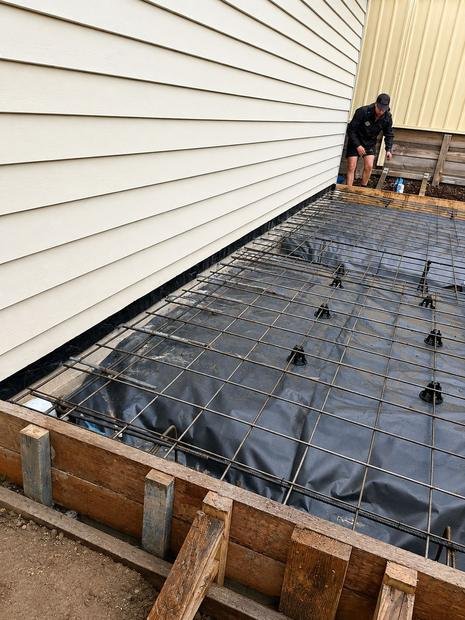
APVMA-registered termiticide applied to the soil, with the option of a reticulation pipe network so the barrier can be recharged later without digging.

Protection for bearers, piers and suspended timber floors on sloping or elevated sites.
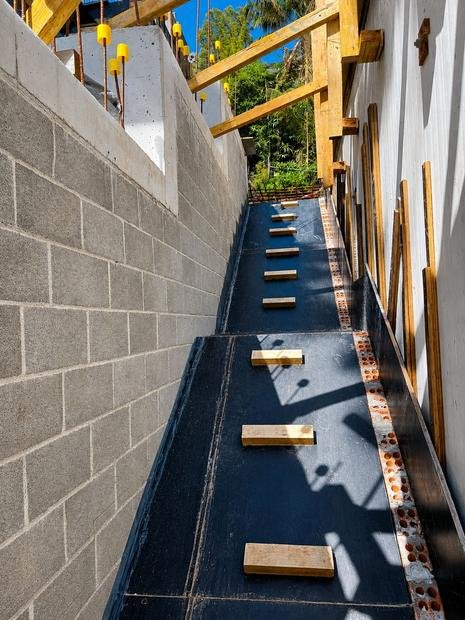
Detailing against retaining walls, sandstone excavation, step-downs and cut-and-fill sites common across Sydney.
Once the slab is poured, the areas termites use most are sealed away for good.
A pre-construction barrier costs far less than a retrofitted system or repairs to termite damage later.
New homes (Class 1) and outbuildings (Class 10) with termite-susceptible primary building elements need a compliant termite management system.
Pipe penetrations and slab joints can only be fully protected before concrete covers them.
An under-slab system protects areas no post-construction treatment can reach.
Your certifier needs the installation certificate and durable notice before issuing the Occupation Certificate.
Documented, compliant termite protection reassures buyers, building inspectors and lenders.
Talk to a licensed Sydney technician today — honest advice and a fixed quote within 30 minutes.
Both approaches can comply with AS 3660.1. Many Sydney builds use a combination.
| System | How it works | Durability & upkeep | Best suited to |
|---|---|---|---|
| Physical membrane, mesh or graded stone | A termite-resistant layer (sheet, stainless mesh or graded stone particles) that termites can't chew through, laid under the slab or at the perimeter | Designed to last as long as the slab if it isn't disturbed. No chemical top-ups. | Slab-on-ground homes and owners who want a non-chemical option |
| Penetration collars | Physical collars sealed around every pipe and conduit through the slab | Long-lasting when installed correctly before the pour | Every slab. Usually combined with a perimeter system. |
| Chemical soil barrier | A treated zone of termiticide in the soil under and around the building | Service life depends on the product label and soil conditions. It can be re-applied. | Budget-conscious builds and some complex sites |
| Reticulation system | A pipe network laid before paving so termiticide can be pumped back into the soil | Rechargeable for the life of the building without digging up paths | Homes surrounded by paving or landscaping |
| Baiting (post-construction) | In-ground monitoring stations that eliminate the colony | Stations need regular servicing | Existing homes, see termite control |
Termite barriers are installed in stages that follow the build, not in a single visit.
Send us your plans and slab details. We recommend a system and give you a fixed price for every stage.
Penetration collars fitted to all services, and an under-slab membrane or chemical treatment installed once the site is prepared.
Perimeter and cavity barriers installed as the brickwork or cladding goes up, so there is no gap at the slab edge.
Where specified, a chemical perimeter or reticulation system is completed around the finished building before paving and landscaping.
A durable notice in the meter box records the system. The installation certificate goes to the builder and certifier.
The owner receives maintenance advice and a recommended inspection schedule to keep the system effective.
| Document | What it is | Who needs it |
|---|---|---|
| Durable notice | A permanent notice in the meter box recording the system, installation date, the life expectancy of any chemical used, the installer and inspection advice | The certifier, the owner and future owners |
| Installation certificate | Written confirmation of the system and products installed, the areas protected and the installer's licence | The builder, the certifier and the owner's records |
| Product information | Details of the physical system or termiticide used, including safety data sheets for chemicals | Builder and owner |
| Maintenance & inspection advice | How to keep the barrier effective, and the recommended inspection frequency (AS 3660.2) | Homeowner |
Architectural plans or a slab plan, slab type (raft, waffle pod, suspended), the site address, approximate pour date and any engineering details for retaining walls or step-downs.
We schedule around the plumber's set-out and the concreter's pour. Tell us when services are in and we will confirm the collar installation before the pour inspection.
Developers and volume builders get consistent pricing, a single point of contact and documentation for every lot or dwelling.
Missing durable notices or unclear installation records are a common reason for occupation certificate delays. We supply everything together so the certifier has what they need.
A barrier only works if it stays intact and visible. Homeowners should follow these points for the life of the building.
| Factor | Why it matters |
|---|---|
| Slab area & perimeter length | Larger footprints need more membrane, more perimeter protection and more labour |
| System type | Full under-slab physical systems, perimeter-only systems and chemical or reticulation options are priced differently |
| Number of penetrations | Every plumbing and electrical penetration through the slab needs a collar |
| Site complexity | Retaining walls, step-downs, sandstone excavation and suspended floors add detailing |
| Number of site visits | Staged installations follow the build program. Multi-dwelling sites may be combined. |
Send your plans for a fixed, written quote. There's no charge to quote.
Sydney's subterranean termites, including the highly destructive Coptotermes species, are active across the whole metropolitan area, from new estates in Box Hill, Oran Park and Marsden Park to knockdown-rebuilds in the Inner West, St George and the Sutherland Shire. Bushland edges, sandstone excavation and heavily landscaped blocks all make the right barrier design more important.
Already built? We protect existing homes with termite treatment and baiting systems, and recommend a timber pest inspection every 12 months.
Reviewed by Ismail, Founder · NSW Pest Management licence 5122967 · Updated September 2026
NSW Pest Management licence 5122967, with installations to AS 3660.1.
We work to your builder's program, so a barrier stage never holds up a pour.
Durable notice, installation certificate and product details, all supplied.
Single dwellings, granny flats, duplexes and multi-unit projects.
Local technicians servicing 380+ suburbs — fast.
Everything you need to know before you book. Still unsure? Call us — we're happy to help.
Get a Free QuoteGenerally yes. The National Construction Code requires a termite management system for new homes and outbuildings in termite-risk areas where primary building elements, such as timber framing, can be damaged by termites. It is installed to AS 3660.1, and your certifier asks for the installation certificate and durable notice before issuing the Occupation Certificate.
Pricing depends on the slab area, the system chosen, the number of pipe penetrations, perimeter length and how many site visits the build needs. Send us your plans and we will give you a fixed written quote covering every stage.
Book as soon as your slab date is roughly known. Penetration collars and under-slab membranes must go in after the plumber sets out the services and before the concrete pour, so the timing has to be coordinated with your builder.
Both can comply with AS 3660.1. Physical systems need no chemical top-ups and last as long as the slab if they aren't disturbed. Chemical systems can cost less up front and can be recharged, especially with reticulation. Many builds combine physical penetration collars with a perimeter system.
A durable notice is a permanent label, usually fixed in the meter box, that AS 3660.1 requires. It records the type of termite management system installed, the date of installation, the installer, and the inspection and maintenance recommendations for the life of the building.
No barrier makes a building termite-proof. A compliant barrier stops concealed entry and forces termites into the open, where regular inspections can find them. That is why inspections at least every 12 months are recommended after handover.
Physical barriers are designed to last as long as the slab while they stay intact. The service life of a chemical soil barrier depends on the product and site conditions, and reticulation systems let it be topped up without disturbing paving.
You receive the durable notice fixed on site, an installation certificate listing the system, product and installer licence, and maintenance and inspection advice to pass on to the owner.
Yes. We install pre-construction systems for extensions, secondary dwellings, duplexes, townhouses and multi-unit developments, and join new work to existing protection where possible.
The under-slab area and pipe penetrations can no longer be protected directly, so the only options are post-construction systems: a chemical soil barrier trenched and injected around the perimeter, or in-ground baiting. That usually costs more and protects less, so book before the pour.
Photographs from Elite jobs across Sydney — not stock imagery.
Fast, friendly, fully insured technicians. No-obligation quote within 30 minutes.