What we need to quote
Architectural plans or a slab plan, slab type (raft, waffle pod, suspended), the site address, approximate pour date and any engineering details for retaining walls or step-downs.

Pre-Construction Termite Barriers in Roseville 2069 — local technicians, fixed prices and a written report. Barriers are quoted off your plans and slab details.
Real, verified feedback from people we've helped — straight from Google.
What we cover in Roseville, and how quickly we can get there.
Roseville is part of the Lower North Shore, 9.6 km or so north of the GPO, and 2069 is a postcode we know well. Our technicians are through Roseville most days, so same-day attendance is usually available.
Most weeks we are somewhere between Chatswood Chase Shopping Centre and Roseville Golf Course in Roseville, and Roseville station is close enough to be on the same run.
The suburb sits in the North Sydney, Mosman, Willoughby, Lane Cove and Hunters Hill area. East Lindfield, Roseville Chase and Castle Cove are all covered on the same day, so a problem that has spread across a boundary can be handled in one visit. The mix here is older houses and converted blocks near the water, where moisture under the floor is usually part of the story.
The termite calls we take from Roseville are mostly waterfront and near-waterfront homes with damp sub-floors and mature gardens. If yours is one of them, mention it when you ring 1300 313 373 - it changes what the technician brings.
Hemsley Reserve and Blue Gum Reserve are on the same round, which means every part of 2069 is within our area.
The 2069 run is set the day before and you are given an arrival time. Where East Lindfield and Roseville Chase fall on the same round, we can usually bring the visit forward.
People expect a barrier to be a wall. It is a managed zone: termites either cannot cross it or must build visible workings to do so.
The value of the system on a Roseville home is detectability. Without the inspections that detectability is never used.
The failures we are called to inspect are rarely the product. They are a collar missed on a late-added pipe, a perimeter left short at a step-down, or a membrane torn by a trade after we left and never reported.
Photos from our own Sydney installations, not stock images. We recommend the right mix for your slab design, site and budget.

A physical, termite-resistant membrane laid over the prepared ground ahead of the pour, covering the slab's entire footprint.

Each service penetrating the slab - pipe, conduit, cable - takes a sealed collar. Penetrations are where termites most often get in unseen.

A physical barrier at the slab edge and continuing into the wall cavity, preventing concealed tunnelling up the slab's outside face.
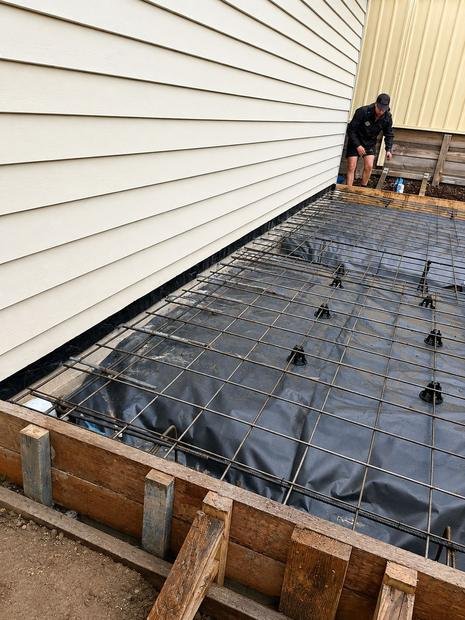
APVMA-registered termiticide applied to the soil. Add a reticulation network and the barrier can be topped up later without digging anything up.

Piers, bearers and suspended timber floors protected, which matters on sloping and elevated blocks.
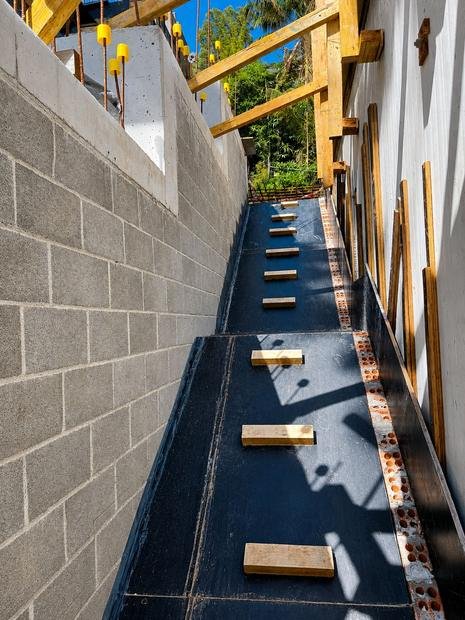
Detailed work against retaining walls, sandstone cuts, step-downs and the cut-and-fill sites common around Sydney.
Once the slab is poured, the areas termites use most are sealed away for good.
A barrier installed during the build costs far less than one retrofitted afterwards or any damage repair.
New Class 1 homes and Class 10 outbuildings need a compliant termite management system where the primary building elements are susceptible.
Pipe penetrations and slab joints can only be fully protected before concrete covers them.
An under-slab system protects the parts of the footprint no later treatment can access.
The installation certificate and durable notice have to reach the certifier before the Occupation Certificate is issued.
Compliant, documented termite protection is something buyers, building inspectors and lenders all look for.
Get a licensed Sydney technician on the phone today - honest advice, fixed quote in 30 minutes.
Both approaches can comply with AS 3660.1. Many Sydney builds use a combination.
| System | How it works | Durability & upkeep | Best suited to |
|---|---|---|---|
| Physical membrane, mesh or graded stone | Sheet, stainless mesh or graded stone creating a layer termites cannot chew through, under the slab or at the perimeter | As durable as the slab itself when left undisturbed, with no top-ups needed | Slab-on-ground homes and non-chemical preferences |
| Penetration collars | Collars physically sealed to every pipe and conduit through the slab | Long-lived where installation before the pour is done properly | Every slab, and typically with a perimeter system as well |
| Chemical soil barrier | Treated soil - termiticide applied beneath and around the building | Longevity depends on label and soil conditions, and it can be renewed | Cost-conscious builds, and some complex sites |
| Reticulation system | A pipe network installed ahead of paving, allowing the soil to be re-treated by pumping | Can be topped up throughout the building's life without digging up paving | Homes surrounded by paving or heavy landscaping |
| Baiting (post-construction) | In-ground stations that monitor and then eliminate the colony | Stations need servicing on a regular schedule | Existing homes - see termite control |
Termite barriers are installed in stages that follow the build, not in a single visit.
Send through the plans and the slab details and you get back a recommended system with a fixed price against every stage.
Penetration collars to all services first, then the under-slab membrane or chemical treatment once the site is ready.
As the brickwork or cladding rises, perimeter and cavity barriers go in so the slab edge is left with no gap.
A chemical perimeter or reticulation system, where specified, is completed around the building before any paving or landscaping.
A durable notice goes into the meter box to record the system, with the installation certificate to the builder and certifier.
The owner receives maintenance advice and a recommended inspection schedule to keep the system effective.
| Document | What it is | Who needs it |
|---|---|---|
| Durable notice | A permanent notice fixed inside the meter box recording system, installation date, chemical life expectancy, installer and inspection advice | Certifier, owner and future owners |
| Installation certificate | A written record of the system and products installed, which areas are protected, and the installer's licence number | The builder, the certifier and the owner's file |
| Product information | Specifications for the physical system or termiticide used, plus safety data sheets where chemicals are involved | Builder and owner |
| Maintenance & inspection advice | How to keep the barrier effective, and the recommended inspection frequency (AS 3660.2) | Homeowner |
Architectural plans or a slab plan, slab type (raft, waffle pod, suspended), the site address, approximate pour date and any engineering details for retaining walls or step-downs.
We work to the plumber's set-out and the concreter's program. Let us know when the services are in and collars are confirmed before the pour inspection.
We give developers and volume builders consistent pricing, one contact, and documentation lot by lot.
A missing durable notice or unclear installation record is a common cause of occupation certificate delay. We supply the lot together so the certifier has everything.
A barrier only works if it stays intact and visible. Homeowners should follow these points for the life of the building.
| Factor | Why it matters |
|---|---|
| Slab size and perimeter run | Larger slabs need more membrane and perimeter protection, and more labour |
| Type of system | Pricing differs between full under-slab physical systems, perimeter-only systems, and chemical or reticulation options |
| How many penetrations | Each plumbing and electrical penetration through the slab requires its own collar |
| Site complexity | Retaining walls, step-downs, sandstone excavation and suspended floors add detailing |
| Number of site visits | Staged installations follow the build program. Multi-dwelling sites may be combined. |
Send your plans for a fixed, written quote. There's no charge to quote.
Estates built on cleared farmland inherit the colonies already living in that soil. A new Roseville house is not a fresh start from a termite point of view - it is a new food source on an established site.
A documented, serviced termite management system is something a Roseville buyer's pest inspector will note favourably. The absence of paperwork is something they will note the other way.
Reactive soil is the argument for a system that tolerates movement rather than a rigid one. We choose based on the soil report for the Roseville site, not on a default.
NSW Pest Management licence 5122967. Every installation is to AS 3660.1.
Scheduled around the builder's program, so a barrier stage does not delay the pour.
You get the durable notice, the installation certificate and the product details.
Single dwellings, granny flats, duplexes and multi-unit projects.
Everything you need to know before you book. Still unsure? Call us — we're happy to help.
Get a Free QuoteBarriers are quoted off your plans and slab details. What changes the figure is the size of the building, how many areas are affected and the access. You get that number up front for Roseville 2069, with no call-out fee. You get the AS 3660.1 certificate and the durable notice for the meter box.
At roughly 9.6 km north of the city, Roseville is on a route we run regularly. Same-day attendance is usually available. You will be given a time, not a window.
Harbourside blocks are often steep, with the lower level cut into the slope. Those lower levels stay cool and damp, which is where we usually find termites.
Older houses and converted blocks, frequently on a slope with a lower level cut into it - which is where we usually start.
Yes. We work in houses, units, strata blocks, rentals and commercial premises across Roseville 2069, and we provide the written report agents and strata managers ask for.
Yes, applied correctly. Products are registered for this use, placed out of reach rather than across open surfaces, and you will know what to stay off and for how long.
Generally no. We will tell you on arrival if any part of the job means keeping out of a room for a while, so there are no surprises.
Typically one to two hours on site. What extends it is size, access and how far the problem has gone, all of which are accounted for in the quote.
You get the AS 3660.1 certificate and the durable notice for the meter box. So if they turn up again within the warranty, ring us and we will attend.
We do. Roseville and East Lindfield, Roseville Chase, Castle Cove and Chatswood are all on the same route, which helps if you own more than one property in the area.
Photographs from Elite jobs across Sydney — not stock imagery.
Fast, friendly, fully insured technicians. No-obligation quote within 30 minutes.