What we need to quote
Send the architectural or slab plan, the slab type - raft, waffle pod or suspended - the site address, an approximate pour date, and engineering details for any retaining walls or step-downs.

Pre-Construction Termite Barriers in Rodd Point 2046 — local technicians, fixed prices and a written report. Barriers are quoted off your plans and slab details.
Real, verified feedback from people we've helped — straight from Google.
What we cover in Rodd Point, and how quickly we can get there.
Rodd Point sits about 6.1 km west of the CBD in the Inner West, and postcode 2046 is one we are in most weeks. Our technicians are through Rodd Point most days, so same-day attendance is usually available.
Around Rodd Point we work the pockets near Leichhardt North station, Nield Park and Leichhardt Park Aquatic Centre most often, so the van is rarely far away when a job comes in.
This is the Inner West, Burwood, Strathfield and Canada Bay area, and our runs here also take in Russell Lea, Five Dock and Wareemba. The building stock is close-packed, so we look at what the property adjoins before deciding where product goes.
Around Rodd Point the pattern is fairly consistent: apartments and converted blocks where the kitchen backs onto a service riser. Tell us which it is on the phone and we will come prepared for it.
The whole of 2046 is on our regular run.
The 2046 run is set the day before and you are given an arrival time. Where Russell Lea and Five Dock fall on the same round, we can usually bring the visit forward.
The system does not stop termites existing - it forces them into the open where an inspection will find them. That is why the annual check is part of the system rather than an optional extra.
A pre-construction barrier goes in while the slab is open. Once the concrete is poured and the frame is up, the same protection costs several times as much and never covers the same ground. On a Rodd Point build this is genuinely a now-or-never detail.
A barrier is a continuous system, so it fails at the join. On Rodd Point sites the usual culprits are a penetration added after our visit and a section of slab edge covered before anyone inspected it.
Photos from our own Sydney installations, not stock images. We recommend the right mix for your slab design, site and budget.

A termite-resistant physical layer across the prepared ground, installed before the pour and covering the whole slab footprint.

Collars sealed to every plumbing pipe, conduit and service that passes through the slab. These are the most common hidden entry points for termites.

A physical barrier around the slab edge and into the wall cavity, which stops termites building concealed tunnels up the outside of the slab.
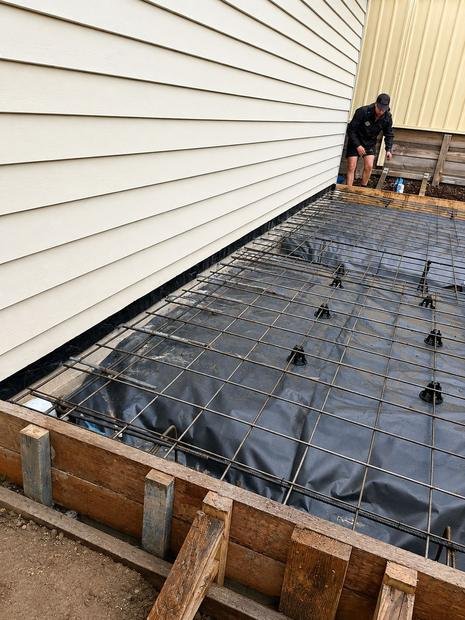
Termiticide registered with the APVMA goes into the soil, and a reticulation pipe network can be added so later recharging needs no digging.

Piers, bearers and suspended timber floors protected, which matters on sloping and elevated blocks.
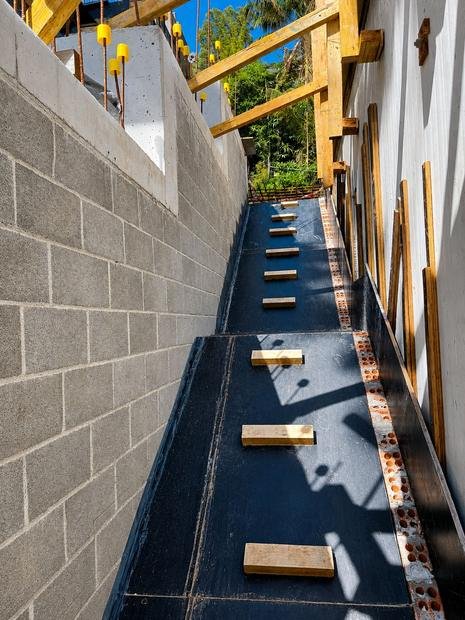
Retaining walls, sandstone excavation, step-downs and cut-and-fill - all common in Sydney, all needing their own detailing.
Once the slab is poured, the areas termites use most are sealed away for good.
The pre-construction price is far below what a retrofit costs, and nowhere near the cost of repairing damage.
Under the NCC, Class 1 homes and Class 10 outbuildings with termite-susceptible primary building elements require a compliant termite management system.
Pipe penetrations and slab joints can only be fully protected before concrete covers them.
Areas no post-construction treatment can ever reach are covered by an under-slab system.
The Occupation Certificate will not be issued until the certifier has the installation certificate and durable notice.
Documented, compliant termite protection reassures buyers, building inspectors and lenders.
Speak to a licensed Sydney technician now. Straight advice, and a fixed quote inside 30 minutes.
Both approaches can comply with AS 3660.1. Many Sydney builds use a combination.
| System | How it works | Durability & upkeep | Best suited to |
|---|---|---|---|
| Physical membrane, mesh or graded stone | Sheet membrane, stainless mesh or graded stone particles form a layer termites cannot pass, under the slab or at the perimeter | Lasts as long as the slab unless disturbed, and never needs a chemical top-up | Slab-on-ground homes, and anyone wanting a non-chemical system |
| Penetration collars | Physical collars sealed around all pipes and conduits penetrating the slab | Correctly installed before the pour, they last | All slabs, normally combined with a perimeter system |
| Chemical soil barrier | A treated zone created with termiticide in the soil below and around the building | The label and the soil conditions set the service life; it can be re-applied | Builds with tighter budgets, and some complex sites |
| Reticulation system | A pipe network installed ahead of paving, allowing the soil to be re-treated by pumping | Can be topped up throughout the building's life without digging up paving | Homes surrounded by paving or heavy landscaping |
| Baiting (post-construction) | Ground stations used for monitoring and then baiting out the colony | Regular servicing of each station is required | For existing homes, see termite control |
Termite barriers are installed in stages that follow the build, not in a single visit.
Send through the plans and slab details, and we will recommend a system with a fixed price for each stage.
Collars go onto every service penetration, and once the site is prepared the under-slab membrane or the chemical treatment is installed.
While the brickwork or cladding goes up, the perimeter and cavity barriers are installed, leaving no gap at the slab edge.
If specified, the chemical perimeter or reticulation system is finished around the completed building before paving and landscaping start.
A durable notice goes into the meter box to record the system, with the installation certificate to the builder and certifier.
At handover the owner is given maintenance advice and the recommended inspection schedule that keeps the system effective.
| Document | What it is | Who needs it |
|---|---|---|
| Durable notice | Fixed permanently in the meter box, recording the system, install date, chemical life expectancy, installer and inspection advice | Certifier, current owner and future owners |
| Installation certificate | Written confirmation covering the system and products used, the protected areas and the installer's licence | Builder, certifier, and the owner's own records |
| Product information | Specifications for the physical system or termiticide used, plus safety data sheets where chemicals are involved | Builder and owner |
| Maintenance & inspection advice | What keeps the barrier working, and the inspection frequency recommended by AS 3660.2 | The homeowner |
Send the architectural or slab plan, the slab type - raft, waffle pod or suspended - the site address, an approximate pour date, and engineering details for any retaining walls or step-downs.
We schedule to the plumber's set-out and the concreter's pour, confirming collar installation before the pour inspection once services are in.
For developers and volume builders: consistent pricing, one point of contact, and documentation issued for every lot or dwelling.
Occupation certificates are often held up by a missing durable notice or vague installation records. Everything is supplied together so the certifier is not left chasing.
A barrier only works if it stays intact and visible. Homeowners should follow these points for the life of the building.
| Factor | Why it matters |
|---|---|
| Slab area & perimeter length | The bigger the footprint, the more membrane, perimeter protection and labour required |
| Which system | A full under-slab physical system, a perimeter-only system, and chemical or reticulation options all price differently |
| Service penetrations | Every plumbing and electrical penetration through the slab has to be collared |
| Complexity of the site | Retaining walls, step-downs, sandstone cuts and suspended floors each add detailing |
| Visits to site | Staged installation tracks the build program, with multi-dwelling sites often combined |
Send your plans for a fixed, written quote. There's no charge to quote.
Clearing removes the trees, not the nests. Stumps and root systems left in the ground around Rodd Point developments keep colonies alive right under the new slabs.
Much of western and south-western Sydney sits on reactive clay that moves with moisture. Around Rodd Point that movement can open hairline paths underground where nothing is visible from the surface.
Anything attached to the structure is part of the structure as far as termites are concerned.
Licensed in NSW under 5122967, with all installations carried out to AS 3660.1.
We attend to suit the builder's program, so the pour is never held up by a barrier stage.
Durable notice, certificate of installation and product details - all supplied together.
From a single dwelling or granny flat through to duplexes and multi-unit projects.
Everything you need to know before you book. Still unsure? Call us — we're happy to help.
Get a Free QuoteBarriers are quoted off your plans and slab details. What changes the figure is the size of the building, how many areas are affected and the access. You get that number up front for Rodd Point 2046, with no call-out fee. You get the AS 3660.1 certificate and the durable notice for the meter box.
Same-day attendance is usually available. Rodd Point is about 6.1 km west of the CBD in the Inner West, and we give you a firm arrival time rather than an all-day window.
The housing stock is old and joined together. A shared wall cavity or a continuous sub-floor lets termites travel from one property to the next, which is why your neighbour matters.
Joined older housing, often with a paved rear courtyard holding damp against the wall. Both things shape the treatment.
We do. A lot of our Rodd Point work is rentals and strata, so the report, the products used and the areas treated are all recorded in writing for whoever needs them.
It is, applied properly. We put product into cracks, voids and stations rather than across open surfaces, and we will tell you what to stay off and for how long before we leave.
Usually not. Most pre-construction termite barriers work is done with you there, and anything that needs the room vacated is for a short period we will tell you about beforehand.
Allow an hour to two hours for most properties. A bigger building, or one where the problem has spread, takes longer - and we would rather tell you that when quoting than rush it.
You get the AS 3660.1 certificate and the durable notice for the meter box. If it is not holding, call us - that is exactly what the warranty is for.
Yes. As well as Rodd Point we cover Russell Lea, Five Dock, Wareemba and Haberfield on the same runs, so a job that crosses a boundary can be handled in one visit.
Photographs from Elite jobs across Sydney — not stock imagery.
Fast and fully insured, with a no-obligation quote back to you within 30 minutes.