
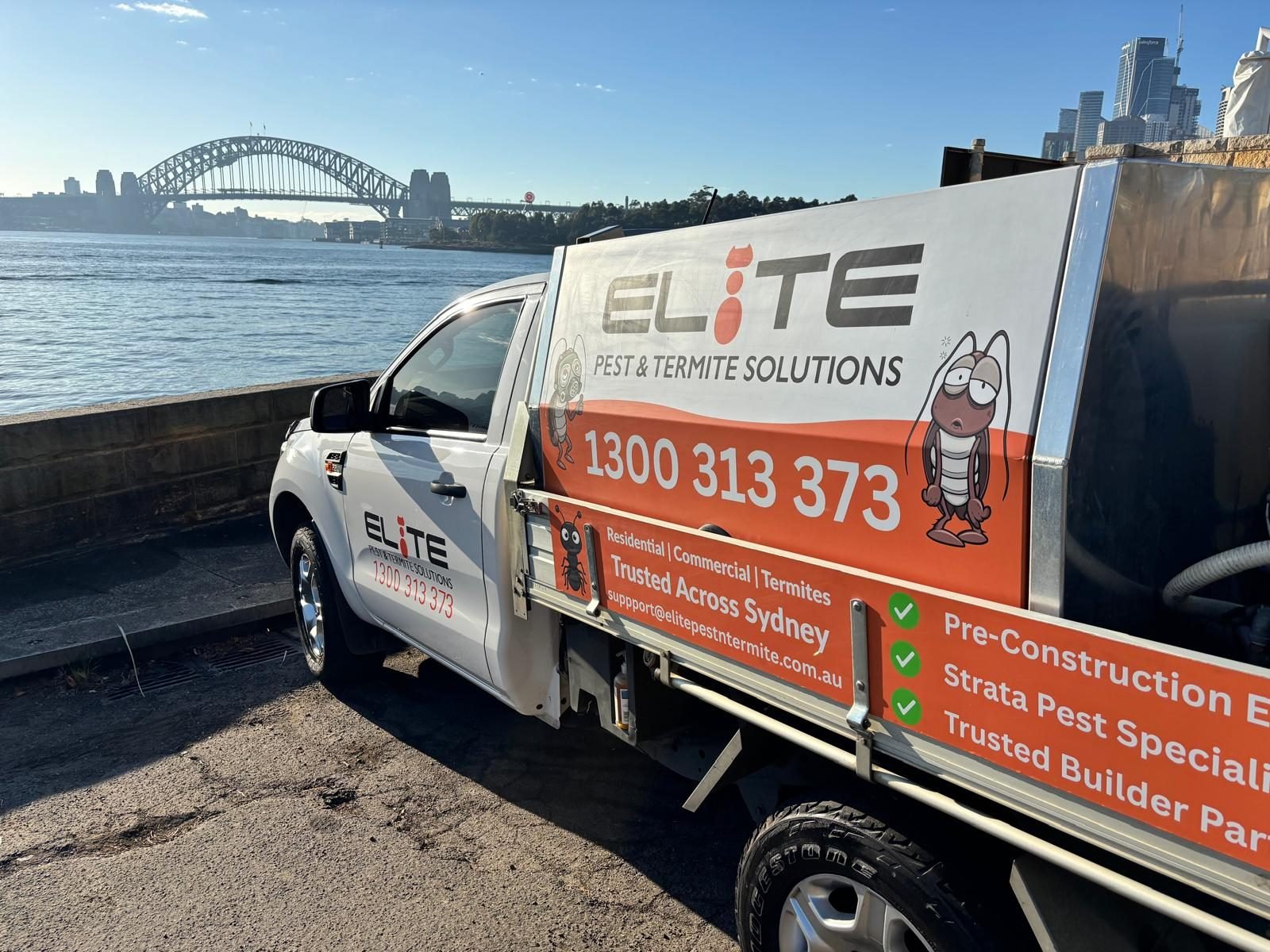
Yes - professional pest control is safe around children and pets when it is applied correctly. Elite Pest uses APVMA-registered, low-toxicity products at label rates, and places baits and dusts in cracks, voids and stations rather than on open surfaces. You are told the exact re-entry time on the day; usually it is just staying off treated surfaces until dry.
- What you are actually dealing with
- The early signs people miss
- Why this property and not the one next door
- How the appointment runs
- Getting ready for the treatment
- What this means if you have kids or animals
- Doing it yourself: the honest version
- The things that set people back
- How the building affects the treatment
- Commercial and common-property situations
- Is this urgent?
- Frequently asked questions
What you are actually dealing with
The useful question is not which spray to buy but where the population actually lives. With pests, what you see moving is a small fraction of what is there, and treating only that fraction is why problems come back.
That is why an inspection comes before any product. It establishes the species, how far the population has spread, and which conditions on the property are sustaining it.
Key points
- A fixed quote should come before any work starts.
- Early action is consistently cheaper than waiting for certainty.
- Ask what the warranty covers and for how long.
- Treat the source, not the sightings: the nest or harbourage is the target.
If you want to see how the treatment is actually carried out, the our full range of pest control services page walks through each stage.
The early signs people miss
The early evidence is usually subtle, and most of it is found in places nobody looks. Worth checking for:
- Droppings, smear marks or shed skins in cupboards and along skirtings.
- Noises in a wall or roof space that follow a nightly pattern.
- Pets fixating on one point of a wall, floor or appliance.
- An unexplained musty, oily or ammonia-like smell in a closed space.
- Entry-point evidence at weep holes, pipe penetrations and door seals.
Where several of these show up together, the population is established rather than passing through, and the treatment needed changes accordingly.
If you are not certain which pest you are dealing with, everything we treat lists what we treat and the signs that point to each.
Why this property and not the one next door
Nothing moves in without a reason. Pests turn up where there is food, water or shelter available, and in most Sydney homes it is a short list of the same culprits:
- Vegetation, mulch and timber in direct contact with the building.
- Delay, which turns a small introduction into an established problem.
- Moisture from leaks, poor drainage or blocked gutters.
- Gaps at weep holes, pipe penetrations, door seals and roof junctions.
- Neighbouring work or vacancy displacing an established population.
Addressing even two or three of these significantly reduces the chance of a repeat.
How the appointment runs
There is not much mystery to it, and most of it is quicker than people expect:
- First look. The technician inspects inside and out, confirms the species and shows you what they have found before anything is applied.
- Agreeing the work. No work starts until you have agreed the price and know what it covers.
- Application. Allow an hour to two hours. You do not need to leave for most general work.
- What you are told. You get the timeline, the aftercare, the specific fixes for your property and your paperwork.
One thing worth knowing: with baiting and colony treatments, activity often rises briefly before it drops. That is the treatment working, not failing.
Getting ready for the treatment
A little preparation makes a measurable difference to the result, and none of it takes long:
- Put food, utensils and pet bowls away or in sealed containers.
- Arrange for pets to be out of the way for a couple of hours.
- Vacuum carpets and hard floors, then empty the vacuum outside.
- Cover or move fish tanks and turn off their air pumps.
- Tell the technician what you have already applied yourself.
Avoid washing down treated areas for at least a week, and resist adding your own spray on top.
What this means if you have kids or animals
Fair question, and worth more than a one-word answer. Professional treatment is safe around families and pets because of how it is applied, not because the products are inert:
- Nothing is applied to food preparation surfaces or anywhere food is stored.
- You are given a specific re-entry time, usually just until treated surfaces are dry.
- Fish tanks are covered and pet bowls and bedding moved before any treatment.
- Baits, gels and dusts go into cracks, voids and secured stations - not across open surfaces.
If anyone in the house has a specific sensitivity, tell us when you book - it changes which products we bring, not whether we can help.
You can see about the team and the qualifications behind the work.
Doing it yourself: the honest version
There is no sense paying for a call-out you do not need. But the reasons DIY fails on a real infestation are consistent:
- Without identification there is no way to know whether it is working or just scattering.
- Concentrations are lower and residual life shorter than professional-grade equivalents.
- Guessing the species usually means the wrong product entirely.
- Retail products kill what they touch and leave the nest or harbourage producing.
If you have already tried something and it returned, that is the signal rather than a reason to try again harder.
It is worth a look through the full range of treatments we carry out, since what you are seeing may not be what you think it is.
The things that set people back
These come up often enough to be worth listing. Each one either prolongs the problem or makes it harder to treat:
- Treating what you can see instead of the source.
- Guessing the species, which means the wrong product.
- Waiting until the problem is obvious, which always costs more.
- Using a repellent product where a bait is needed.
If you have already done one of these, say so when you book. It changes the approach rather than causing offence.
How the building affects the treatment
The building matters as much as the pest. The same species is treated differently in a freestanding house, a unit and a terrace, mostly because of what a technician can reach:
- Commercial premises. Documentation, scheduling and after-hours access become part of the job.
- Townhouses. Common walls plus private courtyards, so internal and external work both matter.
- Apartments and units. Shared walls, services and risers mean the source is often outside your lot - partial treatment just moves it.
- Older Sydney housing. Deeper gaps, timber framing and subfloor moisture raise both termite and rodent exposure.
The recurring-problem-in-a-unit pattern almost always means the population is living in common property.
The approach in a unit differs enough that we cover unit and apartment treatments separately.
Commercial and common-property situations
Commercial and strata work carries requirements a domestic job does not:
- Coordination across multiple lots so the population cannot simply relocate.
- Written service reports an auditor or committee can follow.
- Food-safety alignment for kitchens, cafes and childcare premises.
- After-hours or pre-opening access so trading is not disrupted.
- Safety data sheets and licence documentation held on site.
For a food business in particular, pest records are among the first things an inspector asks for - which makes the documentation as valuable as the treatment.
For owners corporations, strata pest control deals with the risers, voids and common areas individual treatments cannot reach.
Is this urgent?
Not everything needs a same-day visit, and it is reasonable to want to know which this is. Treat it as urgent when:
- Anyone in the household has a known allergy to stings.
- Numbers have visibly increased over a week or two.
- The species is one capable of a medically significant bite.
- There are young children or pets with access to the affected area.
Outside those, a booking in the next few days is generally fine. Waiting a month is where it starts getting more expensive.
If your suburb is not mentioned above, our full service area will confirm whether we are out that way.
Questions we get asked
What will treating pests cost?
Starting prices are $89 for a general treatment and $159 for an inspection with a written report. Anything larger is quoted on inspection rather than over the phone. The quote is fixed, so the invoice matches what you were told.
Will a supermarket spray work?
For a single insect, yes. For an established population, retail products usually fail because they kill what they touch and leave the nest producing. Repellent sprays can also split ant colonies, which turns one problem into several.
How quickly can you come out to Sydney?
Most bookings in Sydney are filled within 48 hours. Urgent situations are prioritised, and we will tell you honestly if yours is not urgent rather than selling you a priority visit.
Are your technicians licensed and insured?
Licensed and insured, and happy to show either. If you are comparing quotes, ask each company for the licence number of the person actually attending rather than just the business name.
What prevents a repeat?
Remove the food, remove the water, seal the gaps and keep vegetation off the walls. Of those, moisture matters most - fixing a leak or clearing a gutter prevents more problems than any spray. A scheduled annual service catches anything that slips through.
When should the pests be gone?
Residual treatments start working within hours, but colony and baiting treatments are deliberately slower - the product has to be carried back to the nest. Expect a clear reduction within a week to two, and do not be alarmed if activity briefly rises first.
What happens if they come back?
Covered pests returning within six months are re-treated free. Termite barriers and baiting systems have their own longer warranties, generally conditional on annual monitoring. You get the terms in writing on the day.
What if the problem is coming from next door?
In a tenancy it usually depends on whether the problem existed at the start of the lease and on the terms of the agreement - raise it with the agent in writing either way. In a strata building, anything in common property such as risers, voids and bin rooms is the owners corporation's responsibility.
Want this sorted properly?
Licensed, insured and working across 650+ Sydney suburbs. You get a fixed price before anything starts, a 6-month warranty on general pest work, and a technician who explains what they found.