
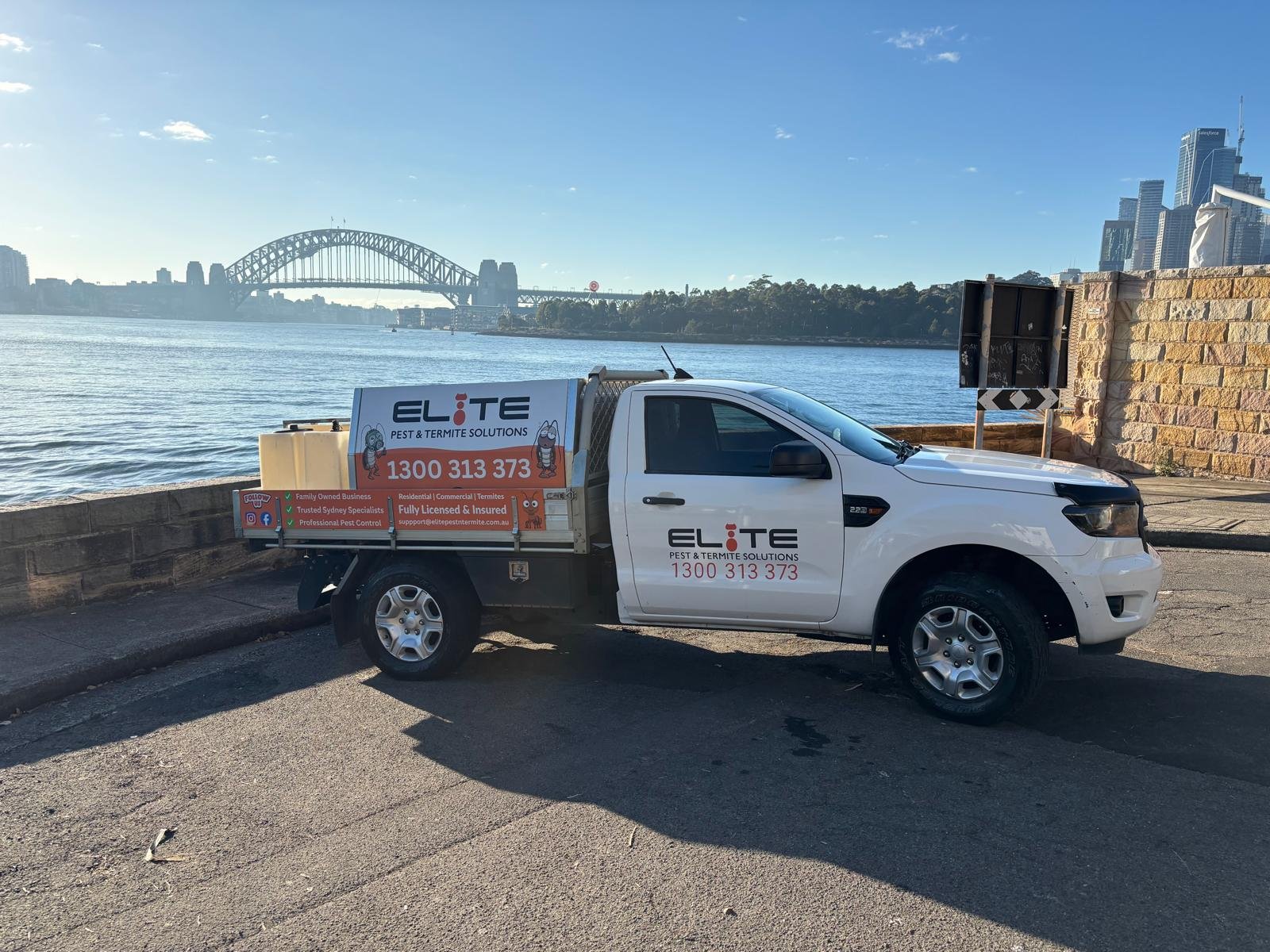
In Sydney, a general pest treatment begins at $89 and an inspection at $159. Larger jobs - termite barriers, baiting systems, commercial programs - are quoted on inspection. Elite Pest confirms the price in writing first, and covered pests returning within six months are re-treated at no charge.
- The part most people get wrong
- How to tell you have a problem
- What is attracting them
- What is actually at stake
- Treatment options compared
- What you are paying for
- What to expect from the visit
- What you should expect to pay
- Where DIY stops working
- What counts as an emergency
- Questions worth asking first
- Frequently asked questions
The part most people get wrong
Almost every unsuccessful treatment starts the same way: the wrong product aimed at the wrong place. Pests are not a single problem with a single answer - the species, the entry point and the conditions around the building all change what works.
So the sequence matters: identify, locate, treat the source, then close the conditions. Skip a step and you are paying again within weeks.
Key points
- Early action is consistently cheaper than waiting for certainty.
- Fix the conditions - moisture, food, entry points - or it returns.
- A fixed quote should come before any work starts.
- Identify the species before treating - the right product depends on it.
If you want to see how the treatment is actually carried out, professional our full range of pest control services walks through each stage.
How to tell you have a problem
The early evidence is usually subtle, and most of it is found in places nobody looks. Worth checking for:
- Damage to packaging, timber, fabric or cabling with no other explanation.
- Trails or runways repeated along the same route day after day.
- Insects visible in daylight, which usually means harbourage is full.
- Entry-point evidence at weep holes, pipe penetrations and door seals.
- A sharp rise in sightings after rain or a run of humid weather.
One of these on its own may mean nothing. Two or more in the same area is worth a professional look, and it is better not to disturb the site before someone has seen it.
It is worth a look through the services we offer across Sydney, since what you are seeing may not be what you think it is.
What is attracting them
Nothing moves in without a reason. Pests turn up where there is food, water or shelter available, and in most Sydney homes it is a short list of the same culprits:
- Moisture from leaks, poor drainage or blocked gutters.
- Neighbouring work or vacancy displacing an established population.
- Gaps at weep holes, pipe penetrations, door seals and roof junctions.
- Vegetation, mulch and timber in direct contact with the building.
- Delay, which turns a small introduction into an established problem.
A technician will walk you through whichever of these apply to your place as part of the visit.
What is actually at stake
Pest problems rarely stay the same size. Most of what Elite Pest treats in Sydney homes would have been cheaper, faster and less invasive a month or two earlier, because breeding continues while you decide. The health, structural and contamination risks all scale with how long the population has been established.
Put plainly: the problem does not stay the same size while you decide.
The method itself, product by product, is explained on our page about our full range of pest control services.
Treatment options compared
The honest trade-offs:
| Method | Works well for | Limitations |
|---|---|---|
| Scheduled program | Keeps pressure down at higher-risk sites | Ongoing service rather than one visit |
| Residual treatment to harbourage | Treats runways, voids and entry points | Surface work alone rarely clears a population |
| Targeted baiting | Removes the colony or population at source | Works over days to weeks |
| Proofing and exclusion | Stops the problem returning | Needs the building cleared first |
Most real jobs combine two of these rather than relying on one. If a quote only mentions a spray, it is worth asking what else is planned.
There is a fuller explanation of the our full range of pest control services page, including what is and is not included.
What you are paying for
There is a defined process behind it, and knowing it makes the invoice easier to read:
- Inspect and identify. Confirm the species, locate nests and harbourage, and note the conditions sustaining them.
- Treat the source. Use the method the species responds to, placed where the population lives rather than where it was seen.
- Allow the method to run. Expect a timeline rather than an instant result, and avoid adding anything of your own in the meantime.
- Close the conditions. Identify and remove what caused it, otherwise the treatment is only a reset.
All of that is done by a licensed and insured technician, with general treatments backed for six months.
We set out the full process, timelines and warranty terms under how our full range of pest control services works.
What to expect from the visit
There is not much mystery to it, and most of it is quicker than people expect:
- Arrival and walk-through. The technician inspects inside and out, confirms the species and shows you what they have found before anything is applied.
- Price confirmed. No work starts until you have agreed the price and know what it covers.
- Application. Allow an hour to two hours. You do not need to leave for most general work.
- Handover. A clear explanation of what happens next, so an increase in activity a few days later does not alarm you.
One thing worth knowing: with baiting and colony treatments, activity often rises briefly before it drops. That is the treatment working, not failing.
What you should expect to pay
Our rates are published rather than quoted on the spot. Starting points:
| Service | From | Notes |
|---|---|---|
| Commercial program | quoted per site | Scheduled servicing with documented reports |
| Flea treatment (internal) | from $160 | Preparation and vacuuming required beforehand |
| Possum removal and proofing | from $250 | One-way exclusion, then sealing the entry |
| Bed bug treatment (per room) | from $280 | Usually includes a follow-up visit |
| Wasp or bee nest treatment | from $150 | Priced on access and nest location |
Two things worth asking any company: is the quote fixed, and what does the warranty actually cover. Ours is fixed, and general work is covered for six months.
How that is done in practice is covered under what the treatment involves.
Where DIY stops working
This is worth being straight about, because DIY is not always the wrong answer. It is the wrong answer once a population is established, for reasons that are fairly mechanical:
- Repellent sprays can split colonies - with ants especially - turning one nest into several.
- Retail products kill what they touch and leave the nest or harbourage producing.
- Concentrations are lower and residual life shorter than professional-grade equivalents.
- Surface application misses the voids and cracks where the population actually lives.
Where it crosses over is roughly when you have treated twice and it has come back, or when the species itself is a safety question.
If you are not certain which pest you are dealing with, the full range of treatments we carry out lists what we treat and the signs that point to each.
What counts as an emergency
A fair question, and the answer is genuinely "it depends". Move quickly if:
- A tenancy, sale or inspection is imminent.
- There is damage to structural timber, cabling or insulation.
- Anyone in the household has a known allergy to stings.
- The species is one capable of a medically significant bite.
If none of those apply, there is no need to panic - but there is also no advantage in waiting, since populations keep breeding either way.
If your suburb is not mentioned above, our full service area will confirm whether we are out that way.
Questions worth asking first
A short list of checks that filters out most of the problems:
- Check whether a follow-up visit is included or charged separately.
- Get the quote in writing, fixed, before any work starts.
- Ask what the warranty covers, what voids it, and how long it runs.
- Ask which method they intend to use and why that one.
- Ask for the technician's NSW pest management licence number, not just the company name.
If someone will not put the quote or the warranty in writing, that is your answer.
That is worth checking before you book anyone, including us - licensed and insured technicians covers our licensing, insurance and how long we have been doing this.
Frequently asked questions
What will treating pests cost?
Starting prices are $89 for a general treatment and $159 for an inspection with a written report. Anything larger is quoted on inspection rather than over the phone. The quote is fixed, so the invoice matches what you were told.
When should the pests be gone?
For a general treatment you should see a drop within 24 to 72 hours. Where baiting is used it takes one to three weeks, because the aim is the colony rather than the foragers. A short increase in sightings early on means the bait is being taken.
Can you just treat it without looking?
An inspection is what tells a technician the species, the extent and the cause. Treating without it is guesswork, and guesswork is the main reason jobs get repeated. On general treatments it is built into the appointment.
Can I treat this myself?
It is worth a try for a one-off sighting and generally a waste of money beyond that. Concentrations are lower, residual life is shorter, and surface application misses the voids where the population actually lives.
How soon can you get here?
Most bookings in Sydney are filled within 48 hours. Urgent situations are prioritised, and we will tell you honestly if yours is not urgent rather than selling you a priority visit.
What qualifications do your technicians hold?
Yes - every technician holds a current NSW pest management licence and we carry public liability insurance. You are entitled to ask any operator for both, and it is worth doing. Ours are available on request.
Do we need to leave the house during treatment?
Yes - and if anyone in the household has asthma, allergies or there is a newborn, tell us when booking and the technician adjusts the method. Re-entry is normally once treated surfaces have dried, and you are told the exact time on the day.
What attracts pests to a house?
Usually something fixable: an unsealed food source, standing water, mulch or timber against the wall, or a gap at a weep hole or pipe penetration. A technician will point out which apply to your property.
Want this sorted properly?
One call gets you a fixed price, usually inside 30 minutes. Licensed technicians, 650+ Sydney suburbs covered, child and pet-safe treatments, and a 6-month warranty on general work.