
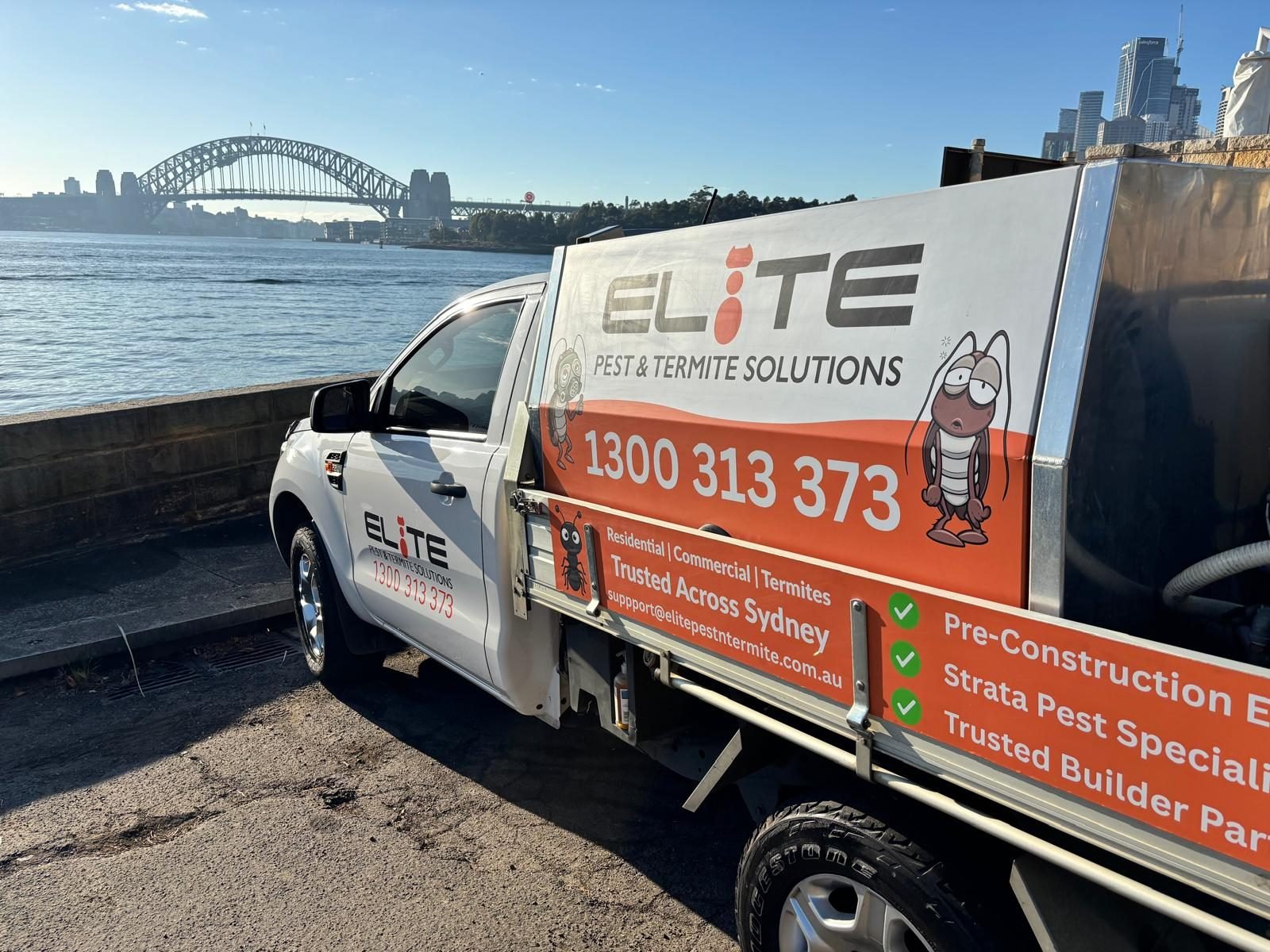
For a business the deliverable is records as much as treatment. A commercial program means scheduled visits, monitored bait stations, a pest map and service reports that stand up in an audit. Elite Pest runs these across Sydney for food premises, offices, strata buildings and warehouses.
- Start by working out what you have
- What to look for
- Why this is not just unpleasant
- Which method suits which situation
- The process, step by step
- Getting ready for the treatment
- Where DIY stops working
- Common missteps
- If this is a business or a strata building
- Choosing a pest controller in Sydney
- After the treatment
- Frequently asked questions
Start by working out what you have
Most of the cost in dealing with ants comes from doing it twice. Getting the identification and the source right the first time is what makes the difference between one treatment and a recurring expense.
Get that sequence right and a single treatment generally holds. Get it wrong and you are treating the same thing next month.
Key points
- Fix the conditions - moisture, food, entry points - or it returns.
- Treat the source, not the sightings: the nest or harbourage is the target.
- Ask what the warranty covers and for how long.
- Early action is consistently cheaper than waiting for certainty.
If you want to see how the treatment is actually carried out, professional ant control walks through each stage.
What to look for
Before numbers become obvious there is almost always a quieter stage. What to look for:
- Ants appearing in a bathroom or ensuite with no food present.
- Small piles of coarse sawdust-like debris near a window frame or decking.
- Winged ants indoors on a humid evening, which signals a mature nest nearby.
- A sudden indoor surge after heavy rain, when nests flood and relocate.
- A steady trail following the same route along a bench, skirting or path.
The more of these you can tick off, the longer it has been going on - which affects both the method and the price.
The rest of what we handle is set out under the services we offer across Sydney.
Why this is not just unpleasant
Most ant species are a nuisance rather than a hazard, but a few matter more. Carpenter ants excavate damp structural timber, coastal brown ants undermine paving and retaining walls, and fire ants are a notifiable biosecurity matter in New South Wales. Species identification is what separates a simple baiting job from something that needs reporting.
That is the argument for acting on the early signs rather than waiting until there is no doubt.
There is a fuller explanation of how ant control works, including what is and is not included.
Which method suits which situation
There is rarely one correct method. What follows is what each approach does well and where it falls short:
| Method | Works well for | Limitations |
|---|---|---|
| Perimeter non-repellent treatment | Reduces entry without splitting colonies | Does not replace baiting the nest |
| Dust to wall voids | Reaches nests inside cavities | Needs void access |
| Granular bait outdoors | Covers nests in lawn, beds and paving | Reapplication after heavy rain |
| Species-matched gel or liquid bait | Taken back to the nest; removes the colony | Needs days to weeks; do not spray trails |
Most real jobs combine two of these rather than relying on one. If a quote only mentions a spray, it is worth asking what else is planned.
The method itself, product by product, is explained on our page about ant control.
The process, step by step
A licensed technician follows a repeatable process rather than blanket-spraying a property. In order:
- Inspect and identify. Confirm the species, locate nests and harbourage, and note the conditions sustaining them.
- Treat the source. Match the method to the species and place it in the harbourage rather than across open surfaces.
- Allow the method to run. Colony treatments take time by design. The technician will say how long before you should expect a change.
- Close the conditions. The gaps to seal, the moisture to fix and the habits to change - this is what makes the result last.
Every Elite Pest treatment is carried out by a licensed, insured technician and general pest work carries a 6-month warranty.
How that is done in practice is covered under what the treatment involves.
Getting ready for the treatment
Treatments work better when the technician can reach things. Before the appointment:
- Arrange for pets to be out of the way for a couple of hours.
- Cover or move fish tanks and turn off their air pumps.
- Make a note of where you have seen activity and when.
- Vacuum carpets and hard floors, then empty the vacuum outside.
- Put food, utensils and pet bowls away or in sealed containers.
Avoid washing down treated areas for at least a week, and resist adding your own spray on top.
Where DIY stops working
Retail products have a place. For one insect in a room they are fine, and nobody needs a technician for that. For an established population they tend to fail, and sometimes make things worse:
- Concentrations are lower and residual life shorter than professional-grade equivalents.
- Retail products kill what they touch and leave the nest or harbourage producing.
- Guessing the species usually means the wrong product entirely.
- Surface application misses the voids and cracks where the population actually lives.
The rule of thumb: a single sighting, try it yourself. Recurring activity, structural risk, anything venomous, or a food business - get a licensed technician in.
It is worth a look through everything we treat, since what you are seeing may not be what you think it is.
Common missteps
Worth avoiding, because each of these costs time or money later:
- Giving up on bait after a few days, which is when it is still working.
- Using bait and spray together, so the bait never gets carried home.
- Wiping away trails before a technician can follow them to the nest.
- Treating indoors only when the nest is in a retaining wall or garden bed.
None of these are unrecoverable - but tell the technician what has already been tried, because it affects what will work now.
If this is a business or a strata building
For a business or an owners corporation the deliverable includes paperwork, not just a result:
- Treatment of common property - risers, voids, bin rooms, roof spaces - not just individual lots.
- After-hours or pre-opening access so trading is not disrupted.
- A site plan showing monitored station locations.
- Food-safety alignment for kitchens, cafes and childcare premises.
- Safety data sheets and licence documentation held on site.
At an audit the question is rarely whether you have pests; it is whether you can show a managed program. That is what the reporting is for.
Businesses carrying a food-safety or compliance obligation need a documented commercial program rather than a one-off visit.
Choosing a pest controller in Sydney
This is a licensed trade, so there are specific things you are entitled to ask:
- Ask which method they intend to use and why that one.
- Ask what the warranty covers, what voids it, and how long it runs.
- Ask for the technician's NSW pest management licence number, not just the company name.
- For termite work, ask whether you receive a written timber pest report.
- Check whether a follow-up visit is included or charged separately.
A good operator will answer all of those without hesitation. Hesitation on any of them is useful information.
You can see about the team and the qualifications behind the work.
After the treatment
General pest treatments from Elite Pest carry a 6-month warranty: if covered pests return inside that period, we come back and re-treat at no charge.
There are limits worth knowing rather than discovering later. The warranty covers the pests treated, not a new and different problem, and it assumes the prevention advice was followed - leaving an open food source or an unrepaired leak is outside it. Termite barriers and baiting systems carry their own separate terms, usually tied to annual monitoring.
It goes on the invoice, so there is no ambiguity about what was covered six months later.
If this is the second or third time you have dealt with it, a regular residential program costs less over a year than repeated call-outs.
Questions we get asked
How much does it cost to get rid of ants in Sydney?
General pest treatments start from $89 and timber pest inspections from $159. Termite treatments and barriers are quoted after an inspection because the price depends on the construction and the extent of the activity. You get a fixed figure before any work begins.
Why does spraying ant trails make it worse?
Better not to. Wiping or spraying a trail removes the evidence a technician follows to find the nest, and repellent products can fragment the colony. If you can, leave the trail alone until it has been seen.
What if the problem is coming from next door?
If the source is common property, it is a building-level job rather than yours. We are happy to provide a written report for an agent or owners corporation setting out where the activity is and what it will take to resolve.
How soon can you get here?
Usually within a day or two, and same-day where there is a safety issue - a sting allergy in the household, young children with access, or live termite activity. We quote most jobs in about thirty minutes over the phone.
What happens if they come back?
Yes - six months on general pest work. A recurrence of the treated pest inside that window is a free return visit. A different species arriving later is a new job, and a recurrence traced to an unfixed cause such as a leak sits outside the cover.
Why have ants come into my home?
Usually something fixable: an unsealed food source, standing water, mulch or timber against the wall, or a gap at a weep hole or pipe penetration. A technician will point out which apply to your property.
Is an inspection really necessary?
For general pest work the inspection happens as part of the visit and is not charged separately. For anything termite-related it is essential and is the deliverable in its own right, because the report determines the treatment and gives you a written record.
How long before the treatment works?
For a general treatment you should see a drop within 24 to 72 hours. Where baiting is used it takes one to three weeks, because the aim is the colony rather than the foragers. A short increase in sightings early on means the bait is being taken.
Sydney pest control, booked today
Licensed, insured and working across 650+ Sydney suburbs. You get a fixed price before anything starts, a 6-month warranty on general pest work, and a technician who explains what they found.