
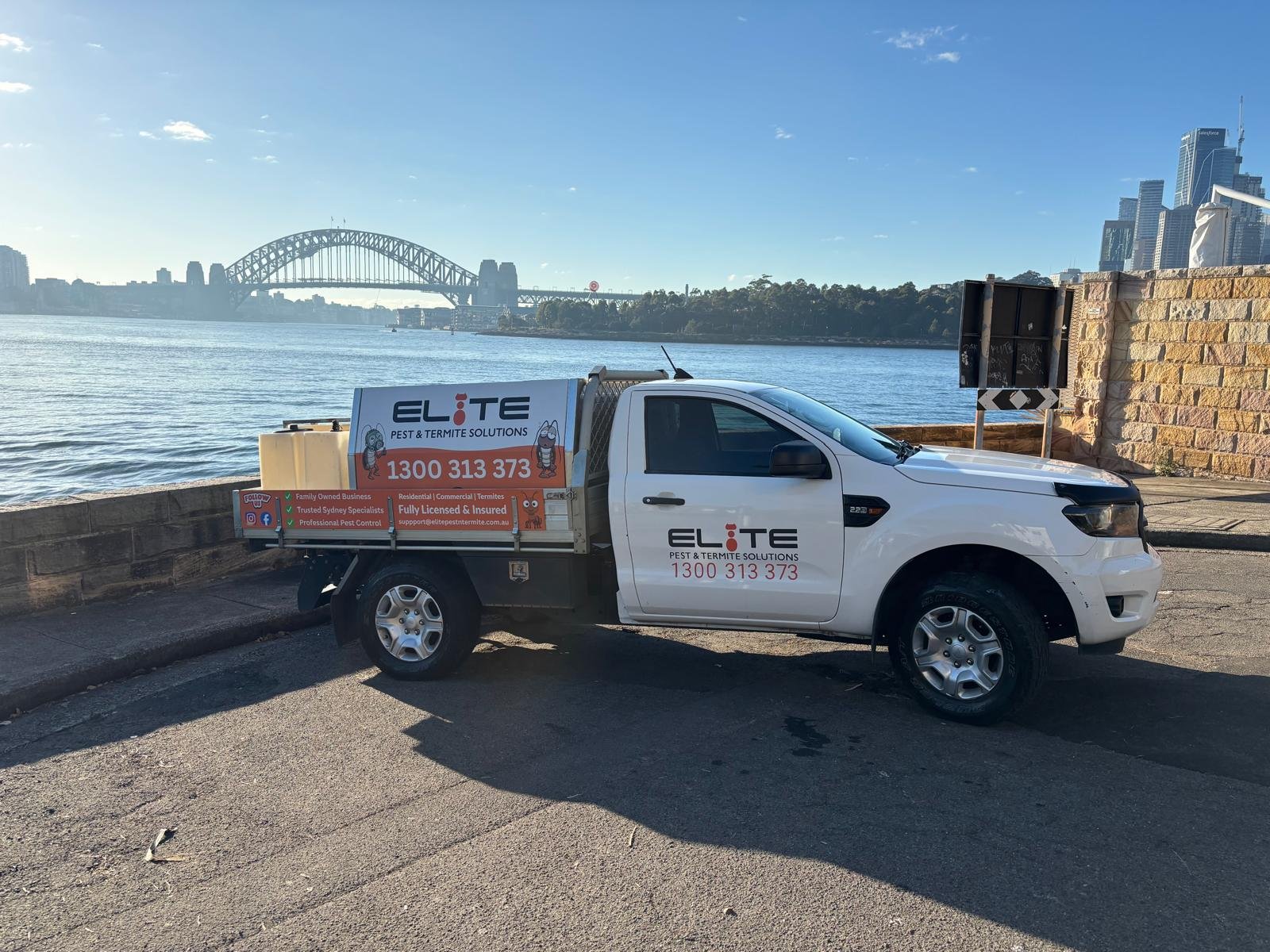
Elite Pest treats pests across Dee Why with licensed, insured technicians and a 6-month warranty on general work. General treatments start from $89 and timber pest inspections from $159. Most Dee Why jobs are quoted in about thirty minutes and booked within a day or two.
- Start by working out what you have
- Signs worth acting on
- Why this property and not the one next door
- Local conditions in Dee Why
- Why it is worth dealing with
- When pests are worst in Sydney
- What happens on the day
- Myths worth dropping
- If this is a business or a strata building
- What to do once it is sorted
- Around Dee Why
- Frequently asked questions
Start by working out what you have
It helps to separate two things: what is making you call someone, and what is causing it. The visible pests are the first; the moisture, the gap or the food source behind them is the second, and only the second decides whether the result holds.
That is why an inspection comes before any product. It establishes the species, how far the population has spread, and which conditions on the property are sustaining it.
Key points
- Treat the source, not the sightings: the nest or harbourage is the target.
- Early action is consistently cheaper than waiting for certainty.
- Fix the conditions - moisture, food, entry points - or it returns.
- A fixed quote should come before any work starts.
How that is done in practice is covered under professional our full range of pest control services.
Signs worth acting on
You rarely see the population itself first - you see what it leaves behind. The signs that matter:
- Droppings, smear marks or shed skins in cupboards and along skirtings.
- Pets fixating on one point of a wall, floor or appliance.
- Entry-point evidence at weep holes, pipe penetrations and door seals.
- Noises in a wall or roof space that follow a nightly pattern.
- A sharp rise in sightings after rain or a run of humid weather.
One of these on its own may mean nothing. Two or more in the same area is worth a professional look, and it is better not to disturb the site before someone has seen it.
It is worth a look through the full range of treatments we carry out, since what you are seeing may not be what you think it is.
Why this property and not the one next door
The question worth answering is why here. These are the conditions that bring pests in, and the ones a technician will point out on the day:
- Gaps at weep holes, pipe penetrations, door seals and roof junctions.
- Neighbouring work or vacancy displacing an established population.
- Vegetation, mulch and timber in direct contact with the building.
- Delay, which turns a small introduction into an established problem.
- Clutter and stored material offering undisturbed harbourage.
Most of these are fixable in an afternoon, and doing so is what turns a treatment into a result.
Local conditions in Dee Why
Dee Why (2099) sits about 15km north-east of the CBD, and the local housing mix is a reasonable predictor of what we find there. Pest activity in the area tends to follow the same few conditions we see across comparable suburbs.
Practically, that affects where a technician spends their time on site rather than which products come out of the van.
If you are weighing up who to call locally, Dee Why pest control covers what we do in the area and how quickly we can get there.
Why it is worth dealing with
The cost of waiting is the part people underestimate. A small introduction becomes an established population, harbourage spreads into voids that are harder to reach, and what would have been a single treatment turns into a program. Early action is almost always the cheaper decision.
Which is why the advice is always to treat it while it is small, however tempting it is to wait and see.
The method itself, product by product, is explained on our page about what the treatment involves.
When pests are worst in Sydney
Most pests in Sydney follow heat and water. The humid months raise numbers across the board, the cooling months move animals indoors, and the wet weeks in between trigger the sudden indoor surges people report after a storm. Knowing which phase you are in explains most of what you are seeing.
It also explains the sudden appearances - the weather changed before the population did.
What happens on the day
So you can plan your day around it:
- Arrival and walk-through. Ten to twenty minutes looking - inside, outside, roof void or subfloor if relevant - then a plain explanation of what is going on.
- Price confirmed. You hear the fixed price and what is included before work begins. If you would rather not proceed, that is fine.
- Application. Most general treatments take 45 to 90 minutes depending on the property size and how much access is involved.
- Handover. A clear explanation of what happens next, so an increase in activity a few days later does not alarm you.
One thing worth knowing: with baiting and colony treatments, activity often rises briefly before it drops. That is the treatment working, not failing.
Myths worth dropping
Some of these are harmless. Others actively cost people money, which is why they are worth correcting:
- Any spray will do. Product choice depends on species, surface and where the population actually sits.
- One treatment should fix anything. Baits, colony treatments and egg-laying cycles all need time and sometimes a follow-up.
- If you cannot see them, they are gone. Most pest populations are mostly hidden. Visible insects are a fraction of the whole.
- DIY is cheaper. It is cheaper only when it works. Repeated failed attempts usually cost more than one correct treatment.
If you are not certain which pest you are dealing with, everything we treat lists what we treat and the signs that point to each.
If this is a business or a strata building
Once more than one occupier is involved, the job changes shape. The treatment may be similar; everything around it is not:
- A site plan showing monitored station locations.
- Food-safety alignment for kitchens, cafes and childcare premises.
- Coordination across multiple lots so the population cannot simply relocate.
- Treatment of common property - risers, voids, bin rooms, roof spaces - not just individual lots.
- After-hours or pre-opening access so trading is not disrupted.
Treating individual lots in a strata building without addressing common property is the most common reason these problems persist for years.
For owners corporations, strata and common-property work deals with the risers, voids and common areas individual treatments cannot reach.
What to do once it is sorted
The treatment buys you a clean slate. These keep it:
- Seal the gaps: door seals, weep holes, pipe penetrations and roof junctions.
- Stay on a schedule so problems are caught before they establish.
- Keep records, which matters most at commercial and strata sites.
- Remove the water: fix leaks, clear gutters, drain standing water.
- Tidy the perimeter: keep mulch, timber and dense planting off the walls.
Even a couple of these makes a measurable difference, particularly anything involving moisture.
The alternative to treating reactively is a scheduled home service, timed around the seasons above.
Around Dee Why
If your place sits just outside Dee Why, these are the adjoining suburbs we service: Brookvale, Cromer, North Curl Curl, Narraweena.
If your suburb is not mentioned above, the Sydney suburbs we cover will confirm whether we are out that way.
Frequently asked questions
What do you charge for pests in Dee Why?
From $89 for general pest work in Dee Why, and from $159 for a timber pest inspection. Termite barriers, baiting systems and commercial programs are priced after a site visit. Nothing is charged above the quoted figure without your agreement.
Are you based near Dee Why?
Yes - Dee Why (2099) is part of our regular run, along with the suburbs around it, so availability is normally a day or two. Call 1300 313 373 for a fixed price in about thirty minutes.
Is everyone who attends licensed?
Yes - every technician holds a current NSW pest management licence and we carry public liability insurance. You are entitled to ask any operator for both, and it is worth doing. Ours are available on request.
Can you just treat it without looking?
For general pest work the inspection happens as part of the visit and is not charged separately. For anything termite-related it is essential and is the deliverable in its own right, because the report determines the treatment and gives you a written record.
I am renting - whose responsibility is this?
In a tenancy it usually depends on whether the problem existed at the start of the lease and on the terms of the agreement - raise it with the agent in writing either way. In a strata building, anything in common property such as risers, voids and bin rooms is the owners corporation's responsibility.
How soon can you get here?
Most bookings in Dee Why are filled within 48 hours. Urgent situations are prioritised, and we will tell you honestly if yours is not urgent rather than selling you a priority visit.
What happens if they come back?
General pest treatments carry a 6-month warranty. If covered pests return within that period we re-treat at no charge. The terms go on your invoice, so there is no ambiguity about what was covered.
Is the treatment safe for children and pets?
It is safe when applied correctly, which is most of what a licence is for. Baits and dusts go where children and pets do not reach, fish tanks are covered and pet bowls moved. For general treatments you do not need to leave the property.
Want this sorted properly?
We treat pests across 650+ suburbs of Sydney. Fixed quote up front, licensed and insured technicians, child and pet-safe application, and general treatments backed for six months.