
The honest version: ants come back when the cause is left in place. What follows covers how to tell what you are dealing with, what a licensed technician will actually do about it, realistic Sydney prices, and the prevention that makes the result hold. General treatments start from $89 with a 6-month warranty.
- What you are actually dealing with
- Signs worth acting on
- Why it is worth dealing with
- What a licensed technician actually does
- What happens on the day
- Getting ready for the treatment
- Honest pricing
- Is it safe for children and pets?
- Doing it yourself: the honest version
- Does your type of property change things?
- If this is a business or a strata building
- Frequently asked questions
What you are actually dealing with
Almost every unsuccessful treatment starts the same way: the wrong product aimed at the wrong place. Ants are not a single problem with a single answer - the species, the entry point and the conditions around the building all change what works.
A licensed technician works through that in order, which is why the first part of a visit is looking rather than spraying.
Key points
- Early action is consistently cheaper than waiting for certainty.
- Fix the conditions - moisture, food, entry points - or it returns.
- Ask what the warranty covers and for how long.
- Identify the species before treating - the right product depends on it.
There is a fuller explanation of how ant control works, including what is and is not included.
Signs worth acting on
You rarely see the population itself first - you see what it leaves behind. The signs that matter:
- A steady trail following the same route along a bench, skirting or path.
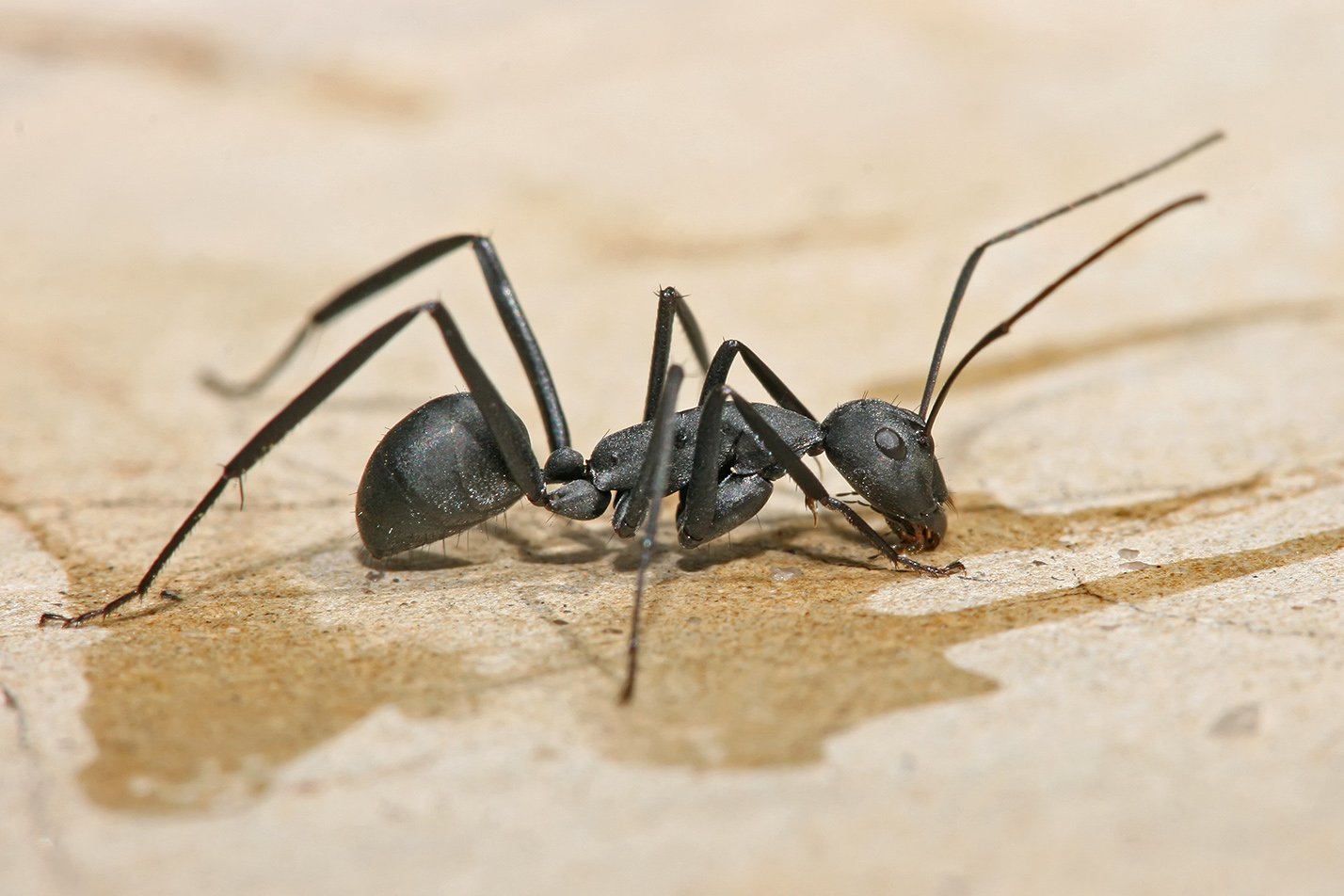
- Hollow, papery sounds from decking timber where a carpenter ant nest has formed.
- Winged ants indoors on a humid evening, which signals a mature nest nearby.
- Fine soil or sand pushed up between pavers, or in a neat cone on the lawn.
- Ants working the stems of a potted plant or a sooty film on its leaves.
If more than one of those applies, treat it as confirmed rather than possible. Disturbing the area first makes identification harder.
The rest of what we handle is set out under the full range of treatments we carry out.
Why it is worth dealing with
Ants are usually treated for amenity, but there are real costs behind them: contaminated food preparation areas, destabilised paving and pavers, electrical faults where nests occupy switchboards and appliances, and farmed aphid populations damaging a garden. Treating the colony rather than the trail is what stops those recurring.
Put plainly: the problem does not stay the same size while you decide.
How that is done in practice is covered under what the treatment involves.
What a licensed technician actually does
The work is more methodical than most people expect, and very little of it involves a spray wand. The sequence:
- Inspect and identify. Establish what it is, how far it has spread, and which conditions on site are feeding it.
- Treat the source. Apply the right method for that species - gel bait, dust, residual, baiting system or trapping - where it does the most work and the least harm.
- Allow the method to run. Baits and colony treatments work over days to weeks; re-spraying during that window undoes them.
- Close the conditions. Identify and remove what caused it, otherwise the treatment is only a reset.
The work is logged, and if covered pests return inside the warranty period we come back at no charge.
We set out the full process, timelines and warranty terms under the ant control page.
What happens on the day
There is not much mystery to it, and most of it is quicker than people expect:
- Arrival and walk-through. The technician inspects inside and out, confirms the species and shows you what they have found before anything is applied.
- Confirming the quote. You hear the fixed price and what is included before work begins. If you would rather not proceed, that is fine.
- The work itself. Allow an hour to two hours. You do not need to leave for most general work.
- Handover. A clear explanation of what happens next, so an increase in activity a few days later does not alarm you.
One thing worth knowing: with baiting and colony treatments, activity often rises briefly before it drops. That is the treatment working, not failing.
Getting ready for the treatment
Nothing elaborate, but these few things genuinely affect how well it works:
- Tell the technician what you have already applied yourself.
- Make a note of where you have seen activity and when.
- Cover or move fish tanks and turn off their air pumps.
- Arrange for pets to be out of the way for a couple of hours.
- Vacuum carpets and hard floors, then empty the vacuum outside.
Avoid washing down treated areas for at least a week, and resist adding your own spray on top.
Honest pricing
Our rates are published rather than quoted on the spot. Starting points:
| Service | From | Notes |
|---|---|---|
| General pest treatment (internal & external) | from $89 | Covers cockroaches, ants, spiders and silverfish |
| Timber pest inspection with report | from $159 | Annual check; the report is the deliverable |
| Possum removal and proofing | from $250 | One-way exclusion, then sealing the entry |
| Rodent treatment and proofing | from $150 | Baiting or trapping, plus entry-point work |
| Termite treatment or barrier | quoted on inspection | Depends on construction, soil and extent of activity |
Two things worth asking any company: is the quote fixed, and what does the warranty actually cover. Ours is fixed, and general work is covered for six months.
The method itself, product by product, is explained on our page about professional ant control.
Is it safe for children and pets?
Short answer, yes. The longer answer is about method:
- Quantities are measured to the area rather than applied until the bottle is empty.
- Where a household has asthma, allergies or a newborn, the method is adjusted on request.
- Baits, gels and dusts go into cracks, voids and secured stations - not across open surfaces.
- Fish tanks are covered and pet bowls and bedding moved before any treatment.
We would rather adjust the approach than have you worry about it afterwards, so raise it on the phone.
That is worth checking before you book anyone, including us - who actually turns up covers our licensing, insurance and how long we have been doing this.
Doing it yourself: the honest version
Retail products have a place. For one insect in a room they are fine, and nobody needs a technician for that. For an established population they tend to fail, and sometimes make things worse:
- Concentrations are lower and residual life shorter than professional-grade equivalents.
- Repellent sprays can split colonies - with ants especially - turning one nest into several.
- Spraying over bait placements makes them unpalatable and wastes the treatment.
- Retail products kill what they touch and leave the nest or harbourage producing.
So: one-off sighting, DIY. Repeat activity, damage risk, venomous species or a commercial premises, book someone licensed.
It is worth a look through the pest control services page, since what you are seeing may not be what you think it is.
Does your type of property change things?
Access decides a lot. What is straightforward in a house can be the hard part in an apartment:
- Terraces and semis. Party walls and shared subfloors let populations travel; treating one side alone rarely holds.
- New builds. Tighter sealing helps, but landscaping against the slab and construction debris are common early problems.
- Apartments and units. Shared walls, services and risers mean the source is often outside your lot - partial treatment just moves it.
- Commercial premises. Documentation, scheduling and after-hours access become part of the job.
Where a building is shared, the honest advice is often to raise it with the owners corporation rather than treat your lot repeatedly.
The approach in a unit differs enough that we cover how apartments are treated separately.
If this is a business or a strata building
For a business or an owners corporation the deliverable includes paperwork, not just a result:
- A site plan showing monitored station locations.
- Coordination across multiple lots so the population cannot simply relocate.
- Scheduled servicing rather than reactive call-outs, with visit dates set in advance.
- Treatment of common property - risers, voids, bin rooms, roof spaces - not just individual lots.
- After-hours or pre-opening access so trading is not disrupted.
Treating individual lots in a strata building without addressing common property is the most common reason these problems persist for years.
Where common property is involved, a building-wide strata program avoids the situation where each owner treats their own lot and the problem simply moves.
Questions we get asked
What will treating ants cost?
From $89 for general pest work in Sydney, and from $159 for a timber pest inspection. Termite barriers, baiting systems and commercial programs are priced after a site visit. Nothing is charged above the quoted figure without your agreement.
Should I spray the ants I can see?
Repellent sprays kill the foragers and signal danger to the colony, which can cause some species to split into several satellite nests. You end up with more trails in more places. Baiting works the opposite way: the workers carry it back and the colony goes with it.
Is an inspection really necessary?
An inspection is what tells a technician the species, the extent and the cause. Treating without it is guesswork, and guesswork is the main reason jobs get repeated. On general treatments it is built into the appointment.
How long before the treatment works?
Residual treatments start working within hours, but colony and baiting treatments are deliberately slower - the product has to be carried back to the nest. Expect a clear reduction within a week to two, and do not be alarmed if activity briefly rises first.
Can you come today?
Most bookings in Sydney are filled within 48 hours. Urgent situations are prioritised, and we will tell you honestly if yours is not urgent rather than selling you a priority visit.
What brings ants indoors?
Almost always a combination of moisture and an easy entry point. Leaks, condensation, blocked gutters and irrigation do more to attract pests than untidiness does, which is why spotless homes get them too.
How do I stop them coming back?
The treatment resets it; prevention keeps it. Sealed food storage, lidded bins, no overnight pet bowls, repaired leaks, clear gutters, and mulch and timber kept clear of the slab. Your technician will tell you which two or three actually matter for your building.
What qualifications do your technicians hold?
All of our technicians are licensed under NSW pest management requirements and insured. Pest control is licensed work in this state, so an operator who cannot produce a licence number should not be in your home.
Sydney pest control, booked today
We treat ants across 650+ suburbs of Sydney. Fixed quote up front, licensed and insured technicians, child and pet-safe application, and general treatments backed for six months.