
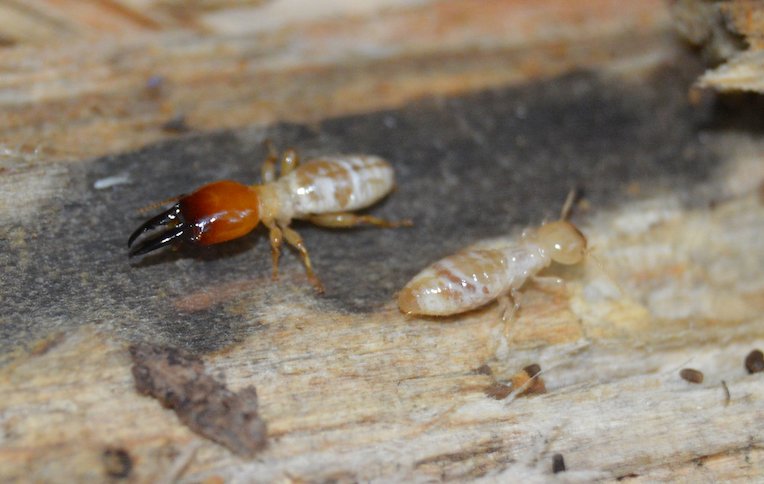
Termites damage more Australian homes each year than fire, storm and flood combined, and home insurance almost never covers it. The reliable approach is a timber pest inspection every twelve months, from $159, followed by a barrier or baiting program if activity is found. Never spray or break open a live termite trail - it scatters the colony.
- The part most people get wrong
- The early signs people miss
- How to prepare for the visit
- What this means if you have kids or animals
- When a supermarket spray is enough
- What not to do
- Setting a few things straight
- Houses, units and townhouses
- Is this urgent?
- Questions worth asking first
- The guarantee, in plain terms
- Frequently asked questions
The part most people get wrong
Almost every unsuccessful treatment starts the same way: the wrong product aimed at the wrong place. Termites are not a single problem with a single answer - the species, the entry point and the conditions around the building all change what works.
So the sequence matters: identify, locate, treat the source, then close the conditions. Skip a step and you are paying again within weeks.
Key points
- Early action is consistently cheaper than waiting for certainty.
- Ask what the warranty covers and for how long.
- Fix the conditions - moisture, food, entry points - or it returns.
- A fixed quote should come before any work starts.
We set out the full process, timelines and warranty terms under how termite control works.
The early signs people miss
The early evidence is usually subtle, and most of it is found in places nobody looks. Worth checking for:
- Floorboards that feel spongy underfoot, particularly near wet areas.
- Pencil-width mud tubes running up foundations, piers or brick walls.
- Mud packing visible in the weep holes along an external brick course.
- Paint or plaster that bubbles, ripples or cracks with no plumbing leak nearby.
- Timber that sounds hollow or papery when you tap along it with a knuckle.
Where several of these show up together, the population is established rather than passing through, and the treatment needed changes accordingly.
That is the case for booking an annual termite inspection rather than waiting for something to become obvious: it is the only stage at which the cost is small.
How to prepare for the visit
Treatments work better when the technician can reach things. Before the appointment:
- Make a note of where you have seen activity and when.
- Tell the technician what you have already applied yourself.
- Clear access to kickboards, under sinks and around appliances.
- Clear a path to the roof void or subfloor access if there is one.
- Cover or move fish tanks and turn off their air pumps.
Afterwards, hold off on mopping treated skirtings and perimeters for a week or so - washing the treatment off is the most common reason a job underperforms.
What this means if you have kids or animals
This is the most common question we get, and the answer is yes - with the important qualifier that it depends on correct application. The reasons it is safe:
- Fish tanks are covered and pet bowls and bedding moved before any treatment.
- Baits, gels and dusts go into cracks, voids and secured stations - not across open surfaces.
- You are given a specific re-entry time, usually just until treated surfaces are dry.
- Nothing is applied to food preparation surfaces or anywhere food is stored.
If anyone in the house has a specific sensitivity, tell us when you book - it changes which products we bring, not whether we can help.
Anyone you let into your home for this work should be licensed and insured, and who actually turns up sets out ours.
When a supermarket spray is enough
Retail products have a place. For one insect in a room they are fine, and nobody needs a technician for that. For an established population they tend to fail, and sometimes make things worse:
- Retail products kill what they touch and leave the nest or harbourage producing.
- Guessing the species usually means the wrong product entirely.
- Spraying over bait placements makes them unpalatable and wastes the treatment.
- Repellent sprays can split colonies - with ants especially - turning one nest into several.
So: one-off sighting, DIY. Repeat activity, damage risk, venomous species or a commercial premises, book someone licensed.
It is worth a look through the services we offer across Sydney, since what you are seeing may not be what you think it is.
What not to do
These come up often enough to be worth listing. Each one either prolongs the problem or makes it harder to treat:
- Spraying or disturbing a live termite trail, which scatters the colony and hides the problem.
- Treating visible damage as the extent of it, when the nest may be metres away.
- Letting an annual inspection lapse because nothing looked wrong.
- Assuming a previous treatment is still protecting the house years later.
If you have already done one of these, say so when you book. It changes the approach rather than causing offence.
Setting a few things straight
The received wisdom on this is unusually wrong:
- Insurance will cover it. Standard home insurance excludes termite damage. That is the main reason inspections matter.
- One treatment lasts forever. Barriers and baiting systems have a service life and need monitoring. An old treatment is not current protection.
- A spray from the hardware store will do. Surface products kill the few termites they touch and leave a colony of hundreds of thousands intact.
- A brick house cannot get termites. Almost every Sydney home has structural timber in the roof, frame or floor. Brick veneer is a skin over a timber frame.
The rest of what we handle is set out under the full range of treatments we carry out.
Houses, units and townhouses
The building matters as much as the pest. The same species is treated differently in a freestanding house, a unit and a terrace, mostly because of what a technician can reach:
- Freestanding houses. Full external access, subfloor and roof void available, so the source can usually be treated directly.
- Terraces and semis. Party walls and shared subfloors let populations travel; treating one side alone rarely holds.
- Commercial premises. Documentation, scheduling and after-hours access become part of the job.
- New builds. Tighter sealing helps, but landscaping against the slab and construction debris are common early problems.
If you are in a unit or a terrace and the problem keeps returning after treatment, the source is very likely not inside your own walls.
Units bring their own constraints - shared walls, shared plumbing, limited external access - and unit and apartment treatments is set up around them.
Is this urgent?
A fair question, and the answer is genuinely "it depends". Move quickly if:
- You have found live termite activity in or against the building.
- Numbers have visibly increased over a week or two.
- There are young children or pets with access to the affected area.
- A tenancy, sale or inspection is imminent.
Where it is not urgent, we will say so rather than selling you a priority call-out.
We cover the whole basin rather than a few postcodes - the suburbs on our run has the full list.
Questions worth asking first
Pest control is licensed work in New South Wales, and the gap between operators is wider than the price difference suggests. Before you book anyone:
- Get the quote in writing, fixed, before any work starts.
- For termite work, ask whether you receive a written timber pest report.
- Ask which method they intend to use and why that one.
- Confirm they hold current public liability insurance.
- Be wary of a price quoted over the phone without any questions about the property.
If someone will not put the quote or the warranty in writing, that is your answer.
You can see licensed and insured technicians and the qualifications behind the work.
The guarantee, in plain terms
General pest treatments from Elite Pest carry a 6-month warranty: if covered pests return inside that period, we come back and re-treat at no charge.
There are limits worth knowing rather than discovering later. The warranty covers the pests treated, not a new and different problem, and it assumes the prevention advice was followed - leaving an open food source or an unrepaired leak is outside it. Termite barriers and baiting systems carry their own separate terms, usually tied to annual monitoring.
It goes on the invoice, so there is no ambiguity about what was covered six months later.
Households that would rather not think about it tend to move to a regular residential program, which catches problems at the point they are still small.
Frequently asked questions
What do you charge for termites in Sydney?
General pest treatments start from $89 and timber pest inspections from $159. Termite treatments and barriers are quoted after an inspection because the price depends on the construction and the extent of the activity. You get a fixed figure before any work begins.
How often should I have a termite inspection?
Annually is the standard advice for Sydney, and more often for high-risk properties - those with a history of activity, a subfloor that holds moisture, or heavy planting against the walls. Termite damage is excluded from almost every home insurance policy, which is why the annual check is the cheap part.
What happens if they come back?
Yes - six months on general pest work. A recurrence of the treated pest inside that window is a free return visit. A different species arriving later is a new job, and a recurrence traced to an unfixed cause such as a leak sits outside the cover.
How quickly can you come out to Sydney?
Usually within a day or two, and same-day where there is a safety issue - a sting allergy in the household, young children with access, or live termite activity. We quote most jobs in about thirty minutes over the phone.
Are your products safe around kids and animals?
It is safe when applied correctly, which is most of what a licence is for. Baits and dusts go where children and pets do not reach, fish tanks are covered and pet bowls moved. For general treatments you do not need to leave the property.
Is DIY worth trying first?
It is worth a try for a one-off sighting and generally a waste of money beyond that. Concentrations are lower, residual life is shorter, and surface application misses the voids where the population actually lives.
What prevents a repeat?
The treatment resets it; prevention keeps it. Sealed food storage, lidded bins, no overnight pet bowls, repaired leaks, clear gutters, and mulch and timber kept clear of the slab. Your technician will tell you which two or three actually matter for your building.
When should the termites be gone?
Most households notice a difference in the first few days, with the full effect over one to three weeks depending on the method. If nothing has changed by the timeframe your technician gave you, call us - that is what the warranty is for.
Need someone to look at it?
Elite Pest & Termite Solutions covers 650+ Sydney suburbs with licensed, insured technicians, child and pet-safe methods and a 6-month warranty on general treatments. Fixed quote in about 30 minutes.