
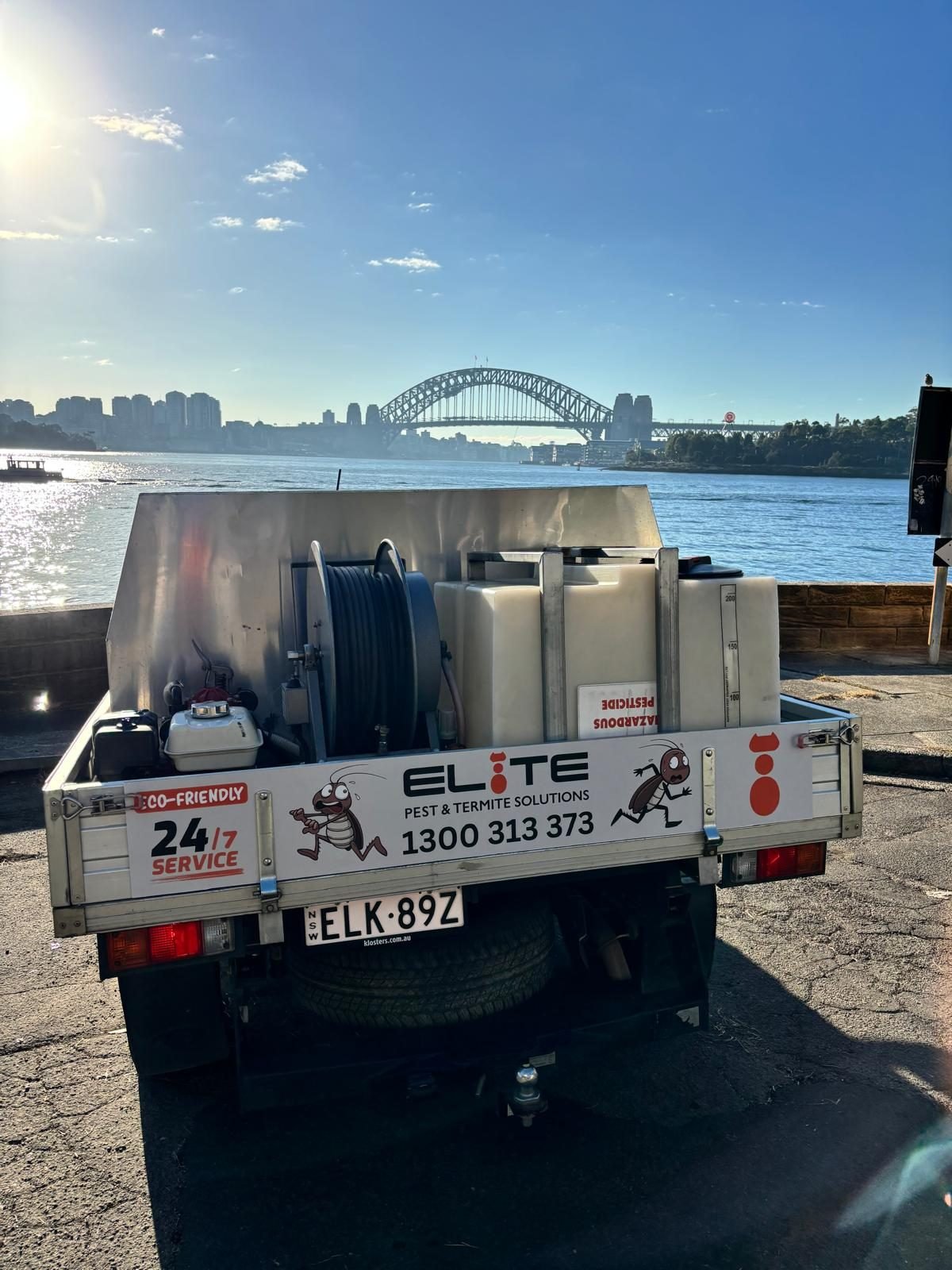
Commercial pest control is a documented, scheduled program rather than a one-off spray. For a food business it underpins your food-safety audit: monitored stations, signed service reports and a site plan an auditor can follow. Elite Pest builds programs for restaurants, offices, strata and warehouses across Sydney on monthly to six-monthly servicing.
- The part most people get wrong
- What to look for
- Timing: when this peaks
- Which method suits which situation
- What a licensed technician actually does
- What happens on the day
- What it costs in Sydney
- Commercial and common-property situations
- What counts as an emergency
- What happens if it comes back
- Prevention that actually works
- Frequently asked questions
The part most people get wrong
Almost every unsuccessful treatment starts the same way: the wrong product aimed at the wrong place. Rodents are not a single problem with a single answer - the species, the entry point and the conditions around the building all change what works.
Get that sequence right and a single treatment generally holds. Get it wrong and you are treating the same thing next month.
Key points
- Early action is consistently cheaper than waiting for certainty.
- Identify the species before treating - the right product depends on it.
- Ask what the warranty covers and for how long.
- Fix the conditions - moisture, food, entry points - or it returns.
How that is done in practice is covered under professional rodent control.
What to look for
The early evidence is usually subtle, and most of it is found in places nobody looks. Worth checking for:
- A persistent sharp ammonia smell in a pantry, roof void or under a sink.
- Greasy rub marks along a regular run between a gap and a food source.
- Gnaw marks on food packaging, skirtings, cabling or irrigation lines.
- Droppings on top of kitchen cupboards, where rats travel but people rarely look.
- A pet fixated on one point of a wall, cupboard or appliance.
One of these on its own may mean nothing. Two or more in the same area is worth a professional look, and it is better not to disturb the site before someone has seen it.
If you are not certain which pest you are dealing with, everything we treat lists what we treat and the signs that point to each.
Timing: when this peaks
The seasonal rhythm with rodents is simple: they come in when it cools. March through June is the busiest period for roof-void activity in Sydney, and a building sealed before that window is far less likely to need treatment during it. Construction and demolition nearby can override the season entirely.
Knowing where you are in that cycle explains a lot of what you are seeing, and it affects when treatment is most effective.
Which method suits which situation
There is rarely one correct method. What follows is what each approach does well and where it falls short:
| Method | Works well for | Limitations |
|---|---|---|
| Secured external bait stations | Controls pressure from outside the building | Tamper-resistant placement essential |
| Trapping in roof and voids | No toxicant inside; carcass is recovered | Needs servicing and access |
| Proofing and exclusion | The only permanent part of the job | Must come after the void is cleared |
| Rodent monitoring program | Early warning at commercial and strata sites | Ongoing service rather than one visit |
Most real jobs combine two of these rather than relying on one. If a quote only mentions a spray, it is worth asking what else is planned.
The method itself, product by product, is explained on our page about the rodent control page.
What a licensed technician actually does
The work is more methodical than most people expect, and very little of it involves a spray wand. The sequence:
- Inspect and identify. Confirm the species, locate nests and harbourage, and note the conditions sustaining them.
- Treat the source. Use the method the species responds to, placed where the population lives rather than where it was seen.
- Allow the method to run. Expect a timeline rather than an instant result, and avoid adding anything of your own in the meantime.
- Close the conditions. Proofing and maintenance advice specific to your building, which is the part that prevents a repeat.
Every Elite Pest treatment is carried out by a licensed, insured technician and general pest work carries a 6-month warranty.
We set out the full process, timelines and warranty terms under how rodent control works.
What happens on the day
So you can plan your day around it:
- Arrival and walk-through. A proper look first, including the places you have not checked, and a straight answer about what you are dealing with.
- Price confirmed. You hear the fixed price and what is included before work begins. If you would rather not proceed, that is fine.
- The work itself. Typically under an hour and a half for a standard home; longer where a roof void, subfloor or large yard is involved.
- Handover. Re-entry time, what to expect over the next fortnight, the prevention that matters for your place, and the warranty in writing.
One thing worth knowing: with baiting and colony treatments, activity often rises briefly before it drops. That is the treatment working, not failing.
What it costs in Sydney
What follows is where pricing begins. An inspection sets the final number, but this is the honest bracket:
| Service | From | Notes |
|---|---|---|
| Rodent treatment and proofing | from $150 | Baiting or trapping, plus entry-point work |
| Commercial program | quoted per site | Scheduled servicing with documented reports |
| Possum removal and proofing | from $250 | One-way exclusion, then sealing the entry |
| Flea treatment (internal) | from $160 | Preparation and vacuuming required beforehand |
| General pest treatment (internal & external) | from $89 | Covers cockroaches, ants, spiders and silverfish |
The quote is confirmed before work begins and does not change unless you ask for more work. General pest treatments carry a six-month warranty.
There is a fuller explanation of what the treatment involves, including what is and is not included.
Commercial and common-property situations
Commercial and strata work carries requirements a domestic job does not:
- Written service reports an auditor or committee can follow.
- Scheduled servicing rather than reactive call-outs, with visit dates set in advance.
- A site plan showing monitored station locations.
- Safety data sheets and licence documentation held on site.
- After-hours or pre-opening access so trading is not disrupted.
For a food business in particular, pest records are among the first things an inspector asks for - which makes the documentation as valuable as the treatment.
Businesses carrying a food-safety or compliance obligation need a documented commercial program rather than a one-off visit.
What counts as an emergency
Not everything needs a same-day visit, and it is reasonable to want to know which this is. Treat it as urgent when:
- A tenancy, sale or inspection is imminent.
- There are young children or pets with access to the affected area.
- Anyone in the household has a known allergy to stings.
- Numbers have visibly increased over a week or two.
If none of those apply, there is no need to panic - but there is also no advantage in waiting, since populations keep breeding either way.
We cover the whole basin rather than a few postcodes - the Sydney suburbs we cover has the full list.
What happens if it comes back
Our general treatments are backed for six months. That is a re-treatment guarantee rather than a refund, which is what actually helps.
What it does not cover: a different species arriving later, a re-introduction you bring in yourself, or a recurrence driven by an unaddressed cause such as a leak or a gap we flagged. Termite work is warranted separately, with terms linked to ongoing inspection.
You should receive the terms with your paperwork on the day rather than having to request them.
Most of the homes we look after are on a regular residential program rather than calling when something appears.
Prevention that actually works
Having dealt with the population, the job is to make the property less worth moving into:
- Check the roof void and subfloor seasonally, especially heading into autumn.
- Fit door brush seals and repair damaged weep-hole screens.
- Seal every gap over about 10mm at pipes, vents and roof junctions.
- Remove nesting cover such as stacked timber, pot piles and dense groundcover.
- Store food, birdseed and pet food in sealed hard containers.
A technician will tell you which of these are actually relevant to your building rather than leaving you a generic list.
Households that would rather not think about it tend to move to routine residential pest control, which catches problems at the point they are still small.
Questions we get asked
What do you charge for rodents in Sydney?
General pest treatments start from $89 and timber pest inspections from $159. Termite treatments and barriers are quoted after an inspection because the price depends on the construction and the extent of the activity. You get a fixed figure before any work begins.
Should I block the holes straight away?
Proofing is the only permanent part of rodent work, so yes - but the order matters. Seal too early and you trap animals inside. A technician will clear the void first, then advise which gaps to close and with what.
What qualifications do your technicians hold?
Licensed and insured, and happy to show either. If you are comparing quotes, ask each company for the licence number of the person actually attending rather than just the business name.
Can you just treat it without looking?
For general pest work the inspection happens as part of the visit and is not charged separately. For anything termite-related it is essential and is the deliverable in its own right, because the report determines the treatment and gives you a written record.
When should the rodents be gone?
For a general treatment you should see a drop within 24 to 72 hours. Where baiting is used it takes one to three weeks, because the aim is the colony rather than the foragers. A short increase in sightings early on means the bait is being taken.
Can you come today?
Usually within a day or two, and same-day where there is a safety issue - a sting allergy in the household, young children with access, or live termite activity. We quote most jobs in about thirty minutes over the phone.
What happens if they come back?
Yes - six months on general pest work. A recurrence of the treated pest inside that window is a free return visit. A different species arriving later is a new job, and a recurrence traced to an unfixed cause such as a leak sits outside the cover.
Will a supermarket spray work?
For a single insect, yes. For an established population, retail products usually fail because they kill what they touch and leave the nest producing. Repellent sprays can also split ant colonies, which turns one problem into several.
Get a fixed price on rodents
Elite Pest & Termite Solutions covers 650+ Sydney suburbs with licensed, insured technicians, child and pet-safe methods and a 6-month warranty on general treatments. Fixed quote in about 30 minutes.