
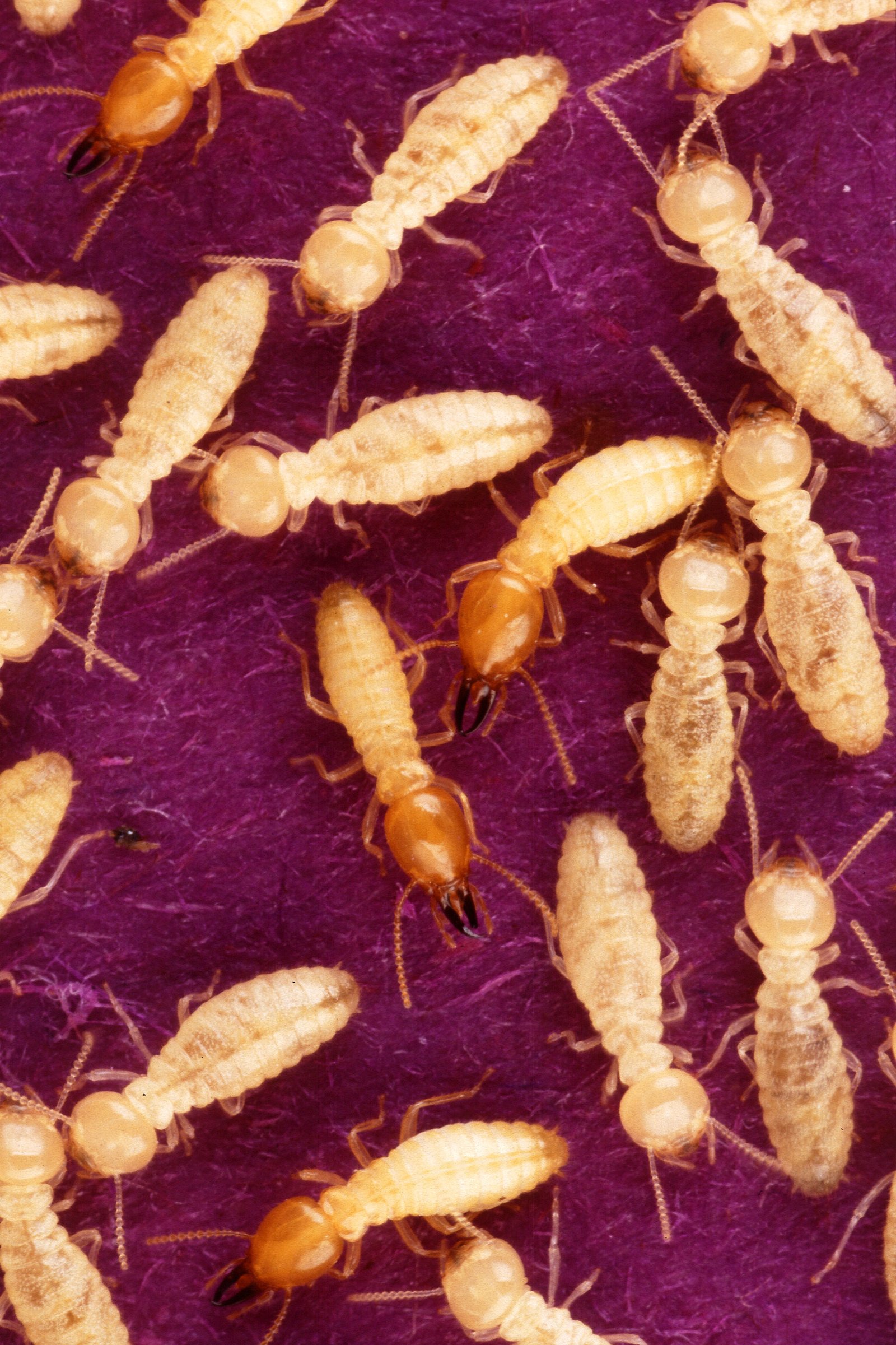
Termite control is an inspection problem before it is a treatment problem. A colony works inside timber for months before anything shows, which is why an annual inspection from $159 is the standard advice. If activity is found, a barrier or baiting system is quoted on the day. Do not disturb live workings.
- The part most people get wrong
- How to tell you have a problem
- Why it is worth dealing with
- Timing: when this peaks
- The process, step by step
- What happens on the day
- What to do before we arrive
- The safety question, answered properly
- When a supermarket spray is enough
- Is this urgent?
- How to tell a good operator from a cheap one
- Frequently asked questions
The part most people get wrong
Almost every unsuccessful treatment starts the same way: the wrong product aimed at the wrong place. Termites are not a single problem with a single answer - the species, the entry point and the conditions around the building all change what works.
So the sequence matters: identify, locate, treat the source, then close the conditions. Skip a step and you are paying again within weeks.
Key points
- Ask what the warranty covers and for how long.
- Treat the source, not the sightings: the nest or harbourage is the target.
- Identify the species before treating - the right product depends on it.
- Early action is consistently cheaper than waiting for certainty.
We set out the full process, timelines and warranty terms under how termite control works.
How to tell you have a problem
Catching this early is the difference between a routine treatment and an expensive one. These are the signs our technicians see most often in Sydney:
- Floorboards that feel spongy underfoot, particularly near wet areas.
- Small piles of discarded wings on windowsills after a warm, humid evening.
- Pencil-width mud tubes running up foundations, piers or brick walls.
- Doors and windows that start sticking without any change in the weather.
- Timber that sounds hollow or papery when you tap along it with a knuckle.
The more of these you can tick off, the longer it has been going on - which affects both the method and the price.
That is the case for booking a full timber pest report rather than waiting for something to become obvious: it is the only stage at which the cost is small.
Why it is worth dealing with
Termites do more damage to Australian homes each year than fire, storm and flood together, and standard home insurance almost never covers it. A colony works inside timber, so by the time a cornice sags or a skirting gives under your thumb the structural work has been going on for months. That is the whole argument for an annual inspection: it is the only point at which the cost is small.
That is the argument for acting on the early signs rather than waiting until there is no doubt.
A technician carrying out a timber pest inspection is looking for exactly these conditions, and documents them whether or not there is live activity.
Timing: when this peaks
Termites stay active in Sydney all year, but the warm, humid stretch from October to March is when colonies expand fastest and when alates swarm after rain. Autumn and winter are the better months for inspection work: activity is slower, so evidence sits undisturbed and a technician can read the history of a subfloor more clearly.
That pattern is why timing a treatment well can do more than increasing the dose.
The process, step by step
The work is more methodical than most people expect, and very little of it involves a spray wand. The sequence:
- Inspect and identify. Work out the species and find where the population actually sits - usually not where it was seen.
- Treat the source. Match the method to the species and place it in the harbourage rather than across open surfaces.
- Allow the method to run. Baits and colony treatments work over days to weeks; re-spraying during that window undoes them.
- Close the conditions. Identify and remove what caused it, otherwise the treatment is only a reset.
All of that is done by a licensed and insured technician, with general treatments backed for six months.
If you want to see how the treatment is actually carried out, professional termite control walks through each stage.
What happens on the day
For a typical residential job, the appointment looks like this:
- Arrival and walk-through. Ten to twenty minutes looking - inside, outside, roof void or subfloor if relevant - then a plain explanation of what is going on.
- Price confirmed. No work starts until you have agreed the price and know what it covers.
- Application. Allow an hour to two hours. You do not need to leave for most general work.
- Before we leave. A clear explanation of what happens next, so an increase in activity a few days later does not alarm you.
If activity seems worse for a few days, that is normal for colony work - call us if it has not changed within the timeframe you were given.
What to do before we arrive
A little preparation makes a measurable difference to the result, and none of it takes long:
- Make a note of where you have seen activity and when.
- Vacuum carpets and hard floors, then empty the vacuum outside.
- Arrange for pets to be out of the way for a couple of hours.
- Clear access to kickboards, under sinks and around appliances.
- Put food, utensils and pet bowls away or in sealed containers.
Afterwards, hold off on mopping treated skirtings and perimeters for a week or so - washing the treatment off is the most common reason a job underperforms.
The safety question, answered properly
Fair question, and worth more than a one-word answer. Professional treatment is safe around families and pets because of how it is applied, not because the products are inert:
- Baits, gels and dusts go into cracks, voids and secured stations - not across open surfaces.
- Where a household has asthma, allergies or a newborn, the method is adjusted on request.
- Fish tanks are covered and pet bowls and bedding moved before any treatment.
- Quantities are measured to the area rather than applied until the bottle is empty.
If anyone in the house has a specific sensitivity, tell us when you book - it changes which products we bring, not whether we can help.
Anyone you let into your home for this work should be licensed and insured, and licensed and insured technicians sets out ours.
When a supermarket spray is enough
This is worth being straight about, because DIY is not always the wrong answer. It is the wrong answer once a population is established, for reasons that are fairly mechanical:
- Concentrations are lower and residual life shorter than professional-grade equivalents.
- Retail products kill what they touch and leave the nest or harbourage producing.
- Without identification there is no way to know whether it is working or just scattering.
- Spraying over bait placements makes them unpalatable and wastes the treatment.
If you have already tried something and it returned, that is the signal rather than a reason to try again harder.
If you are not certain which pest you are dealing with, the pest control services page lists what we treat and the signs that point to each.
Is this urgent?
Some of this can wait a fortnight. Some of it cannot. The dividing line:
- Anyone in the household has a known allergy to stings.
- Numbers have visibly increased over a week or two.
- There are young children or pets with access to the affected area.
- There is damage to structural timber, cabling or insulation.
If none of those apply, there is no need to panic - but there is also no advantage in waiting, since populations keep breeding either way.
We cover the whole basin rather than a few postcodes - the suburbs on our run has the full list.
How to tell a good operator from a cheap one
The cheapest quote is often the one that gets repeated. Things worth confirming:
- For termite work, ask whether you receive a written timber pest report.
- Ask for the technician's NSW pest management licence number, not just the company name.
- Ask what the warranty covers, what voids it, and how long it runs.
- Ask which method they intend to use and why that one.
- Check whether a follow-up visit is included or charged separately.
A good operator will answer all of those without hesitation. Hesitation on any of them is useful information.
You can see about the team and the qualifications behind the work.
Common questions
What will treating termites cost?
From $89 for general pest work in Sydney, and from $159 for a timber pest inspection. Termite barriers, baiting systems and commercial programs are priced after a site visit. Nothing is charged above the quoted figure without your agreement.
How often do termite inspections need doing?
Every twelve months, and that is the minimum rather than a precaution. A colony can work inside timber for months without any visible sign, and insurance will not cover the repair, so the inspection is the only point at which this is inexpensive.
I am renting - whose responsibility is this?
In a tenancy it usually depends on whether the problem existed at the start of the lease and on the terms of the agreement - raise it with the agent in writing either way. In a strata building, anything in common property such as risers, voids and bin rooms is the owners corporation's responsibility.
Do we need to leave the house during treatment?
It is safe when applied correctly, which is most of what a licence is for. Baits and dusts go where children and pets do not reach, fish tanks are covered and pet bowls moved. For general treatments you do not need to leave the property.
When should the termites be gone?
Most households notice a difference in the first few days, with the full effect over one to three weeks depending on the method. If nothing has changed by the timeframe your technician gave you, call us - that is what the warranty is for.
What attracts termites to a house?
Food, water and shelter, in roughly that order. In most Sydney homes it comes down to accessible food or bins, a moisture source such as a leak or blocked gutter, and a gap big enough to get through. Remove any one of the three and the property gets much less attractive.
What prevents a repeat?
The treatment resets it; prevention keeps it. Sealed food storage, lidded bins, no overnight pet bowls, repaired leaks, clear gutters, and mulch and timber kept clear of the slab. Your technician will tell you which two or three actually matter for your building.
What qualifications do your technicians hold?
Yes - every technician holds a current NSW pest management licence and we carry public liability insurance. You are entitled to ask any operator for both, and it is worth doing. Ours are available on request.
Want this sorted properly?
We treat termites across 650+ suburbs of Sydney. Fixed quote up front, licensed and insured technicians, child and pet-safe application, and general treatments backed for six months.