
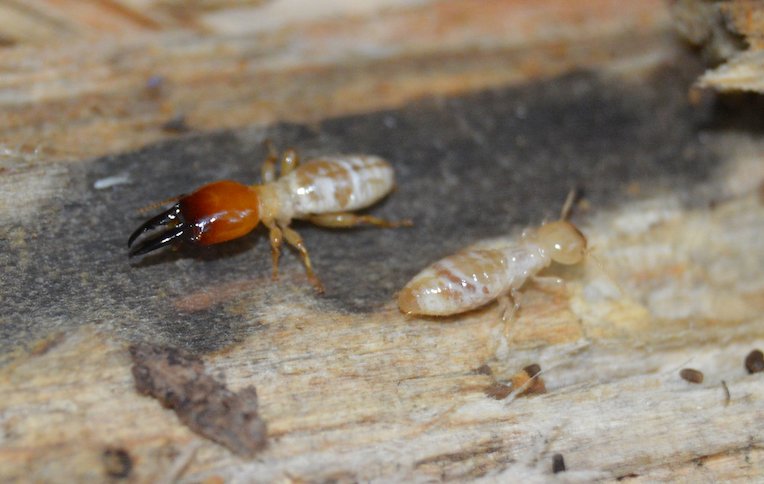
Termites damage more Australian homes each year than fire, storm and flood combined, and home insurance almost never covers it. The reliable approach is a timber pest inspection every twelve months, from $159, followed by a barrier or baiting program if activity is found. Never spray or break open a live termite trail - it scatters the colony.
- Start by working out what you have
- How to tell you have a problem
- What is attracting them
- Why it is worth dealing with
- Treatment options compared
- What you are paying for
- The visit itself
- What it costs in Sydney
- What not to do
- If this is a business or a strata building
- How to tell a good operator from a cheap one
- Frequently asked questions
Start by working out what you have
Almost every unsuccessful treatment starts the same way: the wrong product aimed at the wrong place. Termites are not a single problem with a single answer - the species, the entry point and the conditions around the building all change what works.
A licensed technician works through that in order, which is why the first part of a visit is looking rather than spraying.
Key points
- A fixed quote should come before any work starts.
- Ask what the warranty covers and for how long.
- Identify the species before treating - the right product depends on it.
- Early action is consistently cheaper than waiting for certainty.
We set out the full process, timelines and warranty terms under the termite control page.
How to tell you have a problem
Before numbers become obvious there is almost always a quieter stage. What to look for:
- Pencil-width mud tubes running up foundations, piers or brick walls.
- Small piles of discarded wings on windowsills after a warm, humid evening.
- Thin mud veneer filling cracks in skirtings, architraves or door frames.
- Floorboards that feel spongy underfoot, particularly near wet areas.
- Doors and windows that start sticking without any change in the weather.
One of these on its own may mean nothing. Two or more in the same area is worth a professional look, and it is better not to disturb the site before someone has seen it.
A technician carrying out a timber pest inspection is looking for exactly these conditions, and documents them whether or not there is live activity.
What is attracting them
Treatment deals with the population; this list is what decides whether it comes back. The usual contributors:
- Dense planting and irrigation holding damp soil hard against the brickwork.
- Stored timber, firewood or offcuts stacked against an external wall.
- An untreated or breached physical barrier on an older Sydney build.
- Air vents to the subfloor blocked by a deck, paving or landscaping.
- Subfloor moisture from a leaking pipe, a failed shower base or poor drainage.
None of that requires a trade - it is mostly maintenance - but it is the part that determines whether you call us again.
Why it is worth dealing with
Termites do more damage to Australian homes each year than fire, storm and flood together, and standard home insurance almost never covers it. A colony works inside timber, so by the time a cornice sags or a skirting gives under your thumb the structural work has been going on for months. That is the whole argument for an annual inspection: it is the only point at which the cost is small.
None of that is scaremongering - it is simply the reason the price goes up the longer it is left.
Because the early signs are so easy to miss, a full timber pest report every twelve months is the standard advice for Sydney homes.
Treatment options compared
A technician chooses between these based on the species, the building and how established the population is:
| Method | Works well for | Limitations |
|---|---|---|
| Annual timber pest inspection | Finds activity while it is still cheap | Detection, not treatment |
| Dusting active workings | Fast knock-down on a found trail | A first step, not a complete solution |
| Above-ground baiting | Targets active workings directly | Only where live activity is accessible |
| Chemical soil barrier | Full perimeter protection, long service life | Needs trenching or drilling; priced after inspection |
Ask which of these is being proposed and why. A technician who cannot answer that is guessing.
How that is done in practice is covered under professional termite control.
What you are paying for
A licensed technician follows a repeatable process rather than blanket-spraying a property. In order:
- Inspect and identify. Establish what it is, how far it has spread, and which conditions on site are feeding it.
- Treat the source. Match the method to the species and place it in the harbourage rather than across open surfaces.
- Allow the method to run. Colony treatments take time by design. The technician will say how long before you should expect a change.
- Close the conditions. Proofing and maintenance advice specific to your building, which is the part that prevents a repeat.
All of that is done by a licensed and insured technician, with general treatments backed for six months.
There is a fuller explanation of how termite control works, including what is and is not included.
The visit itself
There is not much mystery to it, and most of it is quicker than people expect:
- First look. The technician inspects inside and out, confirms the species and shows you what they have found before anything is applied.
- Confirming the quote. You hear the fixed price and what is included before work begins. If you would rather not proceed, that is fine.
- Application. Most general treatments take 45 to 90 minutes depending on the property size and how much access is involved.
- Before we leave. You get the timeline, the aftercare, the specific fixes for your property and your paperwork.
Expect a short increase in sightings after a bait treatment. It means the bait is being carried, which is the point.
What it costs in Sydney
What follows is where pricing begins. An inspection sets the final number, but this is the honest bracket:
| Service | From | Notes |
|---|---|---|
| Timber pest inspection with report | from $159 | Annual check; the report is the deliverable |
| Termite treatment or barrier | quoted on inspection | Depends on construction, soil and extent of activity |
| Flea treatment (internal) | from $160 | Preparation and vacuuming required beforehand |
| Commercial program | quoted per site | Scheduled servicing with documented reports |
| Possum removal and proofing | from $250 | One-way exclusion, then sealing the entry |
The quote is confirmed before work begins and does not change unless you ask for more work. General pest treatments carry a six-month warranty.
The method itself, product by product, is explained on our page about termite control.
What not to do
Most of the difficult jobs we attend were straightforward a few weeks earlier. The usual reasons:
- Treating visible damage as the extent of it, when the nest may be metres away.
- Spraying or disturbing a live termite trail, which scatters the colony and hides the problem.
- Assuming a previous treatment is still protecting the house years later.
- Letting an annual inspection lapse because nothing looked wrong.
None of these are unrecoverable - but tell the technician what has already been tried, because it affects what will work now.
If this is a business or a strata building
Once more than one occupier is involved, the job changes shape. The treatment may be similar; everything around it is not:
- Safety data sheets and licence documentation held on site.
- A site plan showing monitored station locations.
- Coordination across multiple lots so the population cannot simply relocate.
- After-hours or pre-opening access so trading is not disrupted.
- Scheduled servicing rather than reactive call-outs, with visit dates set in advance.
At an audit the question is rarely whether you have pests; it is whether you can show a managed program. That is what the reporting is for.
Where common property is involved, strata pest control avoids the situation where each owner treats their own lot and the problem simply moves.
How to tell a good operator from a cheap one
A short list of checks that filters out most of the problems:
- Ask for the technician's NSW pest management licence number, not just the company name.
- Check whether a follow-up visit is included or charged separately.
- Confirm they hold current public liability insurance.
- Be wary of a price quoted over the phone without any questions about the property.
- Ask which method they intend to use and why that one.
None of those questions are unreasonable, and the answers tend to sort operators quickly.
You can see who actually turns up and the qualifications behind the work.
Common questions
What do you charge for termites in Sydney?
Starting prices are $89 for a general treatment and $159 for an inspection with a written report. Anything larger is quoted on inspection rather than over the phone. The quote is fixed, so the invoice matches what you were told.
How often do termite inspections need doing?
Annually is the standard advice for Sydney, and more often for high-risk properties - those with a history of activity, a subfloor that holds moisture, or heavy planting against the walls. Termite damage is excluded from almost every home insurance policy, which is why the annual check is the cheap part.
Are your technicians licensed and insured?
All of our technicians are licensed under NSW pest management requirements and insured. Pest control is licensed work in this state, so an operator who cannot produce a licence number should not be in your home.
How quickly will I see a difference?
For a general treatment you should see a drop within 24 to 72 hours. Where baiting is used it takes one to three weeks, because the aim is the colony rather than the foragers. A short increase in sightings early on means the bait is being taken.
Is DIY worth trying first?
If you have treated it once and it came back, that is the signal to call someone rather than to try again. Tell the technician what you have already applied - it affects which products can be used next.
Can you come today?
Most bookings in Sydney are filled within 48 hours. Urgent situations are prioritised, and we will tell you honestly if yours is not urgent rather than selling you a priority visit.
What brings termites indoors?
Usually something fixable: an unsealed food source, standing water, mulch or timber against the wall, or a gap at a weep hole or pipe penetration. A technician will point out which apply to your property.
Do you offer a warranty?
General pest treatments carry a 6-month warranty. If covered pests return within that period we re-treat at no charge. The terms go on your invoice, so there is no ambiguity about what was covered.
Sydney pest control, booked today
We treat termites across 650+ suburbs of Sydney. Fixed quote up front, licensed and insured technicians, child and pet-safe application, and general treatments backed for six months.