
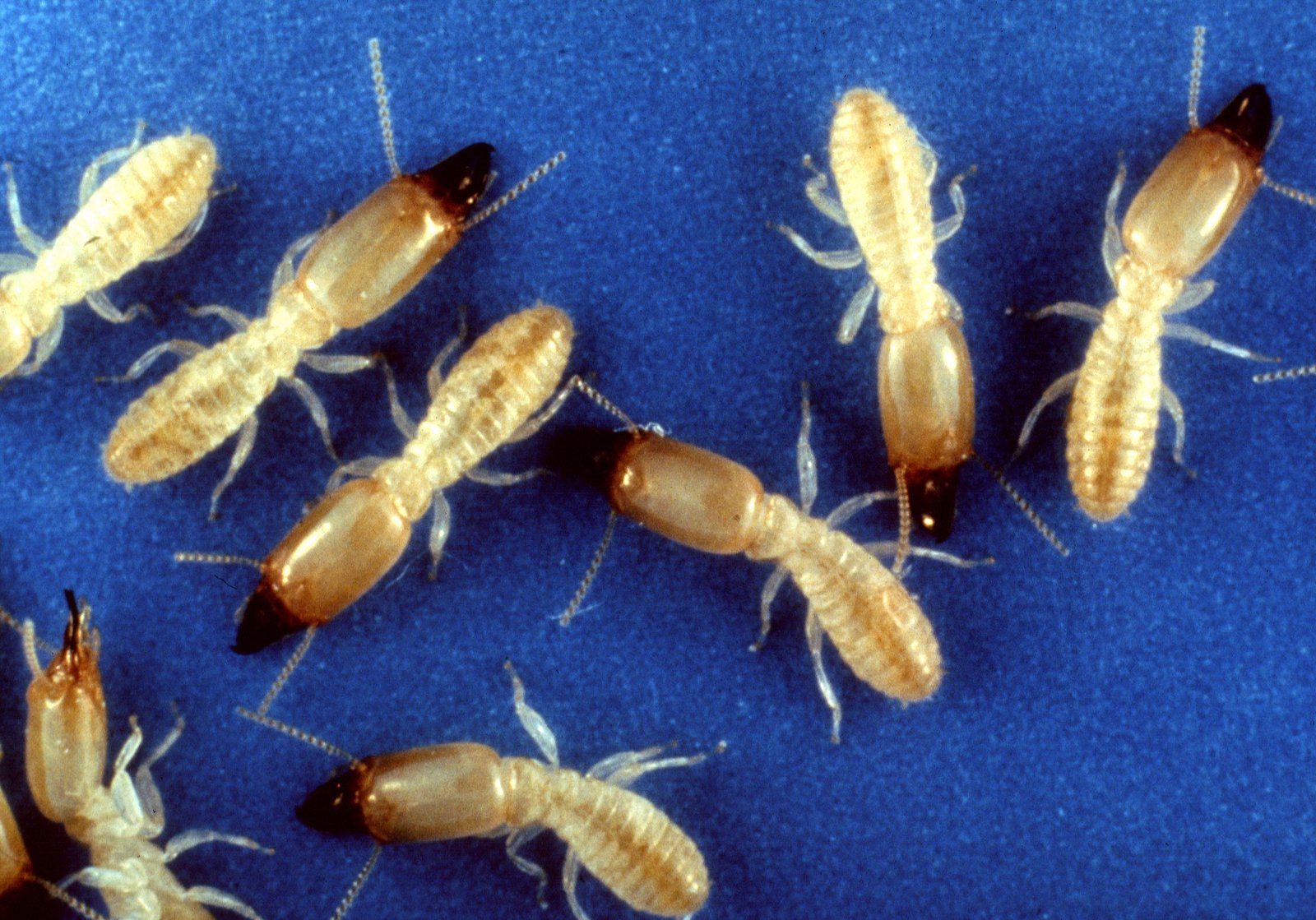
Termite control is an inspection problem before it is a treatment problem. A colony works inside timber for months before anything shows, which is why an annual inspection from $159 is the standard advice. If activity is found, a barrier or baiting system is quoted on the day. Do not disturb live workings.
- What you are actually dealing with
- The early signs people miss
- Treatment options compared
- What you are paying for
- What happens on the day
- Common missteps
- Businesses, strata and shared buildings
- How quickly do you need to act?
- How to tell a good operator from a cheap one
- The guarantee, in plain terms
- Stopping it coming back
- Frequently asked questions
What you are actually dealing with
Almost every unsuccessful treatment starts the same way: the wrong product aimed at the wrong place. Termites are not a single problem with a single answer - the species, the entry point and the conditions around the building all change what works.
So the sequence matters: identify, locate, treat the source, then close the conditions. Skip a step and you are paying again within weeks.
Key points
- Treat the source, not the sightings: the nest or harbourage is the target.
- A fixed quote should come before any work starts.
- Identify the species before treating - the right product depends on it.
- Early action is consistently cheaper than waiting for certainty.
There is a fuller explanation of how termite control works, including what is and is not included.
The early signs people miss
Catching this early is the difference between a routine treatment and an expensive one. These are the signs our technicians see most often in Sydney:
- Small piles of discarded wings on windowsills after a warm, humid evening.
- Pencil-width mud tubes running up foundations, piers or brick walls.
- Timber that sounds hollow or papery when you tap along it with a knuckle.
- A faint musty, earthy smell in a closed room or subfloor.
- Floorboards that feel spongy underfoot, particularly near wet areas.
The more of these you can tick off, the longer it has been going on - which affects both the method and the price.
A technician carrying out an annual termite inspection is looking for exactly these conditions, and documents them whether or not there is live activity.
Treatment options compared
The honest trade-offs:
| Method | Works well for | Limitations |
|---|---|---|
| Dusting active workings | Fast knock-down on a found trail | A first step, not a complete solution |
| Annual timber pest inspection | Finds activity while it is still cheap | Detection, not treatment |
| Chemical soil barrier | Full perimeter protection, long service life | Needs trenching or drilling; priced after inspection |
| In-ground baiting system | Eliminates the colony, low disruption | Works over weeks to months; needs monitoring |
Most real jobs combine two of these rather than relying on one. If a quote only mentions a spray, it is worth asking what else is planned.
We set out the full process, timelines and warranty terms under professional termite control.
What you are paying for
What distinguishes professional treatment is sequencing, not chemistry. It runs like this:
- Inspect and identify. Confirm the species, locate nests and harbourage, and note the conditions sustaining them.
- Treat the source. Match the method to the species and place it in the harbourage rather than across open surfaces.
- Allow the method to run. Colony treatments take time by design. The technician will say how long before you should expect a change.
- Close the conditions. Proofing and maintenance advice specific to your building, which is the part that prevents a repeat.
All of that is done by a licensed and insured technician, with general treatments backed for six months.
If you want to see how the treatment is actually carried out, what the treatment involves walks through each stage.
What happens on the day
So you can plan your day around it:
- Inspection on arrival. A proper look first, including the places you have not checked, and a straight answer about what you are dealing with.
- Agreeing the work. The figure is confirmed against what was actually found, and you decide from there.
- Treatment. Typically under an hour and a half for a standard home; longer where a roof void, subfloor or large yard is involved.
- Before we leave. You get the timeline, the aftercare, the specific fixes for your property and your paperwork.
If activity seems worse for a few days, that is normal for colony work - call us if it has not changed within the timeframe you were given.
Common missteps
Most of the difficult jobs we attend were straightforward a few weeks earlier. The usual reasons:
- Letting an annual inspection lapse because nothing looked wrong.
- Spraying or disturbing a live termite trail, which scatters the colony and hides the problem.
- Assuming a previous treatment is still protecting the house years later.
- Relying on a hardware store product against a colony of hundreds of thousands.
None of these are unrecoverable - but tell the technician what has already been tried, because it affects what will work now.
Businesses, strata and shared buildings
For a business or an owners corporation the deliverable includes paperwork, not just a result:
- After-hours or pre-opening access so trading is not disrupted.
- A site plan showing monitored station locations.
- Scheduled servicing rather than reactive call-outs, with visit dates set in advance.
- Treatment of common property - risers, voids, bin rooms, roof spaces - not just individual lots.
- Food-safety alignment for kitchens, cafes and childcare premises.
At an audit the question is rarely whether you have pests; it is whether you can show a managed program. That is what the reporting is for.
For owners corporations, strata and common-property work deals with the risers, voids and common areas individual treatments cannot reach.
How quickly do you need to act?
Some of this can wait a fortnight. Some of it cannot. The dividing line:
- You have found live termite activity in or against the building.
- Anyone in the household has a known allergy to stings.
- Numbers have visibly increased over a week or two.
- There is damage to structural timber, cabling or insulation.
If none of those apply, there is no need to panic - but there is also no advantage in waiting, since populations keep breeding either way.
If your suburb is not mentioned above, the Sydney suburbs we cover will confirm whether we are out that way.
How to tell a good operator from a cheap one
This is a licensed trade, so there are specific things you are entitled to ask:
- Ask which method they intend to use and why that one.
- For termite work, ask whether you receive a written timber pest report.
- Confirm they hold current public liability insurance.
- Ask for the technician's NSW pest management licence number, not just the company name.
- Get the quote in writing, fixed, before any work starts.
None of those questions are unreasonable, and the answers tend to sort operators quickly.
That is worth checking before you book anyone, including us - about the team covers our licensing, insurance and how long we have been doing this.
The guarantee, in plain terms
Our general treatments are backed for six months. That is a re-treatment guarantee rather than a refund, which is what actually helps.
What it does not cover: a different species arriving later, a re-introduction you bring in yourself, or a recurrence driven by an unaddressed cause such as a leak or a gap we flagged. Termite work is warranted separately, with terms linked to ongoing inspection.
You should receive the terms with your paperwork on the day rather than having to request them.
Most of the homes we look after are on a regular residential program rather than calling when something appears.
Stopping it coming back
The treatment buys you a clean slate. These keep it:
- Direct downpipes and surface water well away from the footings.
- Keep subfloor vents clear so air moves under the building.
- Store firewood and timber off the ground and away from the house.
- Book a timber pest inspection every twelve months, or annually with a report.
- Grind out or remove stumps rather than leaving them in the ground.
A technician will tell you which of these are actually relevant to your building rather than leaving you a generic list.
If this is the second or third time you have dealt with it, an ongoing residential service costs less over a year than repeated call-outs.
Common questions
How much does it cost to get rid of termites in Sydney?
Starting prices are $89 for a general treatment and $159 for an inspection with a written report. Anything larger is quoted on inspection rather than over the phone. The quote is fixed, so the invoice matches what you were told.
How often should I have a termite inspection?
Every twelve months, and that is the minimum rather than a precaution. A colony can work inside timber for months without any visible sign, and insurance will not cover the repair, so the inspection is the only point at which this is inexpensive.
Can you come today?
We cover Sydney regularly, so availability is normally a day or two out. Call 1300 313 373 and we will give you the next slot and a fixed price at the same time.
Is an inspection really necessary?
Yes, at least briefly. We would rather spend fifteen minutes finding the source than apply the wrong product well. For timber pests the inspection is the job, and you receive a written report.
What if the problem is coming from next door?
If the source is common property, it is a building-level job rather than yours. We are happy to provide a written report for an agent or owners corporation setting out where the activity is and what it will take to resolve.
What happens if they come back?
Yes - six months on general pest work. A recurrence of the treated pest inside that window is a free return visit. A different species arriving later is a new job, and a recurrence traced to an unfixed cause such as a leak sits outside the cover.
Is DIY worth trying first?
It is worth a try for a one-off sighting and generally a waste of money beyond that. Concentrations are lower, residual life is shorter, and surface application misses the voids where the population actually lives.
What qualifications do your technicians hold?
Yes - every technician holds a current NSW pest management licence and we carry public liability insurance. You are entitled to ask any operator for both, and it is worth doing. Ours are available on request.
Want this sorted properly?
One call gets you a fixed price, usually inside 30 minutes. Licensed technicians, 650+ Sydney suburbs covered, child and pet-safe treatments, and a 6-month warranty on general work.