
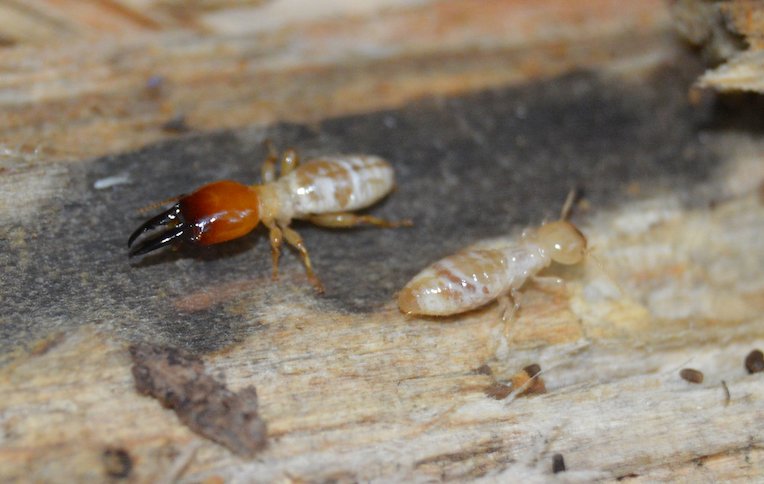
Termites damage more Australian homes each year than fire, storm and flood combined, and home insurance almost never covers it. The reliable approach is a timber pest inspection every twelve months, from $159, followed by a barrier or baiting program if activity is found. Never spray or break open a live termite trail - it scatters the colony.
- Before you treat anything
- How to tell you have a problem
- The conditions behind it
- When termites are worst in Sydney
- The process, step by step
- The visit itself
- Honest pricing
- DIY or call someone?
- Why the same problem is treated differently next door
- When it is not a single home
- Timing: today, this week, or whenever
- Frequently asked questions
Before you treat anything
It helps to separate two things: what is making you call someone, and what is causing it. The visible termites are the first; the moisture, the gap or the food source behind them is the second, and only the second decides whether the result holds.
That is why an inspection comes before any product. It establishes the species, how far the population has spread, and which conditions on the property are sustaining it.
Key points
- Identify the species before treating - the right product depends on it.
- Fix the conditions - moisture, food, entry points - or it returns.
- A fixed quote should come before any work starts.
- Early action is consistently cheaper than waiting for certainty.
We set out the full process, timelines and warranty terms under how termite control works.
How to tell you have a problem
Before numbers become obvious there is almost always a quieter stage. What to look for:
- Small piles of discarded wings on windowsills after a warm, humid evening.
- Floorboards that feel spongy underfoot, particularly near wet areas.
- Sagging or blistered cornices where a nest has worked up inside a wall.
- Pencil-width mud tubes running up foundations, piers or brick walls.
- Mud packing visible in the weep holes along an external brick course.
Where several of these show up together, the population is established rather than passing through, and the treatment needed changes accordingly.
That is the case for booking an annual termite inspection rather than waiting for something to become obvious: it is the only stage at which the cost is small.
The conditions behind it
Treatment deals with the population; this list is what decides whether it comes back. The usual contributors:
- Air vents to the subfloor blocked by a deck, paving or landscaping.
- A hot-water overflow or air-conditioning condensate discharging beside the footing.
- Dense planting and irrigation holding damp soil hard against the brickwork.
- Stored timber, firewood or offcuts stacked against an external wall.
- Subfloor moisture from a leaking pipe, a failed shower base or poor drainage.
None of that requires a trade - it is mostly maintenance - but it is the part that determines whether you call us again.
When termites are worst in Sydney
Termites stay active in Sydney all year, but the warm, humid stretch from October to March is when colonies expand fastest and when alates swarm after rain. Autumn and winter are the better months for inspection work: activity is slower, so evidence sits undisturbed and a technician can read the history of a subfloor more clearly.
None of it changes the method much, but it does change how urgent the booking is.
The process, step by step
There is a defined process behind it, and knowing it makes the invoice easier to read:
- Inspect and identify. Work out the species and find where the population actually sits - usually not where it was seen.
- Treat the source. Apply the right method for that species - gel bait, dust, residual, baiting system or trapping - where it does the most work and the least harm.
- Allow the method to run. Colony treatments take time by design. The technician will say how long before you should expect a change.
- Close the conditions. Proofing and maintenance advice specific to your building, which is the part that prevents a repeat.
All of that is done by a licensed and insured technician, with general treatments backed for six months.
How that is done in practice is covered under the termite control page.
The visit itself
For a typical residential job, the appointment looks like this:
- Arrival and walk-through. A proper look first, including the places you have not checked, and a straight answer about what you are dealing with.
- Agreeing the work. The figure is confirmed against what was actually found, and you decide from there.
- Application. Allow an hour to two hours. You do not need to leave for most general work.
- Handover. Re-entry time, what to expect over the next fortnight, the prevention that matters for your place, and the warranty in writing.
One thing worth knowing: with baiting and colony treatments, activity often rises briefly before it drops. That is the treatment working, not failing.
Honest pricing
What follows is where pricing begins. An inspection sets the final number, but this is the honest bracket:
| Service | From | Notes |
|---|---|---|
| Timber pest inspection with report | from $159 | Annual check; the report is the deliverable |
| Termite treatment or barrier | quoted on inspection | Depends on construction, soil and extent of activity |
| Possum removal and proofing | from $250 | One-way exclusion, then sealing the entry |
| Flea treatment (internal) | from $160 | Preparation and vacuuming required beforehand |
| Rodent treatment and proofing | from $150 | Baiting or trapping, plus entry-point work |
Nothing is charged beyond the quoted figure. Where a job turns out to need more than expected, you are told before it is done, not after.
The method itself, product by product, is explained on our page about what the treatment involves.
DIY or call someone?
Retail products have a place. For one insect in a room they are fine, and nobody needs a technician for that. For an established population they tend to fail, and sometimes make things worse:
- Surface application misses the voids and cracks where the population actually lives.
- Retail products kill what they touch and leave the nest or harbourage producing.
- Spraying over bait placements makes them unpalatable and wastes the treatment.
- Concentrations are lower and residual life shorter than professional-grade equivalents.
If you have already tried something and it returned, that is the signal rather than a reason to try again harder.
It is worth a look through everything we treat, since what you are seeing may not be what you think it is.
Why the same problem is treated differently next door
Access decides a lot. What is straightforward in a house can be the hard part in an apartment:
- Older Sydney housing. Deeper gaps, timber framing and subfloor moisture raise both termite and rodent exposure.
- Townhouses. Common walls plus private courtyards, so internal and external work both matter.
- Apartments and units. Shared walls, services and risers mean the source is often outside your lot - partial treatment just moves it.
- Freestanding houses. Full external access, subfloor and roof void available, so the source can usually be treated directly.
Where a building is shared, the honest advice is often to raise it with the owners corporation rather than treat your lot repeatedly.
The approach in a unit differs enough that we cover apartment pest control separately.
When it is not a single home
Commercial and strata work carries requirements a domestic job does not:
- Written service reports an auditor or committee can follow.
- Food-safety alignment for kitchens, cafes and childcare premises.
- Coordination across multiple lots so the population cannot simply relocate.
- A site plan showing monitored station locations.
- Treatment of common property - risers, voids, bin rooms, roof spaces - not just individual lots.
At an audit the question is rarely whether you have pests; it is whether you can show a managed program. That is what the reporting is for.
In a commercial kitchen the same problem becomes a compliance issue, and food-premises pest programs covers the servicing and records involved.
Timing: today, this week, or whenever
Some of this can wait a fortnight. Some of it cannot. The dividing line:
- There are young children or pets with access to the affected area.
- It is a food business, childcare centre, medical premises or aged care.
- Anyone in the household has a known allergy to stings.
- A tenancy, sale or inspection is imminent.
Where it is not urgent, we will say so rather than selling you a priority call-out.
If your suburb is not mentioned above, the Sydney suburbs we cover will confirm whether we are out that way.
Questions we get asked
What do you charge for termites in Sydney?
Starting prices are $89 for a general treatment and $159 for an inspection with a written report. Anything larger is quoted on inspection rather than over the phone. The quote is fixed, so the invoice matches what you were told.
How often do termite inspections need doing?
Annually is the standard advice for Sydney, and more often for high-risk properties - those with a history of activity, a subfloor that holds moisture, or heavy planting against the walls. Termite damage is excluded from almost every home insurance policy, which is why the annual check is the cheap part.
Do I need an inspection first?
For general pest work the inspection happens as part of the visit and is not charged separately. For anything termite-related it is essential and is the deliverable in its own right, because the report determines the treatment and gives you a written record.
Do we need to leave the house during treatment?
Yes. We use APVMA-registered, low-toxicity products applied at label rates, and most of what goes down is placed in cracks, voids and secured stations rather than on open surfaces. You are given a specific re-entry time, usually just until treated surfaces are dry.
What prevents a repeat?
Maintenance rather than pest control: fix the water, close the gaps, cut the food supply and reduce clutter where things can shelter. Households that would rather not think about it move onto a regular program instead.
How quickly will I see a difference?
Most households notice a difference in the first few days, with the full effect over one to three weeks depending on the method. If nothing has changed by the timeframe your technician gave you, call us - that is what the warranty is for.
What qualifications do your technicians hold?
Licensed and insured, and happy to show either. If you are comparing quotes, ask each company for the licence number of the person actually attending rather than just the business name.
Is there a guarantee on the work?
General pest treatments carry a 6-month warranty. If covered pests return within that period we re-treat at no charge. The terms go on your invoice, so there is no ambiguity about what was covered.
Want this sorted properly?
Licensed, insured and working across 650+ Sydney suburbs. You get a fixed price before anything starts, a 6-month warranty on general pest work, and a technician who explains what they found.