Budding splits the colony
Where a species has many queens, a repellent spray causes budding rather than death. Part of the colony, queen included, moves elsewhere, and you have doubled the problem.

Ant Control in Hinchinbrook 2168 — local technicians, fixed prices and a written report. Ant treatment starts from $89.
Real, verified feedback from people we've helped — straight from Google.
Local technicians, fixed prices and a written report for every job in Hinchinbrook.
If you are in Hinchinbrook or anywhere else in 2168, you are in our South West Sydney patch, 32.3 km west of the CBD. We cover Hinchinbrook on scheduled runs through the South West Sydney, and we will give you a firm time rather than a window.
The Hinchinbrook addresses we attend cluster around Elouera Bushland Reserve and Valley Plaza Shopping Centre. Green Valley Village Shopping Centre is another part of the suburb we are called to often.
Under Liverpool, Fairfield and Cumberland, we cover Hinchinbrook and Green Valley, Miller and Busby alike. Estate blocks are compact with narrow side passages, so access and the perimeter are where most of the work happens.
What we see in Hinchinbrook is newer homes on small blocks where next door has the same problem. Describing it accurately when you book saves a second visit.
The rest of 2168 is covered too, including the pockets around Bradshaw Park and Powell Park.
The 2168 run is set the day before and you are given an arrival time. Where Green Valley and Miller fall on the same round, we can usually bring the visit forward.
Indoor nests sit in wall cavities, behind splashbacks, under baths and in roof insulation. Finding them is most of the work on a Hinchinbrook job.
Coastal brown ants, black house ants and odorous house ants all behave differently and all turn up around Hinchinbrook. We identify before we bait rather than putting down a general-purpose product and hoping.
Ants will defend aphids and scale from predators because that honeydew is their sugar supply. Deal with the scale on the plants near the house and the ant pressure drops with it.
Each of these behaves differently, so the bait and the placement change too. Two photos come from our own jobs.
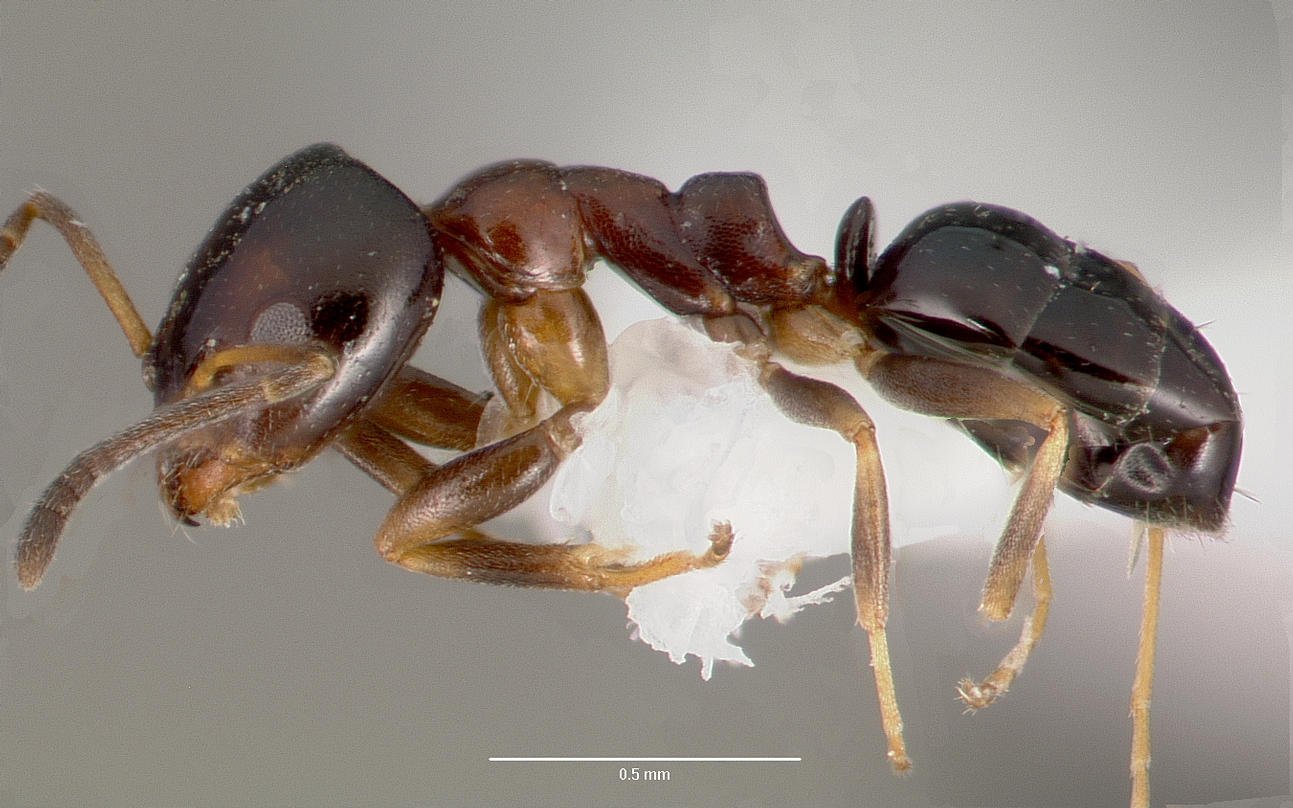
A small black ant with a glossy body, and the one most often in Sydney kitchens. It nests in wall cavities, the roof void and garden edges, trails along skirtings and cabling, and feeds readily on sweet bait.
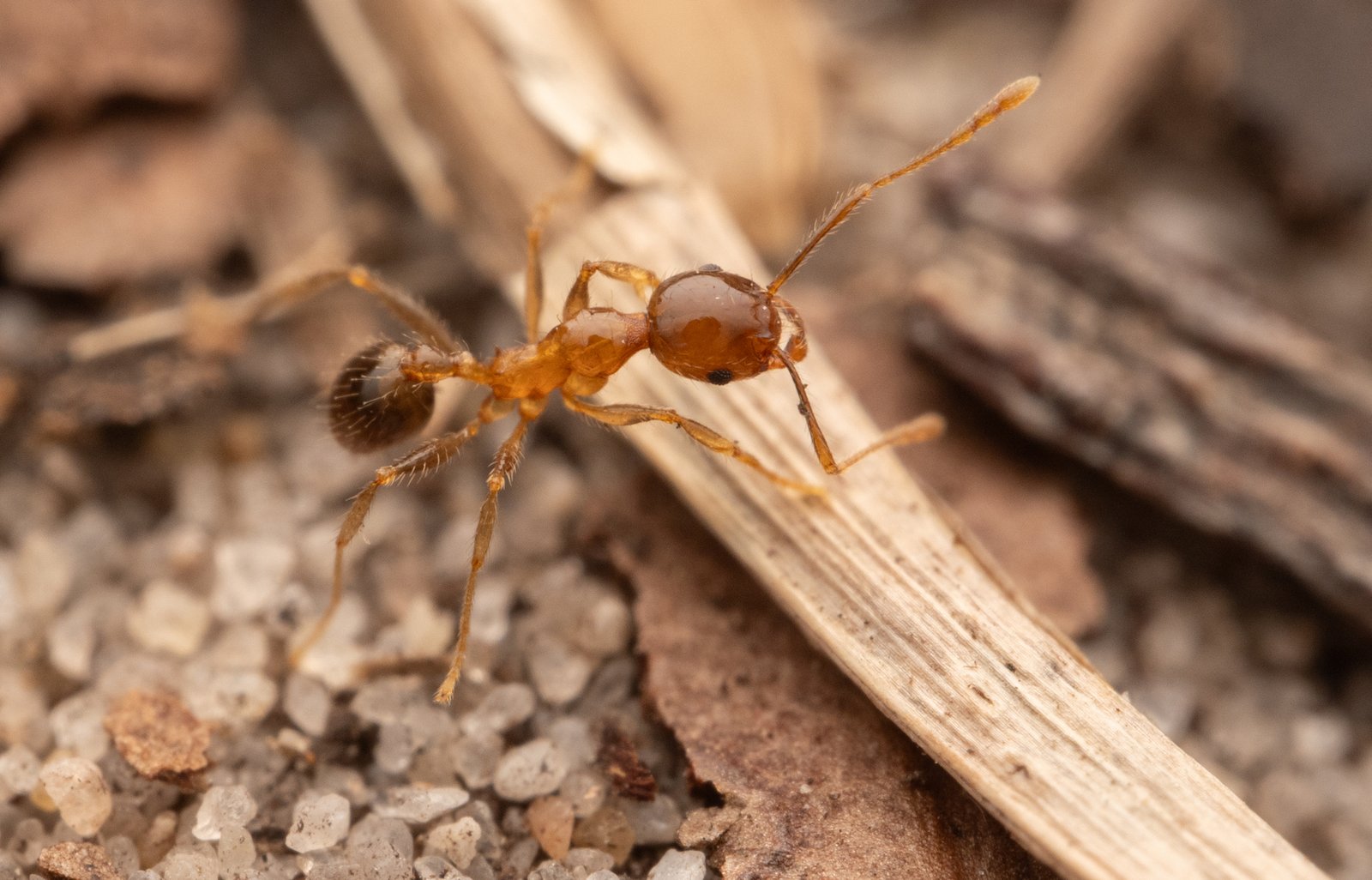
Small brown ants that include a bigger-headed soldier caste. Sandy soil pushed up between pavers and along slab edges gives them away. Colonies run to many nests, and oil-based granular bait is what works.
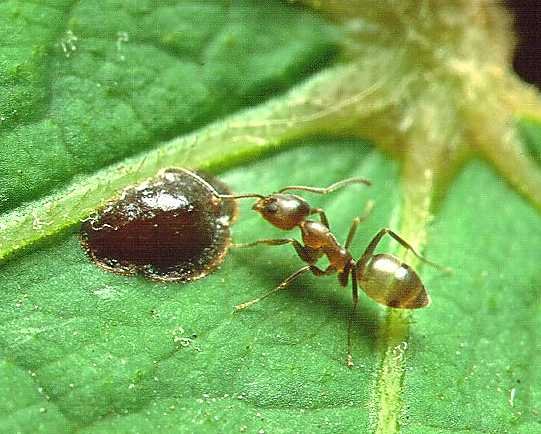
Small and flat brown in colour, running in dense fast trails. Because nests hold many queens and join with those next door, the infestation is usually bigger than one property. Never spray a repellent on it.
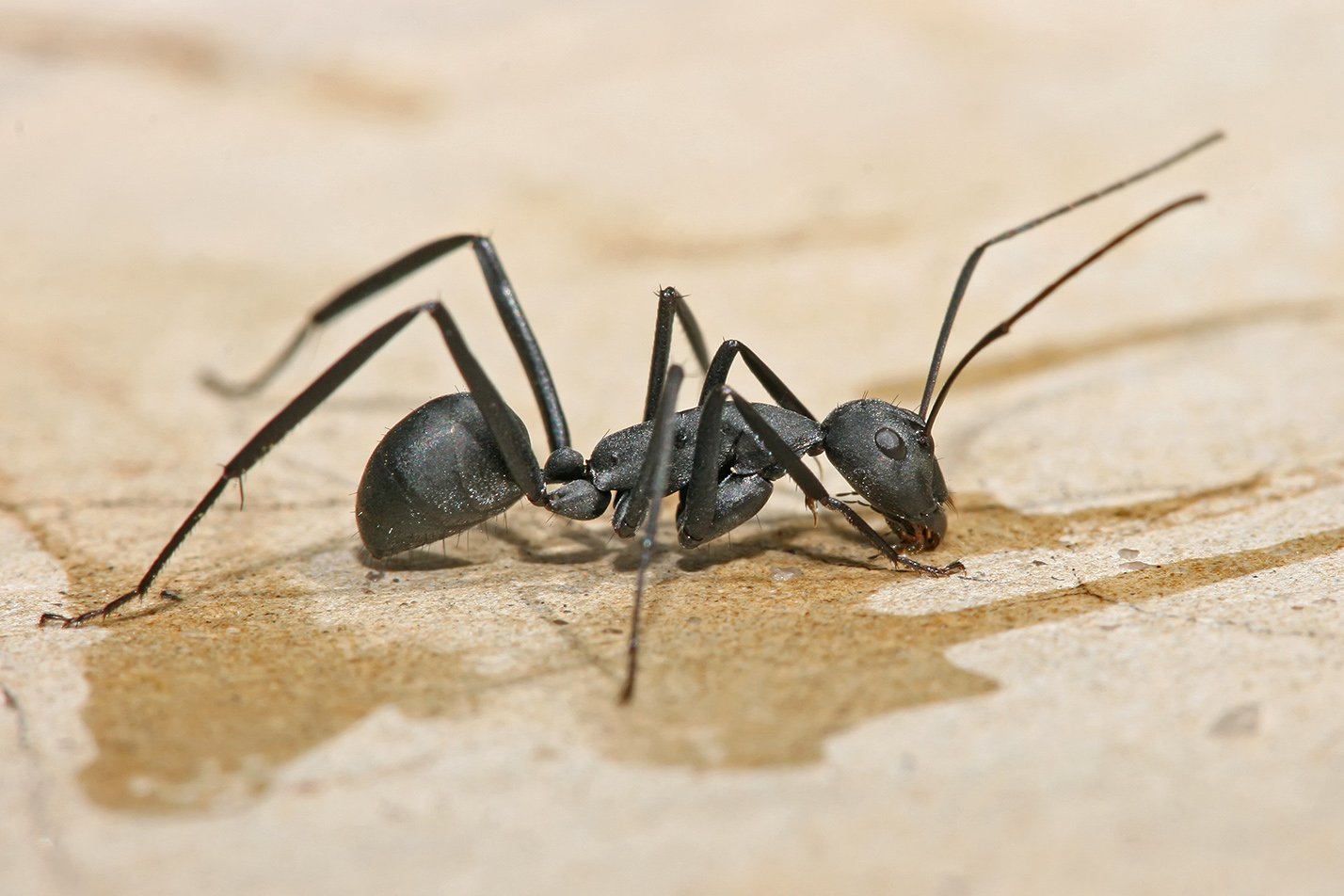
These are the large night-active ants that nest in soil, hollow trees and timber that has softened with damp. Structural damage is uncommon in Australia, but a wall nest points to a leak worth chasing.
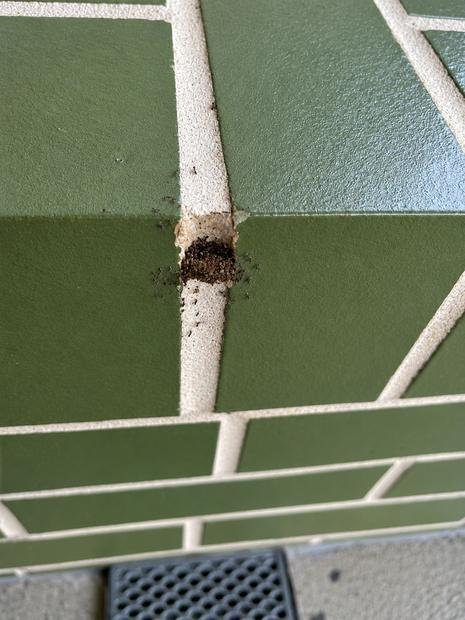
Photo from an Elite job: an ant nest emerging from a mortar joint. Weep holes and cracked mortar lead straight into the wall cavity, which is where many black house ant colonies live.
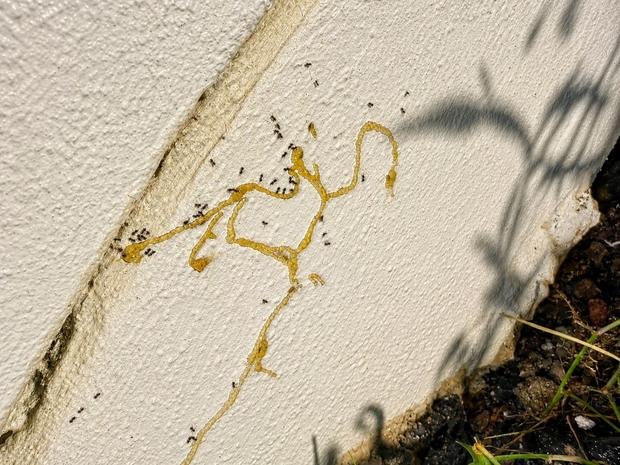
Photo from an Elite job: gel bait placed along an active trail. The ants are left to feed and carry the bait home, so we ask customers not to wipe or spray the trail afterwards.
Where ants appear usually tells us where the nest is and which species we are dealing with.
When they come in from the outside wall, the nest is usually in the cavity or just outside in the garden. We work back from the entry point.
If fine soil keeps appearing in the paving joints and along the drive, coastal brown ants are nesting beneath it.
Ants nesting in switches and electrical fittings are drawn to the warmth. Do not spray into power points; tell us so we can treat safely.
Swarming winged ants in spring or summer are a mating flight. Seen inside the house, it often means the colony is mature and in the building.
Ant trails at the shower, vanity or toilet usually come down to moisture - either damp in the wall or a slow leak they are drinking from.
These are the bull ants and jumper ants nesting in lawns and beds - a painful sting, and a risk of serious allergic reaction for some.
Get a licensed Sydney technician on the phone today - honest advice, fixed quote in 30 minutes.
Where a species has many queens, a repellent spray causes budding rather than death. Part of the colony, queen included, moves elsewhere, and you have doubled the problem.
The difference matters. Retail sprays are repellent - ants sense them and avoid the treated area. Non-repellent products cannot be detected, so foragers cross them, pick up the active and take it back to the nest.
If the bait is not what they want today, they will walk past it. Preference moves between sugar and protein with brood demand, so we test and change as needed.
It takes days for bait to move through a colony. Spraying the trail the day after our visit kills the very ants delivering it - our blog explains budding in more detail.
Tracing first, then baits and non-repellent products that do the work after we leave.
We identify the ant and follow trails back to entry points and nests in walls, paving, garden edges and roof spaces.
A test with small amounts of each bait type - sweet, protein, oil-based - tells us what the colony wants at this point in its cycle.
Gel bait goes along trails, window frames and skirting where ants travel, out of reach of children and pets.
A non-repellent treatment around the foundation, weep holes, door frames and paths intercepts ants coming in.
Under-paver and lawn-edge nests are handled with granular bait, or treated directly where that is better.
The job ends with a written summary, advice on what to avoid spraying, and a 6-month warranty.
The same bait does not suit every ant. This is how we choose.
| Species | Usually feeding on | Treatment approach | Common mistake |
|---|---|---|---|
| Black house ant | Honeydew and sugary liquids, switching to protein when there is brood | Sweet gel on active trails and a non-repellent perimeter at frames and weep holes | Washing the trail down each day, which only relocates the foraging route |
| Coastal brown ant | Protein and oils | Oil-based granular bait on paving and lawn edges | Pouring boiling water or insecticide into one pile while dozens of nests remain |
| Argentine ant | Sugars, with protein at times | Slow-acting baits plus non-repellent treatment across the property line | Repellent barrier sprays, which split multi-queen nests |
| Sugar ants (Camponotus) | Sweet foods and insects, active after dark | Night trail inspection, baiting near the nest, and dealing with damp timber | Inspecting in daylight when the colony is not foraging |
| Bull ants and jumper ants | Insects and nectar outdoors | Direct nest treatment in lawns and garden beds | Digging into the nest by hand and getting stung |
| Time of year | What is happening | What to watch for |
|---|---|---|
| Early spring (Sept to Oct) | Colonies become active and start on brood, which shifts them onto protein | Early indoor trails, and sand piles returning to the paving |
| Late spring to summer (Nov to Feb) | Peak foraging, mating flights after warm humid weather | Winged ants, heavy trails after storms and heatwaves |
| Autumn (Mar to May) | Colonies reach full size and start stocking up ahead of the cold | Trails heading for the pantry and the pet food bowl |
| Winter (Jun to Aug) | Outdoor foraging slows right down while nests in heated walls continue | Ants showing up by heaters, hot water services and in kitchens |
Most failed ant treatments come down to what happens in the week after.
Food premises need bait placement that will not contaminate, and records of what was used where. That is a different job from a domestic callout.
Ants in the cavity of a Hinchinbrook house will appear at power points, architraves and ceiling roses - anywhere the cavity opens into the room.
The garden is usually the source. Shrubs touching the walls, mulch up against the footings and irrigated beds give a colony everything it needs within a metre of your kitchen.
Trails lead somewhere, so we follow them to the colony instead of spraying the sighting.
Which bait we use depends on the ant and the season: sweet, protein or oil-based.
Non-repellent products only - they are taken back to the nest rather than scattering it.
General ant treatments are covered. If ants come back within 6 months, so do we.
Everything you need to know before you book. Still unsure? Call us — we're happy to help.
Get a Free QuoteAnt treatment starts from $89. The fixed price depends on the size of the property and how far the problem has spread, and we confirm it before we start - there is no call-out fee in Hinchinbrook 2168. Every general treatment carries a 6-month warranty.
We cover it on scheduled runs, so a day's notice gets you the best slot. Our South West Sydney technicians cover Hinchinbrook daily, and you get a confirmed arrival time when you book.
The ground here was cleared and rebuilt recently, which displaced whatever lived in it, and the blocks are close enough that ants move between them along the fence lines.
Modern detached homes close together. We treat the perimeter and the boundary because that is the route between properties.
Yes. We work in houses, units, strata blocks, rentals and commercial premises across Hinchinbrook 2168, and we provide the written report agents and strata managers ask for.
It is, applied properly. We put product into cracks, voids and stations rather than across open surfaces, and we will tell you what to stay off and for how long before we leave.
In the great majority of jobs, no. If one area needs to be left for an hour or two we say so before we start rather than after.
Typically one to two hours on site. What extends it is size, access and how far the problem has gone, all of which are accounted for in the quote.
Every general treatment carries a 6-month warranty. Ring us if activity picks up again inside that period and we will arrange the return.
We cover the whole of Hinchinbrook, from the streets around Valley Plaza Shopping Centre out to the suburb boundary and on into Green Valley.
Photographs from Elite jobs across Sydney — not stock imagery.
Insured, licensed technicians and a straight quote within 30 minutes - no obligation either way.