
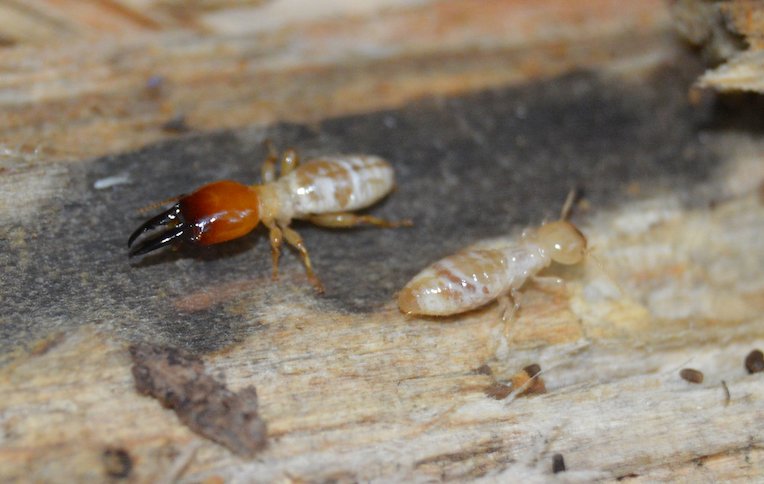
Termites damage more Australian homes each year than fire, storm and flood combined, and home insurance almost never covers it. The reliable approach is a timber pest inspection every twelve months, from $159, followed by a barrier or baiting program if activity is found. Never spray or break open a live termite trail - it scatters the colony.
- Start by working out what you have
- The early signs people miss
- Why they are in your home
- Local conditions in North Sydney
- Sydney's weather and termites
- What a licensed technician actually does
- What to expect from the visit
- What you should expect to pay
- Common missteps
- When it is not a single home
- Nearby suburbs we cover
- Frequently asked questions
Start by working out what you have
The useful question is not which spray to buy but where the population actually lives. With termites, what you see moving is a small fraction of what is there, and treating only that fraction is why problems come back.
So the sequence matters: identify, locate, treat the source, then close the conditions. Skip a step and you are paying again within weeks.
Key points
- Early action is consistently cheaper than waiting for certainty.
- Ask what the warranty covers and for how long.
- Treat the source, not the sightings: the nest or harbourage is the target.
- Identify the species before treating - the right product depends on it.
The treatment plan for a North Sydney property is set out in detail on our page covering termite control work in North Sydney, including the construction types we see locally.
The early signs people miss
You rarely see the population itself first - you see what it leaves behind. The signs that matter:
- Paint or plaster that bubbles, ripples or cracks with no plumbing leak nearby.
- Floorboards that feel spongy underfoot, particularly near wet areas.
- Thin mud veneer filling cracks in skirtings, architraves or door frames.
- Sagging or blistered cornices where a nest has worked up inside a wall.
- Pencil-width mud tubes running up foundations, piers or brick walls.
One of these on its own may mean nothing. Two or more in the same area is worth a professional look, and it is better not to disturb the site before someone has seen it.
Because the early signs are so easy to miss, an annual termite inspection every twelve months is the standard advice for Sydney homes.
Why they are in your home
The question worth answering is why here. These are the conditions that bring termites in, and the ones a technician will point out on the day:
- Dense planting and irrigation holding damp soil hard against the brickwork.
- Subfloor moisture from a leaking pipe, a failed shower base or poor drainage.
- A hot-water overflow or air-conditioning condensate discharging beside the footing.
- Tree stumps and buried form-work left on the block after construction.
- Garden beds, mulch or soil built up above the slab edge, bridging the barrier.
A technician will walk you through whichever of these apply to your place as part of the visit.
Local conditions in North Sydney
We are in North Sydney (2055) regularly. Being about 3km north of the CBD, it shares the conditions of the suburbs around it, and termite activity here follows the same drivers.
What changes locally is access rather than method - whether there is a subfloor, how the roof void is reached, and how much external perimeter there is to treat.
The local page for the North Sydney service page has the rest of what we treat nearby.
Sydney's weather and termites
Termites stay active in Sydney all year, but the warm, humid stretch from October to March is when colonies expand fastest and when alates swarm after rain. Autumn and winter are the better months for inspection work: activity is slower, so evidence sits undisturbed and a technician can read the history of a subfloor more clearly.
None of it changes the method much, but it does change how urgent the booking is.
What a licensed technician actually does
A licensed technician follows a repeatable process rather than blanket-spraying a property. In order:
- Inspect and identify. Work out the species and find where the population actually sits - usually not where it was seen.
- Treat the source. Match the method to the species and place it in the harbourage rather than across open surfaces.
- Allow the method to run. Baits and colony treatments work over days to weeks; re-spraying during that window undoes them.
- Close the conditions. Proofing and maintenance advice specific to your building, which is the part that prevents a repeat.
The work is logged, and if covered pests return inside the warranty period we come back at no charge.
If you want to see how the treatment is actually carried out, the termite control page walks through each stage.
What to expect from the visit
Knowing the shape of the appointment makes it easier to plan around. A standard visit runs roughly like this:
- Inspection on arrival. Ten to twenty minutes looking - inside, outside, roof void or subfloor if relevant - then a plain explanation of what is going on.
- Price confirmed. No work starts until you have agreed the price and know what it covers.
- The work itself. Typically under an hour and a half for a standard home; longer where a roof void, subfloor or large yard is involved.
- Before we leave. You get the timeline, the aftercare, the specific fixes for your property and your paperwork.
Expect a short increase in sightings after a bait treatment. It means the bait is being carried, which is the point.
What you should expect to pay
What follows is where pricing begins. An inspection sets the final number, but this is the honest bracket:
| Service | From | Notes |
|---|---|---|
| Timber pest inspection with report | from $159 | Annual check; the report is the deliverable |
| Termite treatment or barrier | quoted on inspection | Depends on construction, soil and extent of activity |
| General pest treatment (internal & external) | from $89 | Covers cockroaches, ants, spiders and silverfish |
| Commercial program | quoted per site | Scheduled servicing with documented reports |
| Rodent treatment and proofing | from $150 | Baiting or trapping, plus entry-point work |
The quote is confirmed before work begins and does not change unless you ask for more work. General pest treatments carry a six-month warranty.
If you want the specifics for your own street rather than general advice, North Sydney termite control covers the local conditions and what a treatment there usually involves.
Common missteps
Things we routinely arrive to find, and what they cost:
- Letting an annual inspection lapse because nothing looked wrong.
- Relying on a hardware store product against a colony of hundreds of thousands.
- Assuming a previous treatment is still protecting the house years later.
- Breaking open mud tubing to look inside before a technician has assessed it.
If you have already done one of these, say so when you book. It changes the approach rather than causing offence.
When it is not a single home
For a business or an owners corporation the deliverable includes paperwork, not just a result:
- Treatment of common property - risers, voids, bin rooms, roof spaces - not just individual lots.
- A site plan showing monitored station locations.
- Safety data sheets and licence documentation held on site.
- Scheduled servicing rather than reactive call-outs, with visit dates set in advance.
- After-hours or pre-opening access so trading is not disrupted.
Treating individual lots in a strata building without addressing common property is the most common reason these problems persist for years.
In a strata building the cause is often outside the affected unit, which is why strata and common-property work is handled at building level.
Nearby suburbs we cover
If your place sits just outside North Sydney, these are the adjoining suburbs we service: McMahons Point, Lavender Bay, Milsons Point, Waverton.
We cover the whole basin rather than a few postcodes - our full service area has the full list.
Common questions
How much does it cost to get rid of termites in North Sydney?
From $89 for general pest work in North Sydney, and from $159 for a timber pest inspection. Termite barriers, baiting systems and commercial programs are priced after a site visit. Nothing is charged above the quoted figure without your agreement.
How often do termite inspections need doing?
Every twelve months, and that is the minimum rather than a precaution. A colony can work inside timber for months without any visible sign, and insurance will not cover the repair, so the inspection is the only point at which this is inexpensive.
Are you based near North Sydney?
Regularly. North Sydney sits on an established route for us, so we can normally be there within 48 hours and same-day where there is a safety issue.
How do I stop them coming back?
Maintenance rather than pest control: fix the water, close the gaps, cut the food supply and reduce clutter where things can shelter. Households that would rather not think about it move onto a regular program instead.
Why have termites come into my home?
Food, water and shelter, in roughly that order. In most Sydney homes it comes down to accessible food or bins, a moisture source such as a leak or blocked gutter, and a gap big enough to get through. Remove any one of the three and the property gets much less attractive.
Are your technicians licensed and insured?
All of our technicians are licensed under NSW pest management requirements and insured. Pest control is licensed work in this state, so an operator who cannot produce a licence number should not be in your home.
Can you come today?
We cover North Sydney regularly, so availability is normally a day or two out. Call 1300 313 373 and we will give you the next slot and a fixed price at the same time.
Do you offer a warranty?
Covered pests returning within six months are re-treated free. Termite barriers and baiting systems have their own longer warranties, generally conditional on annual monitoring. You get the terms in writing on the day.
Want this sorted properly?
One call gets you a fixed price, usually inside 30 minutes. Licensed technicians, 650+ Sydney suburbs covered, child and pet-safe treatments, and a 6-month warranty on general work.