Days 1 to 3
Cockroaches coming out in daylight and moving sluggishly is the normal first sign. The bait and growth regulator are working. Sweep up what you find and carry on.

Cockroach Control in Lakemba 2195 — local technicians, fixed prices and a written report. A cockroach treatment starts from $89.
Real, verified feedback from people we've helped — straight from Google.
Local technicians, fixed prices and a written report for every job in Lakemba.
Lakemba sits about 13.5 km south-west of the CBD in the Canterbury-Bankstown, and postcode 2195 is one we are in most weeks. We run Lakemba on a regular route, and same-day attendance is usually available.
Around Lakemba we work the pockets near Wiley Park station, Wiley Park and Peel Park most often, so the van is rarely far away when a job comes in.
Lakemba is in the Canterbury-Bankstown area, and we cover Wiley Park, Belmore and Belfield on the same runs - handy if you own more than one property or your cockroach problem has come from next door. The building stock is close-packed, so we look at what the property adjoins before deciding where product goes.
Most Lakemba bookings come in as apartments and converted blocks where the kitchen backs onto a service riser. Say which one applies when you call 1300 313 373 and the technician will have the right products on the van.
We cover the remainder of 2195 as well, from Broadway Plaza through to Campsie Shopping Centre.
You get a confirmed time, not a window. We plan the 2195 run the day before, and if Wiley Park or Belmore is on the same round there is often an earlier slot going.
Where Lakemba housing shares walls and roof voids - semis, terraces, unit blocks - the population is usually shared too. We say so up front rather than treating one flat and letting you discover it a month later.
Floor wastes, overflow pipes and the gap where a waste pipe passes through a cupboard base are all cockroach routes. A dry floor waste in a Lakemba laundry is an open door, and a cup of water down it once a week closes it.
Roughly forty juveniles come out of one case, and they are breeding themselves inside ten weeks. Unless a Lakemba treatment carries something that stops nymphs maturing, you are only ever resetting the clock.
Knowing the species tells us where the nest is and which treatment will work. Two of these photos are from our own Sydney jobs.

At 12 to 15 mm and light brown with two dark stripes behind the head, this is the species we find living permanently indoors. Warmth, food and moisture are all it needs, and it reproduces faster than any other cockroach here.

Reddish-brown and as long as 4 cm. It belongs to the drainage system - sewers, stormwater pits, grease traps, the subfloor - and arrives in the kitchen overnight from there.

As big as the American but marked with pale yellow along the edge of the wings and behind the head. The name misleads: this one lives outside in mulch and garden beds and only comes indoors to look about.

A small species with pale bands across the body that prefers warm, dry spots higher up, such as behind picture frames, in electrical housings and inside cupboards away from water.
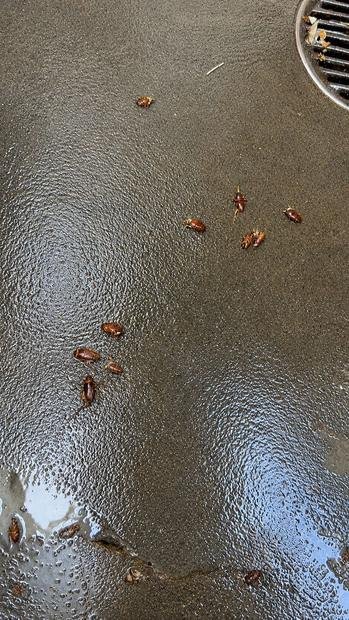
An Elite job photo of German cockroach activity on a Sydney inspection. Egg cases, shed skins and droppings in the harbourage are how we work out what we are dealing with.
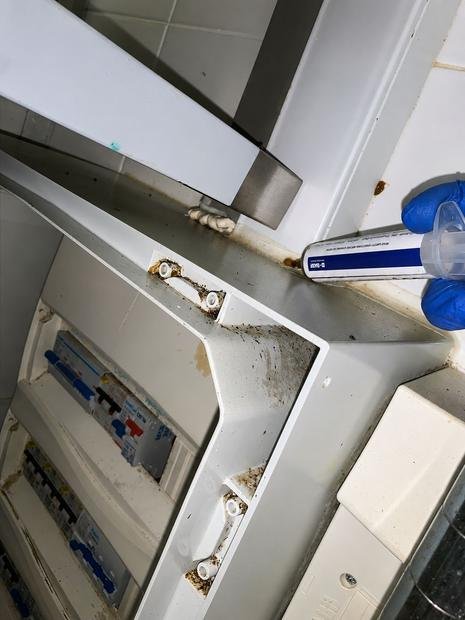
Taken on an Elite commercial job - harbourage inside the equipment itself. Motor cavities, door seals and hollow legs stay warm all night and rarely see a cloth.
Where and when you see them is often a better clue than size. Use this to tell us what you are seeing when you call.
| What you see | Likely species | Where the nest usually is | What treatment focuses on |
|---|---|---|---|
| A dozen small cockroaches on the bench in broad daylight, with dark specks in the cupboard corners | German cockroach, already a heavy infestation | The hinge of a cupboard door, behind the dishwasher and fridge, the kickboard void, inside appliances | Bait rotation and a growth regulator, applied into cracks and crevices right through the kitchen |
| A large cockroach or two after dark, always near a drain, the laundry or the bathroom | American cockroach | The sewer and stormwater pits, the subfloor, and floor-waste traps that have dried out | Pit and drain treatment, the subfloor, and sealing the gaps around pipe penetrations |
| Large cockroaches edged in pale yellow, around the garage or just inside a back door | Australian cockroach | Mulch and leaf litter, woodpiles, and up in the roof void | Perimeter work outside, a dusting of the roof void, and clearing the garden harbourage |
| Little banded cockroaches behind a picture frame or inside the TV unit, away from any water | Brown-banded cockroach | Dry warm spots in furniture and inside electrical gear | Targeted baiting in the rooms you live and sleep in, not the kitchen |
| A flat that clears for a fortnight and then has cockroaches again | German cockroach moving through the building | Shared risers, the bin room, and cavities running between walls | A coordinated treatment across the block. See strata pest control |
Not sure? Send a photo when you book. Our guide to German vs American cockroaches has more ID tips.
Speak to a licensed Sydney technician now. Straight advice, and a fixed quote inside 30 minutes.
Roughly 30 eggs sit in a single case, and the female keeps it with her until it is nearly ready to hatch. Nothing you spray on a surface touches it.
One female produces several egg cases, and in a warm kitchen the young reach maturity within weeks. That is how a handful becomes a serious problem in a short time.
A repellent product scatters rather than clears - deeper into the wall void, through to the unit next door - and leaves residue where food is prepared.
What they leave behind matters: droppings, saliva and cast skins are known asthma and allergy triggers, so this is a health question as much as a comfort one.
What the technician does on the day, in the order it happens.
Step one is knowing which cockroach you have. Step two is finding where it shelters: torch and inspection mirror through hinges, appliance cavities, kickboards and wall voids.
Where build-up is feeding them, you will get a short list of what to clean and the order to do it in - bait has to out-compete everything else available.
Small dots of professional gel bait go into the cracks cockroaches travel through. They eat, return to harbourage and the effect passes through the population.
An insect growth regulator stops nymphs becoming breeding adults, and dust goes into wall voids and cavities where gel cannot reach.
Pits, floor wastes, the subfloor and the roof void get treated for the American and Australian species - they come in from there, so that is where it has to be done.
You receive a written summary of what was found and done. Heavy activity after two weeks, or a return within the 6-month general-treatment warranty, brings us back free of charge.
Some DIY options help with a few stray cockroaches. An established German cockroach colony is a different job.
| Method | What it does well | Where it falls short |
|---|---|---|
| Aerosol surface spray | Works on a cockroach you can actually see | Egg cases and harbourage are untouched, and it repels the others further in |
| Bug bombs and foggers | Gets product onto every open surface at once | Harbourage is missed, benches end up with residue, and the colony splits up |
| Retail bait stations | Has a place when you have only seen one or two | Very little bait in each, and any crumbs or grease will out-compete it |
| Professional gel bait rotation | Carried home and shared where they shelter; if they start refusing one gel we rotate to another | Requires a clean kitchen and patience - days to a couple of weeks, not overnight |
| Insect growth regulator | Prevents the young reaching breeding age, which ends the egg-case cycle | Slow by design, so we never use it on its own - it goes in with bait |
Ten minutes of preparation lets the bait reach more cockroaches.
Cockroaches coming out in daylight and moving sluggishly is the normal first sign. The bait and growth regulator are working. Sweep up what you find and carry on.
Activity should fall steadily. Leave bait spots in hinges and cracks alone, and avoid spraying your own insecticide over them, which can make cockroaches refuse the bait.
If it keeps going, let the agent or building manager know - cockroaches move between units readily. There is more on co-ordinated work on our apartment pest control page.
Steady activity at the two-week mark, or a return inside 6 months of a general treatment, means a warranty re-treatment - ring 1300 313 373.
The pattern we see across Lakemba and the wider Canterbury-Bankstown is a surge after the first properly warm week, then steady pressure until autumn. Treating before that surge is far cheaper than treating after it.
We are around Broadway Plaza and the streets behind it most weeks, and we cover every address in 2195, not just the main roads.
Council officers want records, not reassurance. For food premises around Lakemba we provide the treatment schedule, the products used, the monitoring point locations and the findings from each visit, in a form you can hand over.
Treatment follows identification. Indoor German cockroaches need bait and a growth regulator; drain-dwelling species need the pits and subfloor treated.
Bait placed in cracks and hinges, not a blanket spray over food preparation surfaces.
One flat or a whole commercial kitchen - food premises are done outside trading hours.
A general treatment is covered for 6 months. Cockroaches inside that period mean a free return visit.
Everything you need to know before you book. Still unsure? Call us — we're happy to help.
Get a Free QuoteA cockroach treatment starts from $89. What changes the figure is the size of the building, how many areas are affected and the access. You get that number up front for Lakemba 2195, with no call-out fee. Every general treatment carries a 6-month warranty.
Same-day attendance is usually available. Our Canterbury-Bankstown technicians cover Lakemba daily, and you get a confirmed arrival time when you book.
The housing stock is old and joined together. A shared wall cavity or a continuous sub-floor lets cockroaches travel from one property to the next, which is why your neighbour matters.
Mostly terrace and semi. We look at the party wall, the sub-floor and the roof space, because those are the routes between houses.
Yes. We work in houses, units, strata blocks, rentals and commercial premises across Lakemba 2195, and we provide the written report agents and strata managers ask for.
It is, as long as you follow what we tell you on the day - usually keeping off treated surfaces for a couple of hours. Let us know at booking about young children, pets or an aquarium.
In the great majority of jobs, no. If one area needs to be left for an hour or two we say so before we start rather than after.
For a standard Lakemba home, one to two hours. We would rather tell you it will take longer up front than rush it.
Every general treatment carries a 6-month warranty. If it is not holding, call us - that is exactly what the warranty is for.
Yes - we work right across the Canterbury-Bankstown area, which takes in Lakemba and the suburbs around it.
Photographs from Elite jobs across Sydney — not stock imagery.
Insured, licensed technicians and a straight quote within 30 minutes - no obligation either way.