Days 1 to 3
Cockroaches coming out in daylight and moving sluggishly is the normal first sign. The bait and growth regulator are working. Sweep up what you find and carry on.

Cockroach Control in Zetland 2017 — local technicians, fixed prices and a written report. A cockroach treatment starts from $89.
Real, verified feedback from people we've helped — straight from Google.
Local technicians, fixed prices and a written report for every job in Zetland.
We treat cockroaches right across 2017. Zetland is roughly 4.4 km south of the city, which puts it well inside the Inner South & City Fringe run our technicians work. Our technicians are through Zetland most days, so same-day attendance is usually available.
If you are near Jack Floyd Reserve, Park Sydney Village or The Australian Golf Club, that is ground we cover constantly - it is the busiest part of Zetland for us.
City of Sydney and Bayside is the council area for Zetland, and we treat Kensington, Waterloo and Beaconsfield on the same schedule. Most of the housing here shares a wall, a roof void or a sub-floor with something else, so we check what adjoins the property rather than treating it in isolation.
What we see in Zetland is terraces and semis where the problem has come through a shared wall. Describing it accurately when you book saves a second visit.
We cover the remainder of 2017 as well, from Green Square station through to Nuffield Park.
People assume it is about crumbs. It is mostly about moisture. The leaking waste under a Zetland sink, condensation behind the fridge or a shower recess that never dries will hold a population on its own.
The usual route into a Zetland home is carried, not crawled. Appliance deliveries, recycled cartons and second-hand white goods are the three we trace most often.
The health case is mostly about allergens. Droppings and cast skins are a recognised asthma trigger, and in a Zetland flat with a long-standing population that material works its way into carpet and soft furnishings.
Knowing the species tells us where the nest is and which treatment will work. Two of these photos are from our own Sydney jobs.

Light brown with two dark stripes behind the head, roughly 12 to 15 mm long. It lives indoors near warmth, food and moisture, and it is the species that breeds fastest inside a kitchen.

Up to roughly 4 cm long and reddish-brown. You find it in sewers, pits, grease traps and under the floor, and it travels up through drains after dark rather than nesting indoors.

Similar in size to the American cockroach, told apart by the yellow margins at the head and wing edges. An outdoor species - gardens, mulch, the subfloor - that makes its way in.

A small cockroach with light bands across the body, found away from water in warm dry positions: behind frames, in electrical fittings, in cupboards at height.
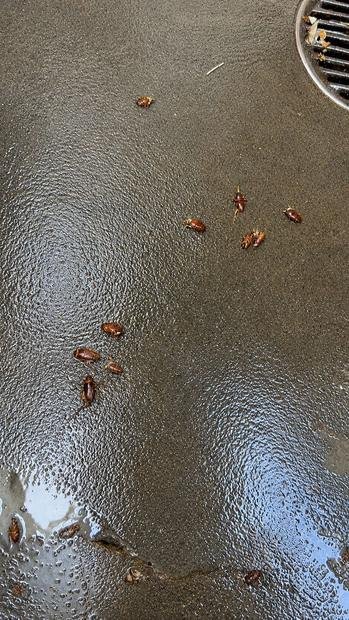
An Elite job photo of German cockroach activity on a Sydney inspection. Egg cases, shed skins and droppings in the harbourage are how we work out what we are dealing with.
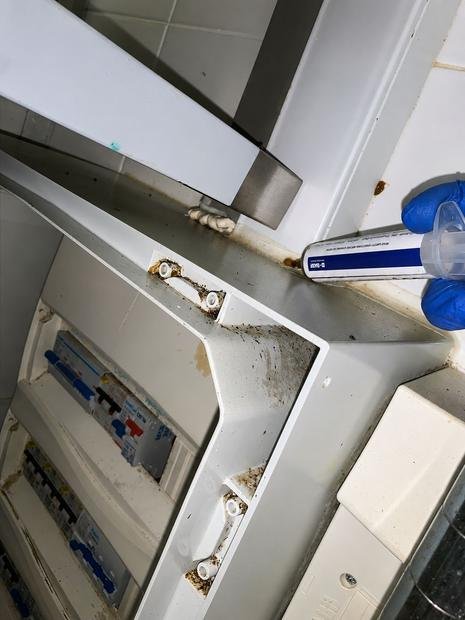
From an Elite commercial job: harbourage found inside kitchen equipment. The motor housing, the door seal and the hollow leg hold warmth after close and almost never get cleaned out.
Where and when you see them is often a better clue than size. Use this to tell us what you are seeing when you call.
| What you see | Likely species | Where the nest usually is | What treatment focuses on |
|---|---|---|---|
| Small cockroaches you can see without a torch, plus droppings like coarse pepper on cupboard edges | German cockroach - daytime sightings mean a lot of them | Hinges, the cavity behind the fridge, under the kickboards, in the housings of the appliances | Gel bait rotated through the job, a growth regulator, and crack-and-crevice work indoors |
| Large cockroaches turning up at night around wet areas, usually one at a time | American cockroach | The pit system, the subfloor, and any floor-waste trap that has lost its water seal | Pit and drain work, subfloor treatment, and closing off pipe penetrations |
| Large ones marked with yellow near the head, found in the garage or wandering in from the yard | Australian cockroach | Mulched beds, leaf litter, woodpiles, and the roof space above | Work outside: the perimeter, the roof void, and the harbourage in the garden itself |
| Small cockroaches found upstairs or in bedrooms rather than around the sink | Brown-banded cockroach | Dry, warm furniture and the inside of electrical appliances | Targeted bait placement through living and sleeping spaces |
| A unit where the problem never quite ends, weeks after a DIY attempt | German cockroach spreading from a neighbouring lot | Shared risers and bin rooms, plus the cavities inside shared walls | A building-wide, coordinated treatment. See strata pest control |
Not sure? Send a photo when you book. Our guide to German vs American cockroaches has more ID tips.
Speak to a licensed Sydney technician now. Straight advice, and a fixed quote inside 30 minutes.
Roughly 30 eggs sit in a single case, and the female keeps it with her until it is nearly ready to hatch. Nothing you spray on a surface touches it.
One female produces several egg cases, and in a warm kitchen the young reach maturity within weeks. That is how a handful becomes a serious problem in a short time.
Supermarket sprays and bombs repel. The colony moves further into the cavity, or next door, and your benchtops end up with residue on them.
Cast skins, droppings and saliva are recognised asthma and allergy triggers, which makes a long-running infestation a health issue rather than just an annoyance.
What the technician does on the day, in the order it happens.
We identify the species, then go looking with a torch and mirror - hinges, inside appliances, behind the kickboards, into the wall voids. What we find decides the treatment, not a set routine.
Where build-up is feeding them, you will get a short list of what to clean and the order to do it in - bait has to out-compete everything else available.
We place gel in precise dots along their travel routes rather than spraying. They feed, return to the harbourage, and the effect spreads through the population by contact and feeding.
An insect growth regulator stops nymphs becoming breeding adults, and dust goes into wall voids and cavities where gel cannot reach.
Pits, floor wastes, the subfloor and the roof void get treated for the American and Australian species - they come in from there, so that is where it has to be done.
We leave you a written record of the job. If it is still heavy at two weeks, or comes back inside the 6 months a general treatment carries, we return at no charge.
Some DIY options help with a few stray cockroaches. An established German cockroach colony is a different job.
| Method | What it does well | Where it falls short |
|---|---|---|
| Aerosol surface spray | Works on a cockroach you can actually see | Egg cases and harbourage are untouched, and it repels the others further in |
| Bug bombs and foggers | Reaches open floor and bench area without effort | Misses the harbourage entirely, leaves residue where you prepare food, and disperses them |
| Retail bait stations | Fine as a first step on a small problem | Not enough bait to matter, and any food left about is more attractive |
| Professional gel bait rotation | Taken back into the harbourage and passed on; we can change formulation if they go off one | Wants a clean kitchen behind it, and takes days to a fortnight rather than minutes |
| Insect growth regulator | Blocks nymphs from maturing into breeders and shuts the egg-case cycle down | Takes time to show, so it is always applied together with bait |
Ten minutes of preparation lets the bait reach more cockroaches.
Cockroaches coming out in daylight and moving sluggishly is the normal first sign. The bait and growth regulator are working. Sweep up what you find and carry on.
Expect activity to taper off. The bait dots in hinges and cracks need to stay put, and nothing should be sprayed over them - that is what makes cockroaches avoid bait.
Where activity continues, raise it with your agent or strata manager, because they cross between lots. See apartment pest control for how a building-wide treatment runs.
If you still see steady activity after two weeks, or cockroaches return within 6 months of a general treatment, call 1300 313 373 for a warranty re-treatment.
A good share of our Zetland work sits close to Jack Floyd Reserve, though the back streets and the Kensington boundary are just as familiar.
Sydney does not give cockroaches an off-season. Around Zetland the warm, humid stretch from October through March drives breeding hardest, but a heated Inner South & City Fringe home keeps a kitchen population going through winter without pause.
For a Zetland cafe or restaurant the standard is different: a documented program, a site plan with numbered monitoring points, and a report an auditor will accept. We work to that rather than turning up with a spray pack.
What we use depends on what you have: baits and growth regulators for German cockroaches, pit and subfloor treatment for the drain species.
Gel baits in cracks and hinges, not blanket spraying across benches where you prepare food.
One flat or a whole commercial kitchen - food premises are done outside trading hours.
If cockroaches return inside 6 months of a general treatment, we come back free of charge.
Everything you need to know before you book. Still unsure? Call us — we're happy to help.
Get a Free QuoteA cockroach treatment starts from $89. The fixed price depends on the size of the property and how far the problem has spread, and we confirm it before we start - there is no call-out fee in Zetland 2017. Every general treatment carries a 6-month warranty.
Same-day attendance is usually available. We are about 4.4 km south of the city here, and Zetland is covered by the Inner South & City Fringe team.
Most of this area is terrace, semi and converted block, and those share more than people realise - cavities, roof spaces, drainage. cockroaches use all of it.
Terraces and semis, often with a paved rear courtyard that traps damp against the wall - both of which shape the job.
We do. A lot of our Zetland work is rentals and strata, so the report, the products used and the areas treated are all recorded in writing for whoever needs them.
It is, as long as you follow what we tell you on the day - usually keeping off treated surfaces for a couple of hours. Let us know at booking about young children, pets or an aquarium.
Most of the time you can carry on as normal. If a particular area needs to be empty we will flag it when we arrive and it is rarely more than a couple of hours.
For a standard Zetland home, one to two hours. We would rather tell you it will take longer up front than rush it.
Every general treatment carries a 6-month warranty. A return visit within the warranty period costs you nothing.
We cover the whole of Zetland, from the streets around Jack Floyd Reserve out to the suburb boundary and on into Kensington.
Photographs from Elite jobs across Sydney — not stock imagery.
Fast and fully insured, with a no-obligation quote back to you within 30 minutes.