Repairing the damage
Hold the repairs until elimination is confirmed - taking out the timber early removes the bait. Then have a builder assess the structural members, bearers and studs and roof timbers included.

Termite Control in Glenwood 2768 — local technicians, fixed prices and a written report. Termite treatment starts from $179 and a full timber pest inspection from $159.
Real, verified feedback from people we've helped — straight from Google.
Local technicians, fixed prices and a written report for every job in Glenwood.
We treat termites right across 2768. Glenwood is roughly 28.8 km north-west of the city, which puts it well inside the Hills District run our technicians work. We cover Glenwood on scheduled runs through the Hills District, and we will give you a firm time rather than a window.
Around Glenwood we are most often near Glenwood Village Shopping Centre and Knightsbridge Reserve.
Our runs through Glenwood also take in Bella Vista, Kings Langley and Acacia Gardens. Backing onto bush means re-entry is the issue, so proofing and the perimeter do the real work here.
Most Glenwood bookings come in as homes on sloping blocks with a sub-floor and bush on the boundary. Say which one applies when you call 1300 313 373 and the technician will have the right products on the van.
The whole of 2768 is on our regular run.
Your appointment is confirmed the day before with a real arrival time. Because Bella Vista and Kings Langley are covered on the same round, 2768 often has an earlier slot available.
Tap along the skirting, the architraves and the door frames. Sound timber gives a solid note; timber eaten from inside gives a light, drum-like one. It is the cheapest check a Glenwood owner can do.
A mature colony can run to a million workers and eat through structural timber steadily rather than dramatically. Most of the serious damage we find in Glenwood homes accumulated over years in a wall nobody opened.
A mud lead is a covered road. They will not cross open air, so they build a tunnel up the brickwork - and that tunnel is usually the first thing anyone notices in a Glenwood sub-floor.
Photos from our own Sydney termite jobs. Most properties need one primary method, and some need two working together.

Stations go into the ground around the building with timber inside. Termites locate it, we switch the timber for bait, and the colony is eliminated from the inside out.
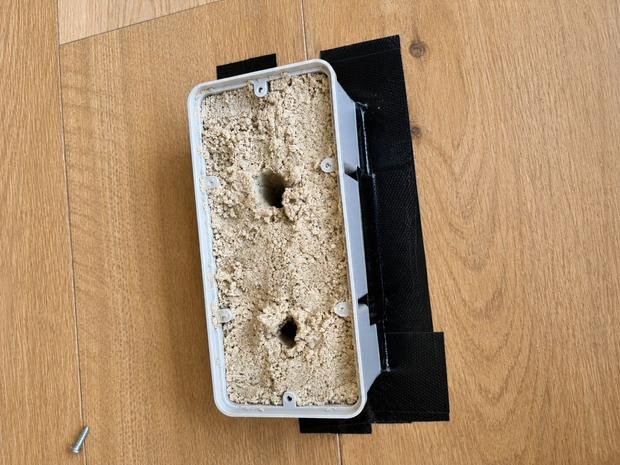
Every station is opened on a set schedule so feeding can be assessed and bait replenished. Programs that fail usually failed because the checks lapsed.
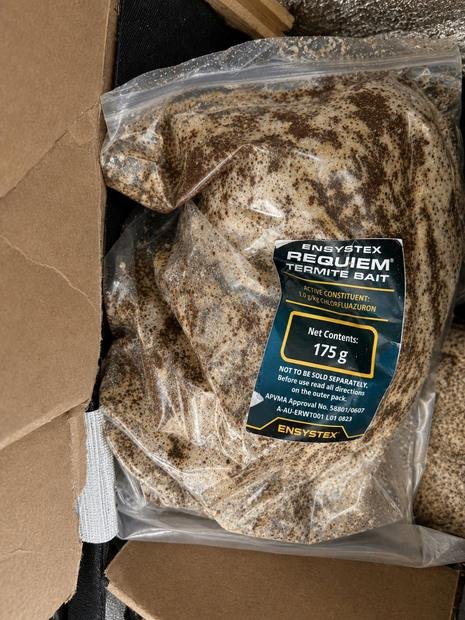
Active workings in a door frame or wall cavity can take bait fixed directly over them. Feeding starts at once, which is the fastest way onto a colony.
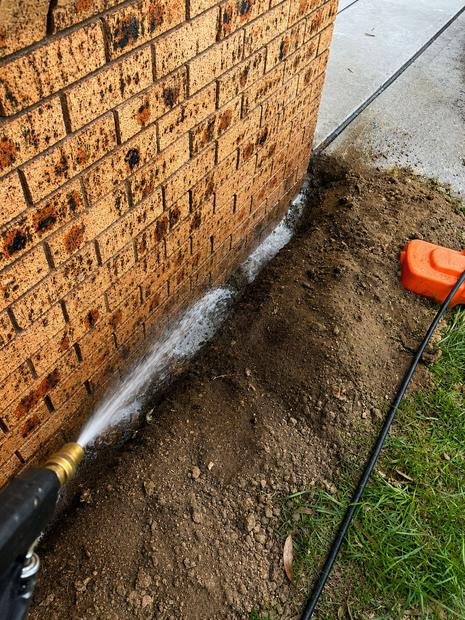
A continuous treated zone in the soil along the footings, applied by trenching and, under paving and slabs, by drilling and injecting.

Where the floor is suspended we treat the soil around each pier and along the internal walls - the subfloor is where hidden activity usually starts.

We walk you through the damaged timber and record it for your builder. Repairs come after elimination is confirmed, not before.
What you do in the first day or two affects how quickly the colony can be eliminated.
Surface spray and bombs are the worst thing to use here. The colony retreats from the treated area and you lose the access point we needed.
Don't pull the workings apart. Exposed tubes dry and the colony retreats, which costs time on the treatment.
Take pictures of anything you have seen and remember where. It tells us what to bring and where to start.
Look around for water - leaks, overflow pipes, the air conditioner drip. Termites want damp soil, and treating without fixing it leaves the attraction in place.
Subterranean termites feed continuously, so waiting costs timber. Same-day and next-day inspections are available right across Sydney.
Townhouse or unit? Notify the strata manager promptly, because common property is usually involved.
Talk to a licensed Sydney technician today - honest advice and a fixed quote within 30 minutes.
Both are recognised approaches for existing buildings under AS 3660.2. The right choice depends on your property.
| Consideration | Baiting system | Chemical soil barrier | Combination |
|---|---|---|---|
| What it is for | Destroying the colony that is feeding on your building | Putting a treated zone in the soil, so termites moving through it are affected | Killing the colony that is there and guarding against the next |
| Installation | In-ground stations around the perimeter, with bait fixed to any live workings | A trench along the footings, plus drilling and injection where there is paving or slab | Baiting to start, and the soil work once the colony has gone |
| Disruption to the property | Very little - no paths drilled, no garden beds dug up | Small holes through paving, sealed afterwards, and trenching along garden beds | Shared out over several staged visits |
| Looking after it | Stations get opened on a schedule and remain as a monitoring system | Label and site determine the service life; it can be re-applied later | Station monitoring continues for as long as the barrier is in service |
| Best suited to | Live activity, properties with a lot of paving, or where chemical use must be kept down | Houses with decent access to open soil along the footings | Serious activity, properties attacked before, or high-risk blocks near bush |
Want more detail? Our guide to chemical, physical and baiting systems compares them side by side.
Termite treatment is a program over several visits, not a one-off spray.
Identification comes first, then we trace the workings and search the roof void, subfloor and garden to locate the nest and the entry points.
A fixed written quote: which method, which areas, which products, and how many follow-up visits it needs.
We put bait onto the live workings or into in-ground stations, or treat the soil they travel through with termiticide.
Return visits carry on until there is no activity left, with bait checked and refilled at each. The duration comes down to colony size and season.
After elimination we advise on protection: a chemical soil barrier, ongoing monitoring through the stations, or a combination of the two.
A written record of every product and location, and a date for the next timber pest inspection.
Treatment starts from $179. Your fixed quote comes after we've seen the activity.
| Factor | Why it changes the price |
|---|---|
| Where the activity is | Termites in one door frame need far less work than activity spread through a subfloor and wall frames |
| Method | Product volume and labour vary considerably between above-ground baiting, in-ground stations and a full barrier |
| Perimeter size and access | A long perimeter, a tight subfloor or a narrow side passage all add hours |
| Paved areas | Any path, patio or garage slab needing drilling and injection adds time over open soil |
| How many visits | Baiting continues until elimination, so the colony's size decides how many return visits are needed |
| Kind of property | Strata, commercial and extended homes - including granny flats - are individually scoped |
For typical scenarios, read how much termite treatment costs in Sydney. Warranty terms for termite work are confirmed in writing with your quote.
Hold the repairs until elimination is confirmed - taking out the timber early removes the bait. Then have a builder assess the structural members, bearers and studs and roof timbers included.
Stations sit level with the soil and lock shut. They must not be moved, mulched over or paved across. If landscaping is coming, let us know first and we will relocate them.
The barrier depends on the soil staying put. Garden beds, pavers and decks built against the house are the usual way one gets broken, so talk to us before the work.
Inspections at least every 12 months is the AS 3660.2 recommendation, with shorter intervals in high-risk areas. Post-treatment, that is what finds the next colony while it is small.
Treatment removes the colony. These property conditions attract the next one, and most are cheap to fix.
The Hills District has its own pattern - the properties backing onto reserve, gully or paddock see the most pressure, and those are the ones where an annual inspection genuinely earns its cost.
Risk is partly about the street, not just the building. Old stumps, timber fences and untreated structures nearby all sustain colonies within foraging distance of a Glenwood home.
Some species are destructive, some barely touch sound timber. We identify from the soldiers in the workings, because treating a Glenwood home for the wrong one wastes the visit.
NSW licence 5122967. Work on existing buildings is planned against AS 3660.2.
Finding the source comes before picking a treatment. Spraying the visible workers is not a plan.
Everything is documented - products, treated areas, follow-up visits - for your records, your insurer or a future buyer.
The program includes its own follow-ups, so baiting is never left part-done.
Everything you need to know before you book. Still unsure? Call us — we're happy to help.
Get a Free QuoteTermite treatment starts from $179 and a full timber pest inspection from $159. There is no call-out charge in Glenwood 2768. The final number comes down to the property itself, and it is fixed before we begin. Treatments carry a 6-month warranty and we re-inspect annually.
We cover it on scheduled runs, so a day's notice gets you the best slot. Glenwood sits roughly 28.8 km north-west of the CBD, inside our Hills District run, so we book a time and keep to it.
Leaf litter, fallen timber and undisturbed ground right up to the boundary keep termites populations healthy next door to you, whatever you do indoors.
Homes with sub-floors, roof voids and bush at the boundary - all three get inspected.
We do. A lot of our Glenwood work is rentals and strata, so the report, the products used and the areas treated are all recorded in writing for whoever needs them.
It is, as long as you follow what we tell you on the day - usually keeping off treated surfaces for a couple of hours. Let us know at booking about young children, pets or an aquarium.
In most cases you can stay. Where an area does need to be left clear it is for a couple of hours at most, and we say so before we start.
Between one and two hours covers the majority of jobs. We do not book so tightly that a technician has to cut a job short.
Treatments carry a 6-month warranty and we re-inspect annually. So if they turn up again within the warranty, ring us and we will attend.
We do. Glenwood and Bella Vista, Kings Langley, Acacia Gardens and Parklea are all on the same route, which helps if you own more than one property in the area.
Photographs from Elite jobs across Sydney — not stock imagery.
Friendly, fully insured technicians and a no-obligation quote inside 30 minutes.