Budding splits the colony
Argentine ants and a number of house ants carry multiple queens. Spray them with a repellent and a queen plus a few hundred workers simply moves out and starts again nearby.

Ant Control in Kensington 2033 — local technicians, fixed prices and a written report. Ant treatment starts from $89.
Real, verified feedback from people we've helped — straight from Google.
Where Kensington sits, who covers it and what it costs.
We treat ants right across 2033. Kensington is roughly 4.6 km south of the city, which puts it well inside the Eastern Suburbs run our technicians work. Our technicians are through Kensington most days, so same-day attendance is usually available.
Around Kensington we work the pockets near Green Square station, Wills Reserve and Gunyama Park Aquatic and Recreation Centre most often, so the van is rarely far away when a job comes in.
This is the Waverley, Randwick and Woollahra area, and our runs here also take in Zetland, Waterloo and Moore Park. Being this close to the coast, sub-floors and ground-floor bathrooms stay damp most of the year, which is the condition that keeps activity going.
Kensington jobs tend to be apartments where the problem is really in the building rather than the flat. Let us know which when you ring and we will plan the visit around it.
Jack Floyd Reserve and The Australian Golf Club are on the same round, which means every part of 2033 is within our area.
The 2033 run is set the day before and you are given an arrival time. Where Zetland and Waterloo fall on the same round, we can usually bring the visit forward.
Some species excavate soft, damp timber rather than eat it. Finding them in a Kensington window frame or bathroom wall usually means moisture has been getting into that timber for a while.
Indoor nests sit in wall cavities, behind splashbacks, under baths and in roof insulation. Finding them is most of the work on a Kensington job.
Several of the species we treat around Kensington are polydomous - one colony spread across many nests. Treating the nest you found leaves the rest of it working, which is why we look for the extent before we choose a product.
Each of these behaves differently, so the bait and the placement change too. Two photos come from our own jobs.
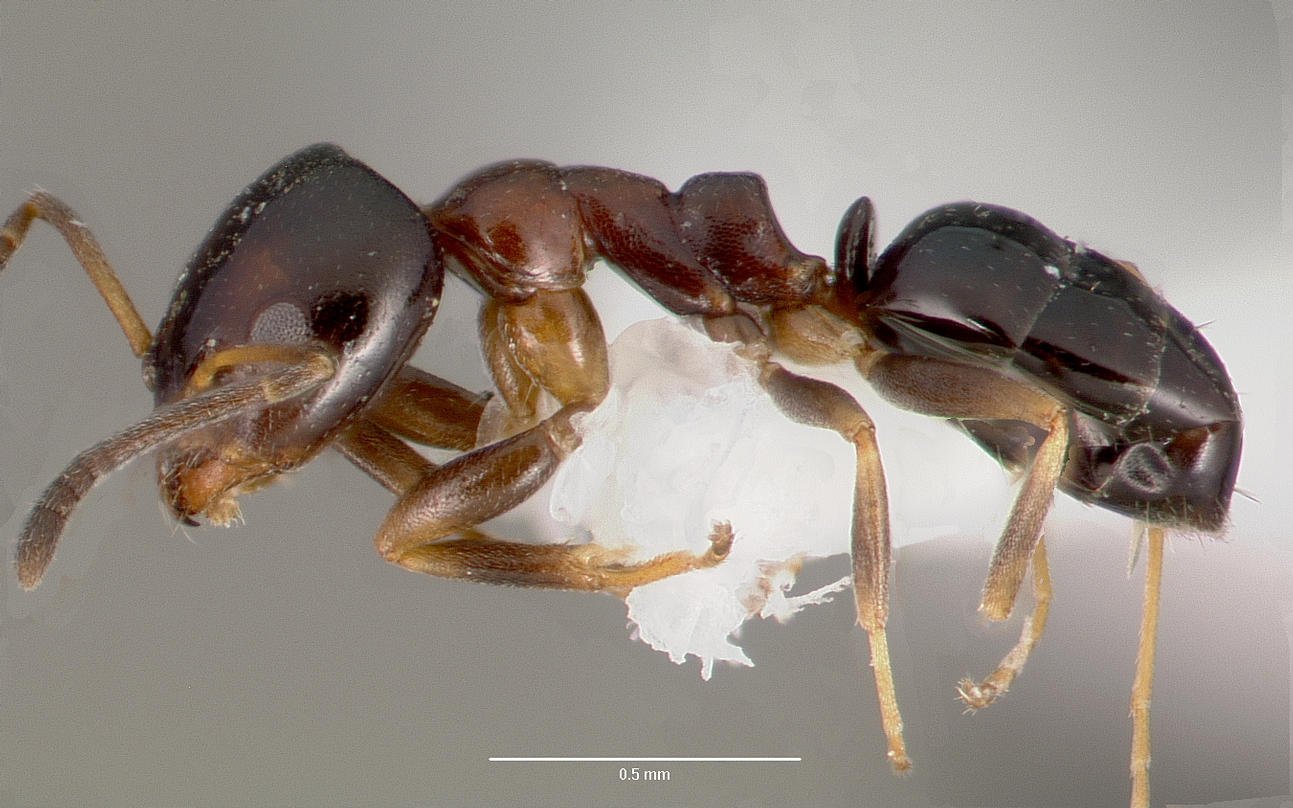
Small, shiny and black, and one of the most common kitchen ants in Sydney. It trails along skirting boards, window frames and power cables, and nests in wall voids, roof spaces and garden edges. It readily takes sweet baits.
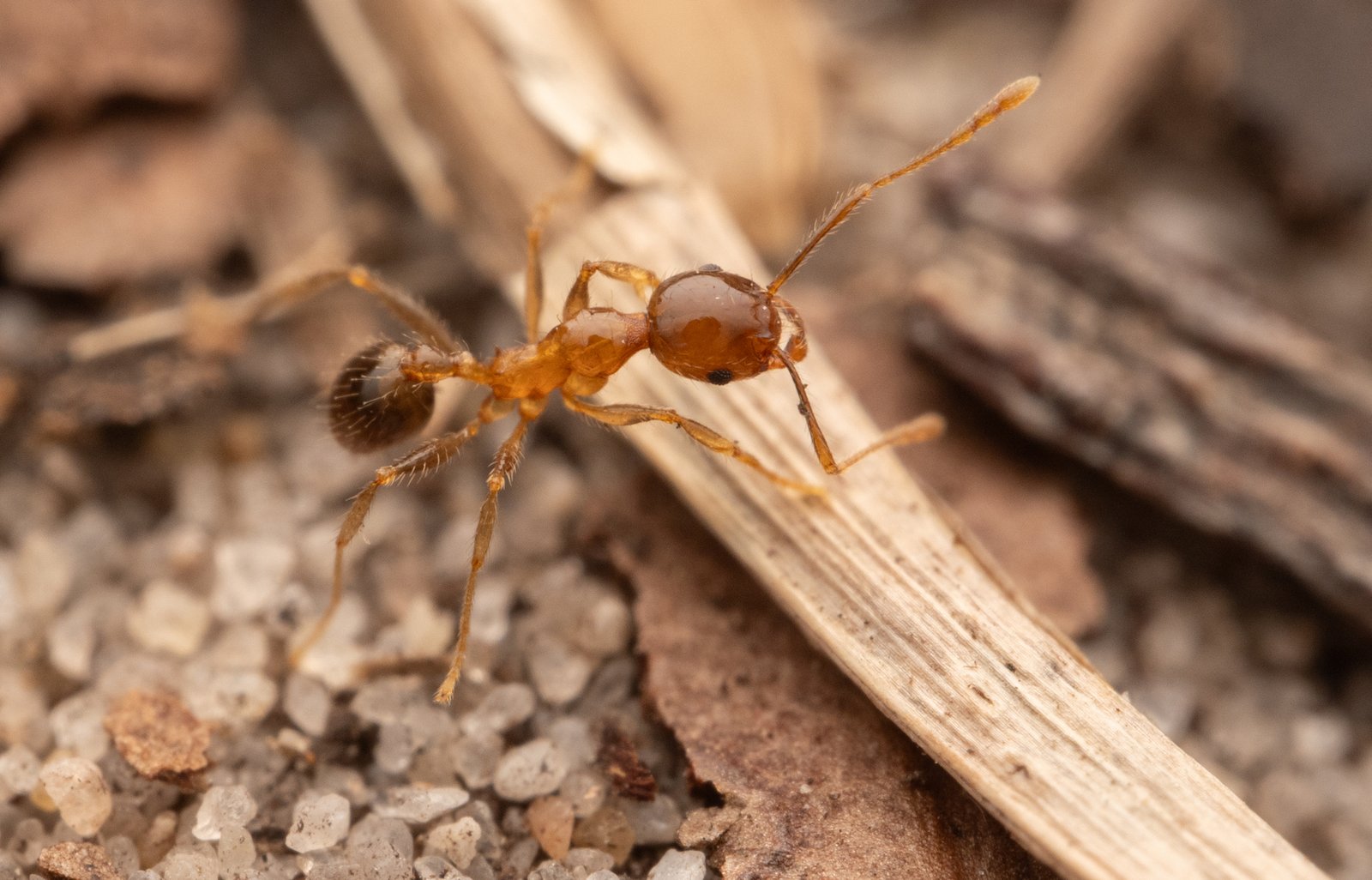
Tiny and brown, with a distinct large-headed soldier. The sign is loose sand appearing between pavers, along the slab edge and in grout lines. Many nests to a colony, which is why we use oil-based granular baits.
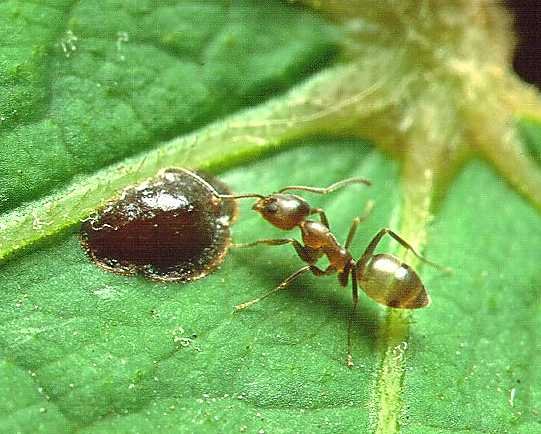
Small, dull brown and fast-moving in thick trails. Nests hold many queens and connect with neighbouring nests, so infestations can stretch across several properties. Repellent sprays are especially counter-productive with this species.
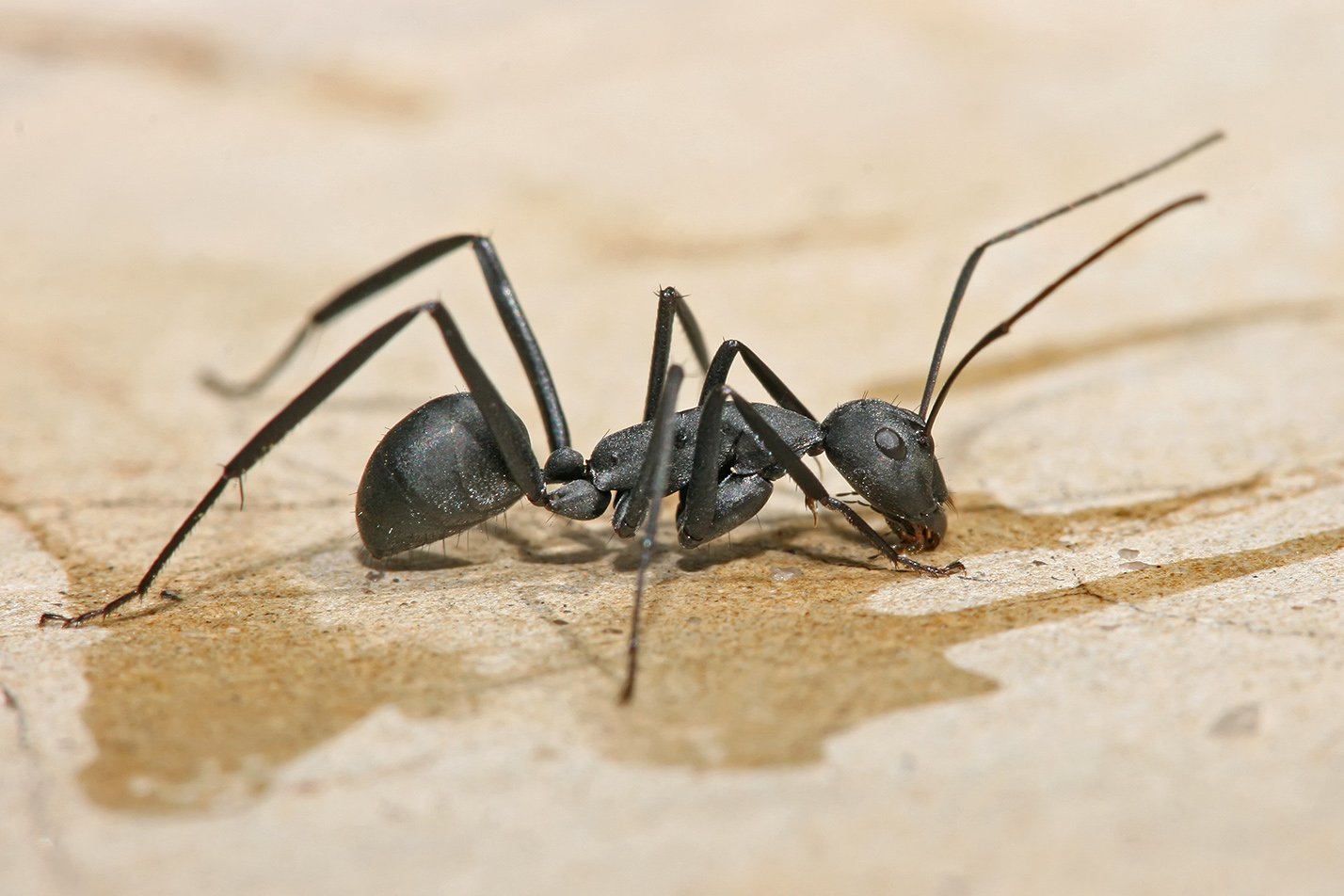
These are the large night-active ants that nest in soil, hollow trees and timber that has softened with damp. Structural damage is uncommon in Australia, but a wall nest points to a leak worth chasing.
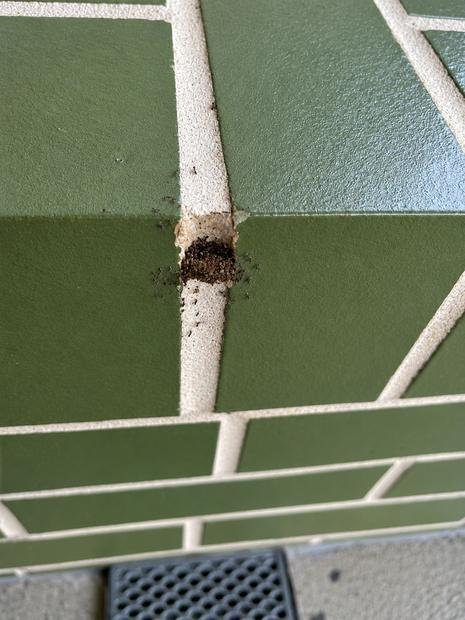
An Elite job photo showing a nest in masonry. Weep holes and cracked mortar lead into the wall cavity - the spot black house ants most often choose.
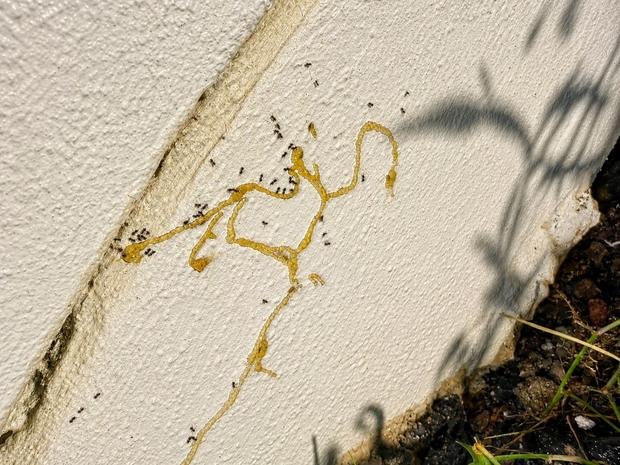
From an Elite job - gel bait set down on a live trail. The ants feed and carry it back to the nest, which is why we ask you not to wipe or spray that trail afterwards.
Where ants appear usually tells us where the nest is and which species we are dealing with.
A trail coming in from the external wall normally means a nest in the cavity or at the garden edge, and that entry point is where the tracing begins.
Fine soil pushed up along paving, driveways and slab joints is the classic sign of coastal brown ants nesting underneath.
A nest in a power point or appliance is about warmth. Spraying into electrical fittings is dangerous - tell us and we will treat it the right way.
Swarming winged ants in spring or summer are a mating flight. Seen inside the house, it often means the colony is mature and in the building.
Ant trails at the shower, vanity or toilet usually come down to moisture - either damp in the wall or a slow leak they are drinking from.
Bull ants and jumper ants nest in the lawn and garden beds. The sting is genuinely painful and in some people causes a serious allergic reaction.
One call to a licensed Sydney technician gets you straight advice and a fixed quote within 30 minutes.
Argentine ants and a number of house ants carry multiple queens. Spray them with a repellent and a queen plus a few hundred workers simply moves out and starts again nearby.
The difference matters. Retail sprays are repellent - ants sense them and avoid the treated area. Non-repellent products cannot be detected, so foragers cross them, pick up the active and take it back to the nest.
If the bait is not what they want today, they will walk past it. Preference moves between sugar and protein with brood demand, so we test and change as needed.
A bait program works over days. The worst thing you can do is spray the trail once we have gone - those ants are the delivery system. See our blog on budding in more detail.
Tracing first, then baits and non-repellent products that do the work after we leave.
Identification comes first. Then we trace the trails to the entry points and the nests themselves, whether those are in walls, paving, garden edges or the roof.
A test with small amounts of each bait type - sweet, protein, oil-based - tells us what the colony wants at this point in its cycle.
Indoor placements are gel on the trail - skirting, window frames, travel routes - sited away from children and pets.
A non-repellent treatment around the foundation, weep holes, door frames and paths intercepts ants coming in.
For nests beneath pavers and in lawn edges - typically coastal brown ants - we use granular bait or treat the nest directly.
You receive the job summary in writing, guidance on what to leave alone, and 6 months of warranty on the general treatment.
The same bait does not suit every ant. This is how we choose.
| Species | Usually feeding on | Treatment approach | Common mistake |
|---|---|---|---|
| Black house ant | Sugary liquids and honeydew, plus protein when raising brood | Sweet gel bait on trails, non-repellent perimeter at weep holes and frames | Wiping trails with detergent daily, which keeps the colony foraging elsewhere |
| Coastal brown ant | Protein and oil | Oil-based granular bait applied to paving and lawn edges | Pouring insecticide into one pile and assuming that was the colony |
| Argentine ant | Sugars, with protein at times | Slow-acting baits plus non-repellent treatment across the property line | Repellent barrier sprays, which split multi-queen nests |
| Sugar ants (Camponotus) | Nocturnal, on sweet foods and insects | Trails inspected at night, bait placed near the nest, timber moisture fixed | Only ever treating during the day, when there is nothing to see |
| Bull ants and jumper ants | Nectar and insects, outdoors | Treating the nest directly where it sits in lawn or garden bed | Digging the nest out by hand, which is how people get stung |
| Time of year | What is happening | What to watch for |
|---|---|---|
| Early spring (Sept to Oct) | Colonies become active and start on brood, which shifts them onto protein | Early indoor trails, and sand piles returning to the paving |
| Late spring to summer (Nov to Feb) | Foraging peaks, and warm humid spells trigger mating flights | Swarms of winged ants, and heavy trails following storms or heatwaves |
| Autumn (Mar to May) | Colonies peak in size and stock up for the cooler months | Trails into the pantry and around pet bowls |
| Winter (Jun to Aug) | Outside activity drops away, though nests in warm wall cavities carry on | Ants near heaters, hot water units and in the kitchen |
Most failed ant treatments come down to what happens in the week after.
A branch touching the roof is a bridge. Mulch banked against brickwork is harbourage. Most of what brings ants inside a Kensington home is in the garden immediately around it.
Fine soil pushed up along paving joints, path edges and garden edging is excavation - there is a nest directly beneath. Around Kensington that is coastal brown ants more often than not.
Activity climbs from early spring as colonies start brood-rearing, peaks through the hot months and tails off in autumn. Treating in early spring around Kensington gets ahead of it rather than chasing it.
The trail gets traced to its source. Spraying where you saw ants achieves very little.
Which bait we use depends on the ant and the season: sweet, protein or oil-based.
Non-repellent products only - they are taken back to the nest rather than scattering it.
If ants return within 6 months of a general treatment, we return at no charge.
Everything you need to know before you book. Still unsure? Call us — we're happy to help.
Get a Free QuoteAnt treatment starts from $89. There is no call-out charge in Kensington 2033. The final number comes down to the property itself, and it is fixed before we begin. Every general treatment carries a 6-month warranty.
Same-day attendance is usually available. Kensington is about 4.6 km south of the CBD in the Eastern Suburbs, and we give you a firm arrival time rather than an all-day window.
Being near the water means humidity that never really drops. Sub-floors stay moist, lower levels stay cool and damp, and ants do well in both.
Walk-up blocks and free-standing houses, with moisture the common factor. The sub-floor gets as much attention as the kitchen.
We do. A lot of our Kensington work is rentals and strata, so the report, the products used and the areas treated are all recorded in writing for whoever needs them.
Yes, with the usual care. Everything is APVMA-registered and used to label, and we will work around pets, aquariums and anyone in the house with a respiratory condition if you tell us when you book.
Most of the time you can carry on as normal. If a particular area needs to be empty we will flag it when we arrive and it is rarely more than a couple of hours.
An hour to two hours covers most jobs. The size of the building and the extent of the problem are what change it.
Every general treatment carries a 6-month warranty. Call us if activity picks up again and we will arrange the return visit.
Yes. As well as Kensington we cover Zetland, Waterloo, Moore Park and Eastlakes on the same runs, so a job that crosses a boundary can be handled in one visit.
Photographs from Elite jobs across Sydney — not stock imagery.
Fast and fully insured, with a no-obligation quote back to you within 30 minutes.