Days 1 to 3
Seeing more of them at first is expected. They come out, move slowly and die - the bait and growth regulator doing their job. Sweep up and leave everything else alone.

Cockroach Control in St Andrews 2566 — local technicians, fixed prices and a written report. A cockroach treatment starts from $89.
Real, verified feedback from people we've helped — straight from Google.
What we cover in St Andrews, and how quickly we can get there.
St Andrews sits about 38.6 km south-west of the CBD in the Macarthur, and postcode 2566 is one we are in most weeks. We cover St Andrews on scheduled runs through the Macarthur, and we will give you a firm time rather than a window.
A lot of our St Andrews jobs are in the streets around Minto Marketplace and Eagle Vale Marketplace, and we are out near Minto station regularly enough that the technician usually knows the access before they arrive.
St Andrews is in the Campbelltown and Camden area, and we cover Bow Bowing, Raby and Minto on the same runs - handy if you own more than one property or your cockroach problem has come from next door. On a newer estate the houses are near-identical and tightly spaced, which means a problem in one tends to turn up in the ones either side.
The bulk of our St Andrews work is estate houses with narrow side access and a shared fence line. Mention the detail when you call 1300 313 373 - it decides how long we need on site.
Spitfire Park and Jack Donohoe Park are on the same round, which means every part of 2566 is within our area.
Bookings for 2566 are confirmed the day before with a set arrival time, not an all-day window. Jobs at Bow Bowing and Raby often share the same run, which is how earlier slots come up.
Cockroaches do not respect a lease boundary. In a St Andrews block they move through service risers, shared drains and the cavity between units, so treating one kitchen in a building with a problem is money spent on a holding pattern.
One at night is a cockroach. One at midday is a population. When harbourage fills up they are forced into the open to find somewhere else, which is why daytime activity changes how we scope the job.
Cockroach calls climb from October and peak through February, because warmth shortens the time a nymph needs to reach breeding age. The same population that was manageable in a St Andrews kitchen in winter can double over a hot month.
Knowing the species tells us where the nest is and which treatment will work. Two of these photos are from our own Sydney jobs.

Light brown with two dark stripes behind the head, roughly 12 to 15 mm long. It lives indoors near warmth, food and moisture, and it is the species that breeds fastest inside a kitchen.

Up to roughly 4 cm long and reddish-brown. You find it in sewers, pits, grease traps and under the floor, and it travels up through drains after dark rather than nesting indoors.

About the same size as the American, distinguished by pale yellow margins behind the head and along the wing edges. It is an outdoor cockroach - mulch, garden beds and subfloors - that wanders inside.

A small banded cockroach that favours warmth and dryness rather than moisture. Look for it high up: behind frames, inside electrical enclosures and in cupboards well away from the sink.
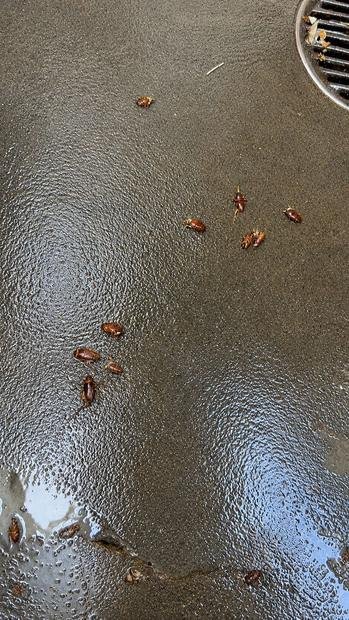
An Elite job photo of German cockroach activity on a Sydney inspection. Egg cases, shed skins and droppings in the harbourage are how we work out what we are dealing with.
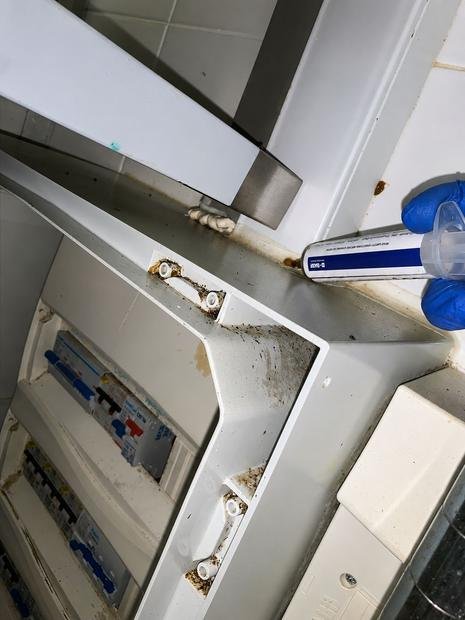
An Elite photo of cockroaches living inside commercial equipment. Warm motor cavities, perished door seals and hollow legs are the three places we open first on a kitchen job.
Where and when you see them is often a better clue than size. Use this to tell us what you are seeing when you call.
| What you see | Likely species | Where the nest usually is | What treatment focuses on |
|---|---|---|---|
| Cockroaches barely 15 mm out in the open by day, with dark pepper-like specks where cupboards meet | German cockroach, and an established one | Inside hinges, appliance cavities, the kickboard void, the housings of the appliances themselves | Gel baits rotated through the job, a growth regulator, and crack-and-crevice application indoors |
| A single big one after dark by the laundry tub, the bathroom or a floor drain | American cockroach | Stormwater and sewer pits, the space under the floor, floor wastes that have dried out | Treating the pits and drains, the subfloor, and sealing the gaps where pipes pass through |
| Large ones marked with yellow near the head, found in the garage or wandering in from the yard | Australian cockroach | Mulched beds, leaf litter, woodpiles, and the roof space above | Work outside: the perimeter, the roof void, and the harbourage in the garden itself |
| Small ones in a bedroom or living room - behind a picture, inside the TV cabinet - not near water | Brown-banded cockroach | Furniture and electrical gear that stays warm and dry | Baiting aimed at the living and sleeping rooms rather than the kitchen |
| Cockroaches that always come back to the flat no matter how well you treat your own kitchen | German cockroach moving around the block | Shared service risers, the bin room, and cavities inside the party walls | Treating the whole building together. See strata pest control |
Not sure? Send a photo when you book. Our guide to German vs American cockroaches has more ID tips.
One call to a licensed Sydney technician gets you honest advice and a fixed quote within 30 minutes.
A German cockroach egg case holds around 30 eggs, and the female carries it until shortly before hatching. Killing adults on the surface leaves the next generation untouched.
One female produces several egg cases, and in a warm kitchen the young reach maturity within weeks. That is how a handful becomes a serious problem in a short time.
Supermarket sprays and bombs repel. The colony moves further into the cavity, or next door, and your benchtops end up with residue on them.
Cockroach droppings, saliva and cast skins are recognised triggers for allergies and asthma, so a lingering infestation is a health issue as well as a nuisance.
What the technician does on the day, in the order it happens.
Species confirmation comes first, then the search. Torch and inspection mirror into cupboard hinges, appliance housings, the kickboard void and the wall cavity, so the treatment is aimed rather than general.
Grease and food residue keep a colony going, so we show you the spots that matter most. Bait only wins if it is the best meal in the room.
Rather than spray, we put small amounts of gel exactly where they travel. They eat and return to shelter, and that is how the treatment reaches the ones you never see.
Two products with different jobs: the growth regulator stops nymphs maturing, and dust carries the treatment into voids and cavities beyond the reach of gel.
Pits, floor wastes, the subfloor and the roof void get treated for the American and Australian species - they come in from there, so that is where it has to be done.
You get a written summary. If activity is still heavy after two weeks or returns within 6 months of a general treatment, we come back at no charge.
Some DIY options help with a few stray cockroaches. An established German cockroach colony is a different job.
| Method | What it does well | Where it falls short |
|---|---|---|
| Aerosol surface spray | Takes care of the one in front of you | Does nothing to egg cases or voids, and drives the rest deeper into the walls |
| Bug bombs and foggers | Reaches open floor and bench area without effort | Misses the harbourage entirely, leaves residue where you prepare food, and disperses them |
| Retail bait stations | Useful for a light problem | Low bait volume, and easily out-competed by crumbs and grease |
| Professional gel bait rotation | Taken into the harbourage and shared around; if they tire of one gel we change it | Needs the kitchen clean behind it, and works over days rather than hours |
| Insect growth regulator | Blocks nymphs from maturing into breeders and shuts the egg-case cycle down | Takes time to show, so it is always applied together with bait |
Ten minutes of preparation lets the bait reach more cockroaches.
Seeing more of them at first is expected. They come out, move slowly and die - the bait and growth regulator doing their job. Sweep up and leave everything else alone.
Through the second week activity should fall away. Leave the bait in place in hinges and cracks, and resist spraying anything over it, which puts cockroaches off feeding.
If it keeps going, let the agent or building manager know - cockroaches move between units readily. There is more on co-ordinated work on our apartment pest control page.
Steady activity at the two-week mark, or a return inside 6 months of a general treatment, means a warranty re-treatment - ring 1300 313 373.
Sydney does not give cockroaches an off-season. Around St Andrews the warm, humid stretch from October through March drives breeding hardest, but a heated Macarthur home keeps a kitchen population going through winter without pause.
A good share of our St Andrews work sits close to Minto Marketplace, though the back streets and the Bow Bowing boundary are just as familiar.
Council officers want records, not reassurance. For food premises around St Andrews we provide the treatment schedule, the products used, the monitoring point locations and the findings from each visit, in a form you can hand over.
The species sets the method - gel and growth regulator indoors for German cockroaches, pits and subfloor for the drain dwellers.
Bait placed in cracks and hinges, not a blanket spray over food preparation surfaces.
One flat or a whole commercial kitchen - food premises are done outside trading hours.
Six months on a general treatment - if they come back inside it, so do we, at no charge.
Everything you need to know before you book. Still unsure? Call us — we're happy to help.
Get a Free QuoteA cockroach treatment starts from $89. There is no call-out charge in St Andrews 2566. The final number comes down to the property itself, and it is fixed before we begin. Every general treatment carries a 6-month warranty.
We cover it on scheduled runs, so a day's notice gets you the best slot. Our Macarthur technicians cover St Andrews daily, and you get a confirmed arrival time when you book.
Estates are built fast and close. Shared fence lines, narrow side access and uniform construction mean cockroaches rarely stay at just one address.
Newer estate housing with narrow side access and young landscaping, which puts the focus on the boundary and the fence line.
Yes. Houses, townhouses, units, strata common property, rentals and commercial sites in St Andrews 2566 are all part of what we do, and the paperwork is the kind agents accept.
It is, as long as you follow what we tell you on the day - usually keeping off treated surfaces for a couple of hours. Let us know at booking about young children, pets or an aquarium.
Generally no. We will tell you on arrival if any part of the job means keeping out of a room for a while, so there are no surprises.
Typically one to two hours on site. What extends it is size, access and how far the problem has gone, all of which are accounted for in the quote.
Every general treatment carries a 6-month warranty. That is the point of the warranty - you do not pay twice for the same problem.
All of them. St Andrews sits alongside Bow Bowing, Raby, Minto and Varroville in our coverage, and they are serviced on the same schedule.
Photographs from Elite jobs across Sydney — not stock imagery.
Fully insured technicians who turn up when they say they will. Quote within 30 minutes, no obligation.