Repairing the damage
Hold off on repairs until we confirm the colony is no longer active. Replacing timber too early can remove the bait termites were feeding on. A builder should assess structural members like bearers, studs and roof timbers.

Termite Control in Port Hacking 2229 — local technicians, fixed prices and a written report. Termite treatment starts from $179 and a full timber pest inspection from $159.
Real, verified feedback from people we've helped — straight from Google.
Local technicians, fixed prices and a written report for every job in Port Hacking.
Port Hacking is part of the Sutherland Shire, 23.7 km or so south of the GPO, and 2229 is a postcode we know well. We run Port Hacking on a regular route, and same-day attendance is usually available.
The Port Hacking addresses we attend cluster around Shiprock Aquatic Reserve and Maian Bar Beach. Maris Park is another part of the suburb we are called to often.
We work under the Sutherland Shire area here, and Lilli Pilli, Dolans Bay and Maianbar are all on the same route, which matters when termite problems are moving between adjoining properties. Backing onto bush means re-entry is the issue, so proofing and the perimeter do the real work here.
What we see in Port Hacking is homes on sloping blocks with a sub-floor and bush on the boundary. Describing it accurately when you book saves a second visit.
The whole of 2229 is on our regular run.
The 2229 run is set the day before and you are given an arrival time. Where Lilli Pilli and Dolans Bay fall on the same round, we can usually bring the visit forward.
A mature colony can run to a million workers and eat through structural timber steadily rather than dramatically. Most of the serious damage we find in Port Hacking homes accumulated over years in a wall nobody opened.
Nasutitermes is common in gardens around Port Hacking and far less destructive than Coptotermes. Knowing which you have is the difference between urgent and manageable.
Swarming season around Port Hacking runs through the warmer, wetter months. A flight does not mean your house is infested, but it does mean a colony within flying distance has reached maturity.
Photos from our own Sydney termite jobs. Most properties need one primary method, and some need two working together.

Stations set into the soil around the building. Once termites find the timber inside, it is swapped for bait they carry back to the nest, which is how the colony is eliminated.
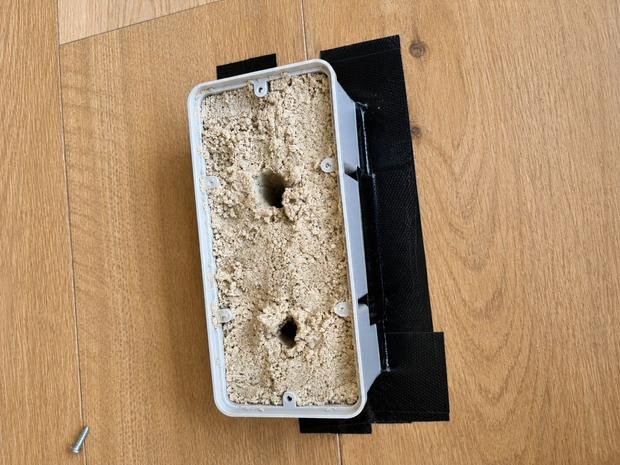
Stations are opened on a schedule to check for feeding and top up bait. Missed checks are a common reason baiting programs stall.
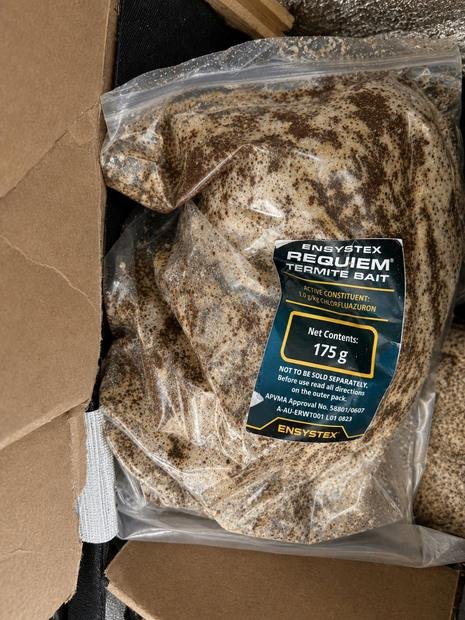
Active workings in a door frame or wall cavity can take bait fixed directly over them. Feeding starts at once, which is the fastest way onto a colony.
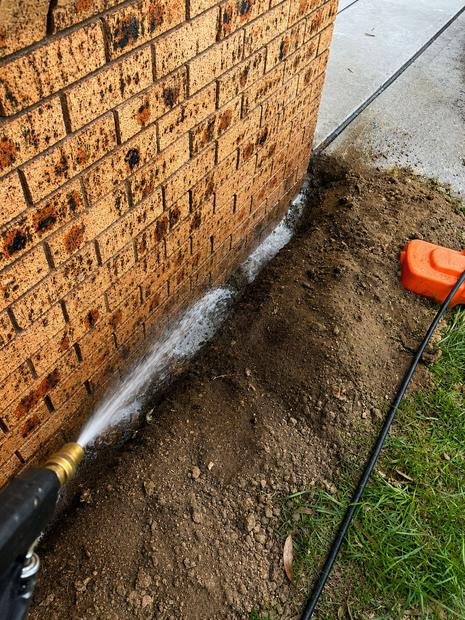
Termiticide placed into the soil around the building - trenched where there is soil, injected through drilled holes where there is concrete - forming a treated zone termites have to cross.

Where the floor is suspended we treat the soil around each pier and along the internal walls - the subfloor is where hidden activity usually starts.

You will be shown every piece of affected timber so a builder can price the repairs. Those repairs should wait until we have confirmed the colony is gone.
What you do in the first day or two affects how quickly the colony can be eliminated.
Surface spray and bombs are the worst thing to use here. The colony retreats from the treated area and you lose the access point we needed.
Mud tubes and eaten timber are best left alone. Open them up and they dry out, the termites withdraw, and the treatment takes longer.
Take pictures of anything you have seen and remember where. It tells us what to bring and where to start.
Have a look for a dripping tap, a hot water overflow or an air conditioner drain near where you found them. Damp soil is an attractant and has to be dealt with as well.
Subterranean termites keep eating while you wait. Same-day and next-day inspections of active termites are available across Sydney.
Townhouse or unit? Notify the strata manager promptly, because common property is usually involved.
A licensed Sydney technician will talk it through and give you a fixed quote within half an hour.
Both are recognised approaches for existing buildings under AS 3660.2. The right choice depends on your property.
| Consideration | Baiting system | Chemical soil barrier | Combination |
|---|---|---|---|
| The job it does | Wipes out the colony currently eating the building | Treats the soil around the building so anything crossing it is affected | Deals with the live colony, then protects against new arrivals |
| How it is applied | Perimeter stations in the ground, plus bait placed straight onto working termites | Trenched along the footings, drilled and injected under concrete | Staged: baiting, then soil treatment after the colony is dead |
| Impact on the site | Minimal - we neither drill the paths nor dig out the beds | Drilled holes in paving, sealed on completion, plus digging along the beds | Divided across a staged series of visits |
| Ongoing maintenance | Regular scheduled station checks, which double as ongoing monitoring | How long it lasts comes down to the product label and the site, and it can be re-applied | The station checks carry on while the barrier does its job |
| Best suited to | Live activity, properties with a lot of paving, or where chemical use must be kept down | Houses with decent access to open soil along the footings | Serious activity, properties attacked before, or high-risk blocks near bush |
Want more detail? Our guide to chemical, physical and baiting systems compares them side by side.
Termite treatment is a program over several visits, not a one-off spray.
Species confirmed, workings traced, and the roof void, subfloor and garden inspected to find where the nest and entry points are.
The plan is written down and priced: method, areas treated, products used, follow-up visits included.
Depending on the site: bait fixed to active workings, bait into in-ground stations, or termiticide into the soil where they move.
Monitoring runs until elimination: each visit records feeding and replenishes bait. Bigger colonies and cooler months take longer.
With the colony eliminated, the next question is protection - a soil barrier, continued station monitoring, or both together.
Everything applied is recorded in writing, with the recommended date for your next timber pest inspection.
Treatment starts from $179. Your fixed quote comes after we've seen the activity.
| Factor | Why it changes the price |
|---|---|
| How far it has spread | One door frame is quick. Activity through the subfloor and into the wall frames is a much bigger job |
| Method | Product volume and labour vary considerably between above-ground baiting, in-ground stations and a full barrier |
| Perimeter length & access | Long perimeters, low subfloor clearance and narrow side passages add time |
| Paving and slabs | Where a path, patio or garage slab has to be drilled and injected, it takes longer than open ground |
| How many visits | Baiting continues until elimination, so the colony's size decides how many return visits are needed |
| Building type | Strata buildings, commercial sites and homes with extensions or granny flats are scoped individually |
For typical scenarios, read how much termite treatment costs in Sydney. Warranty terms for termite work are confirmed in writing with your quote.
Hold off on repairs until we confirm the colony is no longer active. Replacing timber too early can remove the bait termites were feeding on. A builder should assess structural members like bearers, studs and roof timbers.
The in-ground stations are flush to the soil with locking lids. Leave them where they are - not buried in mulch, not concreted over - and tell us before any landscaping so we can relocate them.
The barrier depends on the soil staying put. Garden beds, pavers and decks built against the house are the usual way one gets broken, so talk to us before the work.
The standard, AS 3660.2, recommends an inspection at least annually and more frequently where risk is high. After a treatment, those inspections are how a new colony gets caught early.
Treatment removes the colony. These property conditions attract the next one, and most are cheap to fix.
Colonies forage over a wide area underground - tens of metres - so a stump, a timber retaining wall or an untreated deck on the adjoining block feeds a colony that can reach your Port Hacking house.
If you are buying in Port Hacking, get the timber pest inspection done before you exchange, not after. Afterwards it is information; beforehand it is leverage.
If you are anywhere in 2229, or over toward Lilli Pilli, you are inside the area we cover for inspections and treatment.
NSW licence 5122967, with termite work planned around AS 3660.2 for existing buildings.
We locate where they are coming from first, then decide the method. Treating what you can see achieves very little.
Products, areas and follow-ups all recorded, so you have the paperwork for your file, your insurer or a sale.
Return visits are built into the program so baiting is never left half-finished.
Everything you need to know before you book. Still unsure? Call us — we're happy to help.
Get a Free QuoteTermite treatment starts from $179 and a full timber pest inspection from $159. The fixed price depends on the size of the property and how far the problem has spread, and we confirm it before we start - there is no call-out fee in Port Hacking 2229. Treatments carry a 6-month warranty and we re-inspect annually.
Same-day attendance is usually available. Our Sutherland Shire technicians cover Port Hacking daily, and you get a confirmed arrival time when you book.
The bush is a permanent reservoir. Treating inside does little here unless the boundary and the perimeter are dealt with, because re-entry is the real issue.
Free-standing homes with gardens running into bush. We treat the boundary as seriously as the building.
Yes. Houses, townhouses, units, strata common property, rentals and commercial sites in Port Hacking 2229 are all part of what we do, and the paperwork is the kind agents accept.
Yes. Everything we use is registered for the purpose and applied at label rates, and we place product where people and animals do not go. Tell us about pets, aquariums or anyone with a respiratory condition at booking.
In most cases you can stay. Where an area does need to be left clear it is for a couple of hours at most, and we say so before we start.
Most termite control jobs in a Port Hacking home take between one and two hours on site, depending on the size of the property and how much of it is affected.
Treatments carry a 6-month warranty and we re-inspect annually. A return visit within the warranty period costs you nothing.
We cover the whole of Port Hacking, from the streets around Shiprock Aquatic Reserve out to the suburb boundary and on into Lilli Pilli.
Photographs from Elite jobs across Sydney — not stock imagery.
Friendly, fully insured technicians and a no-obligation quote inside 30 minutes.