Days 1 to 3
Expect more sightings, not fewer - slow-moving cockroaches out in the open or dead on the floor. That is the bait and growth regulator taking effect. Sweep them up.

Cockroach Control in Pagewood 2035 — local technicians, fixed prices and a written report. A cockroach treatment starts from $89.
Real, verified feedback from people we've helped — straight from Google.
Local technicians, fixed prices and a written report for every job in Pagewood.
Postcode 2035 covers Pagewood and the streets immediately around it. At about 8 km south of the CBD it falls in the Eastern Suburbs, where we have vans out daily. Our technicians are through Pagewood most days, so same-day attendance is usually available.
The Pagewood addresses we attend cluster around Westfield Eastgardens and Bonnie Doon Golf Course. Dalley Avenue Reserve is another part of the suburb we are called to often.
We work under the Waverley, Randwick and Woollahra area here, and Eastgardens, Botany and Hillsdale are all on the same route, which matters when cockroach problems are moving between adjoining properties. The coastal damp is the part that matters: sub-floors and ground-floor wet areas rarely dry out properly.
Around Pagewood the pattern is fairly consistent: unit blocks a street or two back from the water, plus the odd beachfront cafe. Tell us which it is on the phone and we will come prepared for it.
The whole of 2035 is on our regular run.
You get a confirmed time, not a window. We plan the 2035 run the day before, and if Eastgardens or Botany is on the same round there is often an earlier slot going.
If you are seeing them with the lights on, the numbers behind the kickboard are substantial. We treat a daytime report in Pagewood as an established infestation rather than a few strays.
If cockroaches keep appearing in a Pagewood bathroom rather than the kitchen, the drain is the first thing we check. They travel the pipework between units and come up wherever the seal has dried out.
Roughly forty juveniles come out of one case, and they are breeding themselves inside ten weeks. Unless a Pagewood treatment carries something that stops nymphs maturing, you are only ever resetting the clock.
Knowing the species tells us where the nest is and which treatment will work. Two of these photos are from our own Sydney jobs.

Small, 12 to 15 mm, light brown, marked with two dark stripes behind the head. This is the indoor breeder: it wants warmth, food and damp, and a kitchen supplies all three.

Reddish-brown and as long as 4 cm. It belongs to the drainage system - sewers, stormwater pits, grease traps, the subfloor - and arrives in the kitchen overnight from there.

Similar in size to the American cockroach but with pale yellow edges near the head and along the wings. Despite the name it is an outdoor species that comes in from gardens, mulch and subfloors.

A small species with pale bands across the body that prefers warm, dry spots higher up, such as behind picture frames, in electrical housings and inside cupboards away from water.
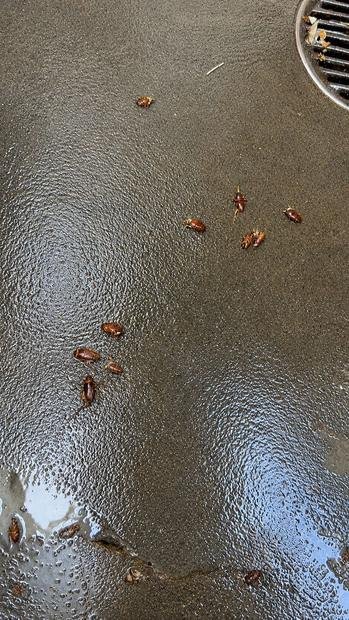
An Elite inspection photo showing German cockroach activity in Sydney. What we look for is the evidence - droppings, cast skins, egg cases - because it identifies the species and how long it has been there.
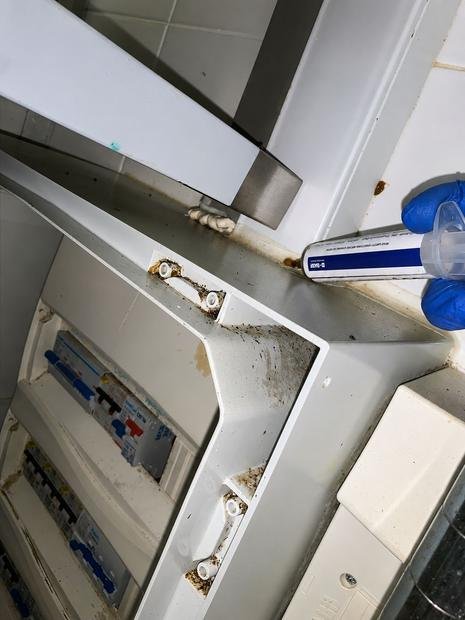
Taken on an Elite commercial job - harbourage inside the equipment itself. Motor cavities, door seals and hollow legs stay warm all night and rarely see a cloth.
Where and when you see them is often a better clue than size. Use this to tell us what you are seeing when you call.
| What you see | Likely species | Where the nest usually is | What treatment focuses on |
|---|---|---|---|
| A dozen small cockroaches on the bench in broad daylight, with dark specks in the cupboard corners | German cockroach, already a heavy infestation | The hinge of a cupboard door, behind the dishwasher and fridge, the kickboard void, inside appliances | Bait rotation and a growth regulator, applied into cracks and crevices right through the kitchen |
| Large cockroaches turning up at night around wet areas, usually one at a time | American cockroach | The pit system, the subfloor, and any floor-waste trap that has lost its water seal | Pit and drain work, subfloor treatment, and closing off pipe penetrations |
| Sizeable cockroaches with pale edging that appear in the garage or at a back door | Australian cockroach | Leaf litter and mulch, stacked timber, and the roof cavity | Treating the perimeter, dusting the roof void, and reducing harbourage in the garden |
| Small cockroaches turning up in bedrooms and living rooms, never around the sink | Brown-banded cockroach | Warm dry furniture, and the inside of electrical appliances | Bait placed through the living and sleeping areas where they actually are |
| A unit that goes quiet for a couple of weeks and then has cockroaches again | German cockroach coming through from another lot | The risers, bin room and wall cavities the units have in common | A treatment coordinated across the building. See strata pest control |
Not sure? Send a photo when you book. Our guide to German vs American cockroaches has more ID tips.
A licensed Sydney technician will talk it through with you and give you a fixed quote within half an hour.
Roughly 30 eggs sit in a single case, and the female keeps it with her until it is nearly ready to hatch. Nothing you spray on a surface touches it.
Multiply several egg cases per female by nymphs that mature in a few warm weeks and you have the reason a minor sighting turns into an infestation.
Bombs and supermarket sprays push cockroaches deeper into wall voids and into the unit next door, and can contaminate the surfaces you prepare food on.
Cockroach droppings, saliva and cast skins are recognised triggers for allergies and asthma, so a lingering infestation is a health issue as well as a nuisance.
What the technician does on the day, in the order it happens.
First we establish which cockroach it is, then map where it lives - torch and mirror into hinges, motor cavities, behind kickboards and into wall voids. Everything after this depends on that map.
Where build-up is feeding them, you will get a short list of what to clean and the order to do it in - bait has to out-compete everything else available.
We place gel in precise dots along their travel routes rather than spraying. They feed, return to the harbourage, and the effect spreads through the population by contact and feeding.
Two products with different jobs: the growth regulator stops nymphs maturing, and dust carries the treatment into voids and cavities beyond the reach of gel.
For American and Australian cockroaches we treat pits, floor wastes, the subfloor and roof void, because those species live outside the kitchen and travel in.
We leave you a written record of the job. If it is still heavy at two weeks, or comes back inside the 6 months a general treatment carries, we return at no charge.
Some DIY options help with a few stray cockroaches. An established German cockroach colony is a different job.
| Method | What it does well | Where it falls short |
|---|---|---|
| Aerosol surface spray | Quick on a cockroach you can actually reach | No effect on egg cases or harbourage, and it pushes the others deeper into cavities |
| Bug bombs and foggers | Reaches open floor and bench area without effort | Misses the harbourage entirely, leaves residue where you prepare food, and disperses them |
| Retail bait stations | Can help if you have only seen a few | The bait volume is small, and competing food such as grease wins out |
| Professional gel bait rotation | Taken back into the harbourage and passed on; we can change formulation if they go off one | Wants a clean kitchen behind it, and takes days to a fortnight rather than minutes |
| Insect growth regulator | Stops nymphs maturing into breeding adults, which breaks the egg-case cycle | Works slowly, so it is always paired with bait |
Ten minutes of preparation lets the bait reach more cockroaches.
Expect more sightings, not fewer - slow-moving cockroaches out in the open or dead on the floor. That is the bait and growth regulator taking effect. Sweep them up.
Numbers should drop away through this period. Do not wipe the bait out of hinges and cracks, and do not spray over it - cockroaches will stop taking bait that has been sprayed.
Still seeing them? Tell the agent or building manager, since the source is often a neighbouring lot. Apartment pest control explains what a building-wide job involves.
Steady activity at the two-week mark, or a return inside 6 months of a general treatment, means a warranty re-treatment - ring 1300 313 373.
A good share of our Pagewood work sits close to Westfield Eastgardens, though the back streets and the Eastgardens boundary are just as familiar.
Cockroaches do not respect a lease boundary. In a Pagewood block they move through service risers, shared drains and the cavity between units, so treating one kitchen in a building with a problem is money spent on a holding pattern.
A cockroach sighting in a Pagewood food business is a compliance problem before it is a pest problem. The program we run is built so the paperwork exists before anyone asks for it.
German cockroaches get baits and growth regulators, and drain species get pit and subfloor work. The species decides the treatment.
We bait into cracks and hinges instead of spraying benchtops, because that is where food is prepared.
Apartments through to commercial kitchens, with food businesses serviced when they are closed.
Cockroaches back within 6 months of a general treatment? We return at no charge.
Everything you need to know before you book. Still unsure? Call us — we're happy to help.
Get a Free QuoteA cockroach treatment starts from $89. What changes the figure is the size of the building, how many areas are affected and the access. You get that number up front for Pagewood 2035, with no call-out fee. Every general treatment carries a 6-month warranty.
Same-day attendance is usually available. Pagewood is about 8 km south of the CBD in the Eastern Suburbs, and we give you a firm arrival time rather than an all-day window.
The air never really dries out near the water, so sub-floors and lower rooms hold moisture through the year. cockroaches need that damp more than they need food, and here they always have it.
A mix of walk-up blocks and free-standing homes, where the lower level and the sub-floor are what we concentrate on.
We do all of those. A good share of the Pagewood jobs we run are tenanted or strata properties, so the written record comes as standard.
Yes, when it is applied properly. We use registered products at label rates and tell you which areas to keep clear and for how long. Mention pets, fish tanks or allergies when you book.
Normally you can stay. Some treatments mean keeping out of a particular room briefly, and we will flag that when we arrive so you can plan around it.
Typically one to two hours on site. What extends it is size, access and how far the problem has gone, all of which are accounted for in the quote.
Every general treatment carries a 6-month warranty. That is the point of the warranty - you do not pay twice for the same problem.
Yes. As well as Pagewood we cover Eastgardens, Botany, Hillsdale and Banksmeadow on the same runs, so a job that crosses a boundary can be handled in one visit.
Photographs from Elite jobs across Sydney — not stock imagery.
Fully insured technicians who turn up when they say they will. Quote within 30 minutes, no obligation.