Repairing the damage
Hold the repairs until elimination is confirmed - taking out the timber early removes the bait. Then have a builder assess the structural members, bearers and studs and roof timbers included.

Termite Control in Glenhaven 2156 — local technicians, fixed prices and a written report. Termite treatment starts from $179 and a full timber pest inspection from $159.
Real, verified feedback from people we've helped — straight from Google.
Local technicians, fixed prices and a written report for every job in Glenhaven.
Our Hills District technicians cover Glenhaven and the rest of 2156 as a matter of course - it is only about 26.3 km north-west of the city. We cover Glenhaven on scheduled runs through the Hills District, and we will give you a firm time rather than a window.
A lot of our Glenhaven jobs are in the streets around Dural Nature Reserve and Dural Golf Driving Range, and we are out near Kellyville Village regularly enough that the technician usually knows the access before they arrive.
We cover Castle Hill, Dural and Kenthurst on the same runs as Glenhaven, which helps when termite problems are moving between neighbouring properties. Backing onto bush means re-entry is the issue, so proofing and the perimeter do the real work here.
Around Glenhaven the pattern is fairly consistent: houses backing onto a reserve, where the pressure is constant from outside. Tell us which it is on the phone and we will come prepared for it.
We cover the remainder of 2156 as well, from Castle Hill Lions Park through to Glendale Park.
Your appointment is confirmed the day before with a real arrival time. Because Castle Hill and Dural are covered on the same round, 2156 often has an earlier slot available.
People assume they are covered until they claim. Termite damage is excluded as a maintenance issue, so for a Glenhaven home the only protection that exists is finding them early.
Termites are after cellulose, which means skirtings, architraves, door jambs, built-in wardrobes, floorboards and the paper facing on plasterboard - not just the frame. Stored cardboard and books in a Glenhaven garage are fair game too.
Coptotermes is the species that does most of the structural damage in Sydney, and it can nest inside a tree or a wall cavity as well as in soil. Identifying what is in the workings decides the Glenhaven treatment.
Photos from our own Sydney termite jobs. Most properties need one primary method, and some need two working together.

Soil stations placed around the footings. The timber inside draws termites in, bait replaces it, and the nest is destroyed by the workers' own foraging.
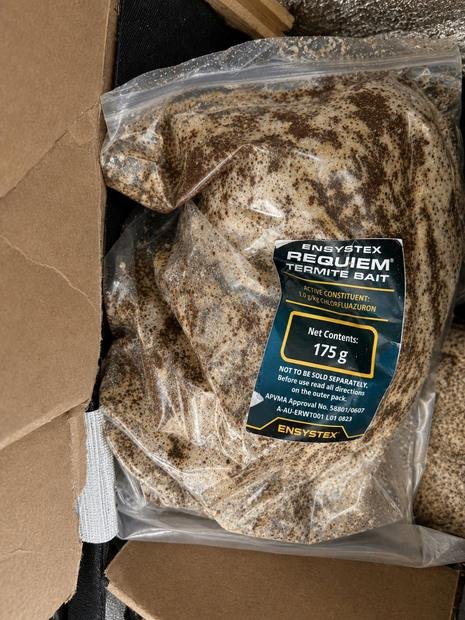
Stations are opened on a schedule to check for feeding and top up bait. Missed checks are a common reason baiting programs stall.
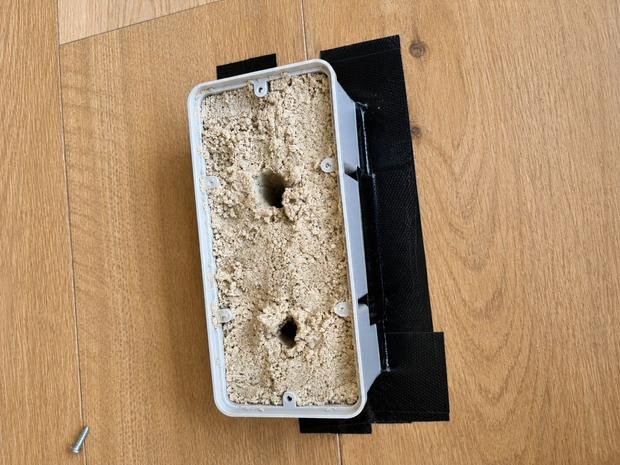
If there is active work inside a wall or architrave, we can mount bait straight onto it, which puts the colony onto bait immediately rather than waiting for them to find a station.
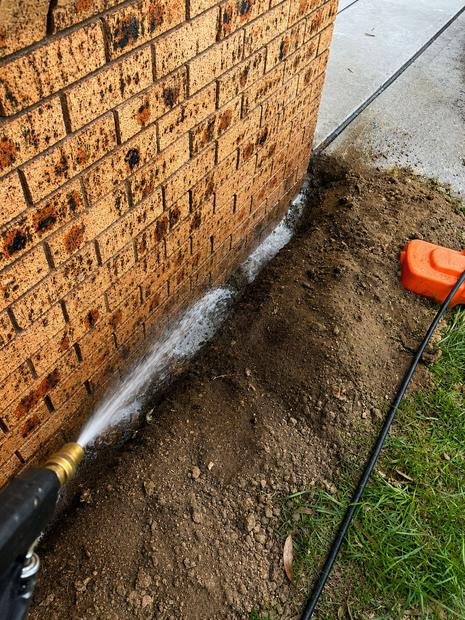
We trench along the footings and apply termiticide, drilling and injecting through paths and slabs where trenching is not possible, so the treated zone is continuous.

Suspended floors get the subfloor done too: the soil at the piers and along the walls, because that is where concealed attacks most often begin.

We mark up where the timber has gone so a builder can assess structural work - scheduled after, not before, the colony is confirmed eliminated.
What you do in the first day or two affects how quickly the colony can be eliminated.
Resist the spray can. You will kill a few workers and move the rest somewhere you cannot see, leaving nothing to bait.
Don't pull the workings apart. Exposed tubes dry and the colony retreats, which costs time on the treatment.
Photos help. Mud tubes, eaten timber, winged termites, and a note of the location, all make the visit more efficient.
Look around for water - leaks, overflow pipes, the air conditioner drip. Termites want damp soil, and treating without fixing it leaves the attraction in place.
Subterranean termites feed continuously, so waiting costs timber. Same-day and next-day inspections are available right across Sydney.
Townhouse or unit? Notify the strata manager promptly, because common property is usually involved.
Talk to a licensed Sydney technician today - honest advice and a fixed quote within 30 minutes.
Both are recognised approaches for existing buildings under AS 3660.2. The right choice depends on your property.
| Consideration | Baiting system | Chemical soil barrier | Combination |
|---|---|---|---|
| Main job | Eliminates the colony feeding on the building | Creates a treated zone so termites travelling through the soil are affected | Removes the active colony and protects against new ones |
| Method of install | Soil stations round the perimeter and bait onto the workings themselves | Trenching at the footings with drilling and injection through hard surfaces | Bait phase first, soil barrier second |
| Site disturbance | Almost none: no drilling through paths, no excavating garden beds | Small sealed drill holes in paving, and trenching where there are gardens | Spread across the staged visits |
| Maintenance | Scheduled checks of each station, which also serve as monitoring | Longevity depends on the label and the site, and it can be renewed | Ongoing station checks run in parallel with the barrier |
| Typically chosen for | Active termites, sites under extensive paving, or where chemical input must be minimised | Properties where there is good access to the soil at the footings | Heavy activity, a history of attacks, or a high-risk bushland block |
Want more detail? Our guide to chemical, physical and baiting systems compares them side by side.
Termite treatment is a program over several visits, not a one-off spray.
Identification comes first, then we trace the workings and search the roof void, subfloor and garden to locate the nest and the entry points.
You receive a fixed quote that names the method, the areas, the products and the return visits required.
Depending on the site: bait fixed to active workings, bait into in-ground stations, or termiticide into the soil where they move.
We keep coming back to read the feeding and refill bait until the activity ends. How long that takes depends on the colony and the time of year.
Once the colony is gone, we recommend a soil barrier, ongoing station monitoring, or both, to lower the risk of a new attack.
A written record of every product and location, and a date for the next timber pest inspection.
Treatment starts from $179. Your fixed quote comes after we've seen the activity.
| Factor | Why it changes the price |
|---|---|
| Extent of the attack | Contained activity in a single frame costs far less than termites spread across the subfloor and wall framing |
| Method chosen | Above-ground baiting, in-ground stations and full soil barriers use different amounts of product and labour |
| Size and access | The longer the perimeter and the tighter the subfloor and side access, the longer the job |
| Paving and slabs | Where a path, patio or garage slab has to be drilled and injected, it takes longer than open ground |
| Follow-up visits | Baiting needs return visits until the colony is gone, and larger colonies can need more of them |
| Property type | Strata buildings, commercial sites and homes that have been extended are each scoped separately |
For typical scenarios, read how much termite treatment costs in Sydney. Warranty terms for termite work are confirmed in writing with your quote.
Hold the repairs until elimination is confirmed - taking out the timber early removes the bait. Then have a builder assess the structural members, bearers and studs and roof timbers included.
You will have in-ground stations sitting flush with locking lids. Keep them clear of mulch and concrete, leave them in place, and call before landscaping so we can relocate them.
Treated soil works best left undisturbed. New garden beds, pavers or a deck against the house can break the treated zone, so call us before those works.
Annual inspections at minimum under AS 3660.2, and more frequently in high-risk locations. Once a property has had termites, those inspections are what protect it.
Treatment removes the colony. These property conditions attract the next one, and most are cheap to fix.
Risk is partly about the street, not just the building. Old stumps, timber fences and untreated structures nearby all sustain colonies within foraging distance of a Glenhaven home.
Around Glenhaven the risk is driven by what is in the soil and what the house is made of. Timber-framed homes with gardens against the slab edge are the ones we find activity in most often.
We are around Kellyville Village and the surrounding streets regularly, and we inspect every address in 2156 - including the ones the big franchises will not travel to.
Licensed in NSW under 5122967, with every termite job planned around AS 3660.2.
We work out where termites are coming from before choosing a method, rather than spraying what's visible.
Products, areas and follow-ups all recorded, so you have the paperwork for your file, your insurer or a sale.
Baiting only works if someone comes back, so the return visits are built into the program from the start.
Everything you need to know before you book. Still unsure? Call us — we're happy to help.
Get a Free QuoteTermite treatment starts from $179 and a full timber pest inspection from $159. What changes the figure is the size of the building, how many areas are affected and the access. You get that number up front for Glenhaven 2156, with no call-out fee. Treatments carry a 6-month warranty and we re-inspect annually.
We cover it on scheduled runs, so a day's notice gets you the best slot. Our Hills District technicians cover Glenhaven daily, and you get a confirmed arrival time when you book.
Leaf litter, fallen timber and undisturbed ground right up to the boundary keep termites populations healthy next door to you, whatever you do indoors.
Homes with sub-floors, roof voids and bush at the boundary - all three get inspected.
Yes. We work in houses, units, strata blocks, rentals and commercial premises across Glenhaven 2156, and we provide the written report agents and strata managers ask for.
It is, applied properly. We put product into cracks, voids and stations rather than across open surfaces, and we will tell you what to stay off and for how long before we leave.
Usually not. Most of the work is done with you in the house, and where a room does need to be clear it is for a short period we will tell you about on arrival.
Usually between one and two hours on site. Bigger properties and heavier infestations take more, and that is included in the quote rather than added afterwards.
Treatments carry a 6-month warranty and we re-inspect annually. Call us if activity picks up again and we will arrange the return visit.
Yes. As well as Glenhaven we cover Castle Hill, Dural, Kenthurst and Cherrybrook on the same runs, so a job that crosses a boundary can be handled in one visit.
Photographs from Elite jobs across Sydney — not stock imagery.
Fast and fully insured, with a no-obligation quote back to you within 30 minutes.