Repairing the damage
Hold off on repairs until we confirm the colony is no longer active. Replacing timber too early can remove the bait termites were feeding on. A builder should assess structural members like bearers, studs and roof timbers.

Termite Control in Guildford West 2161 — local technicians, fixed prices and a written report. Termite treatment starts from $179 and a full timber pest inspection from $159.
Real, verified feedback from people we've helped — straight from Google.
What we cover in Guildford West, and how quickly we can get there.
Our Greater Parramatta & Cumberland technicians cover Guildford West and the rest of 2161 as a matter of course - it is only about 22.8 km west of the city. We run Guildford West on a regular route, and same-day attendance is usually available.
A lot of our Guildford West jobs are in the streets around Yennora station and O S Young Park, and we are out near Hyland Road Reserve regularly enough that the technician usually knows the access before they arrive.
This is the City of Parramatta and Cumberland area, and our runs here also take in Yennora, Merrylands West and Fairfield. Terraces, semis and converted blocks share cavities and risers, which is why a single-unit treatment often does not hold on its own.
Around Guildford West the pattern is fairly consistent: apartments and converted blocks where the kitchen backs onto a service riser. Tell us which it is on the phone and we will come prepared for it.
Our Guildford West runs also take in Neeta City Shopping Centre and the area near Woodville Golf Course, so the whole postcode is served.
You get a confirmed time, not a window. We plan the 2161 run the day before, and if Yennora or Merrylands West is on the same round there is often an earlier slot going.
They eat from the inside out and leave the paint film intact, so a Guildford West skirting board can look perfect and sound papery when you tap it. That hollow note is often the first real evidence.
Subterranean termites must stay in contact with soil moisture, so they build pencil-width mud tubes to carry it with them. On a Guildford West pier, slab edge or internal wall, those tubes are the most reliable sign there is.
Garden beds built up over the slab edge, timber sleepers against the wall, and mulch piled to the brickwork all give termites a covered path straight past whatever protection the house has. It is the most common fault we find in Guildford West.
Photos from our own Sydney termite jobs. Most properties need one primary method, and some need two working together.

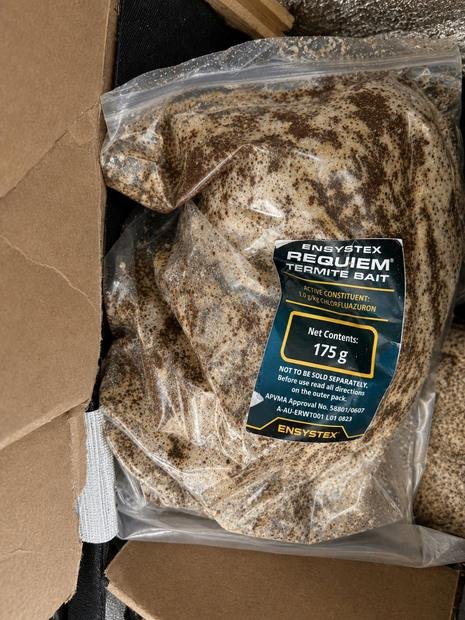
Stations go into the ground around the building with timber inside. Termites locate it, we switch the timber for bait, and the colony is eliminated from the inside out.
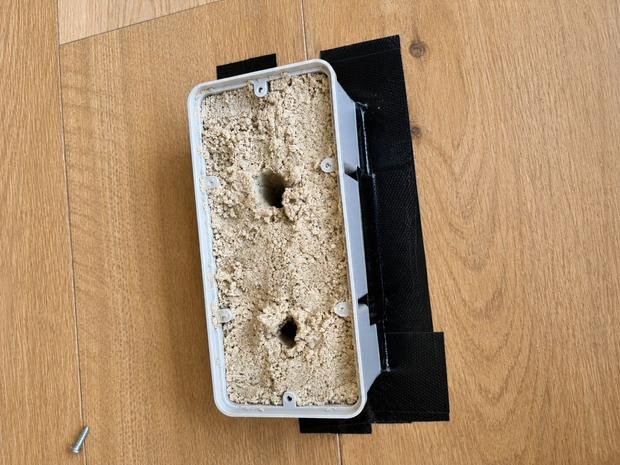
Scheduled visits to inspect feeding and replace consumed bait. A baiting program only works if it is kept topped up, which is why the checks are part of it.
Where termites are working inside a wall or door frame, bait can be fixed directly over the active workings so the colony starts feeding straight away.
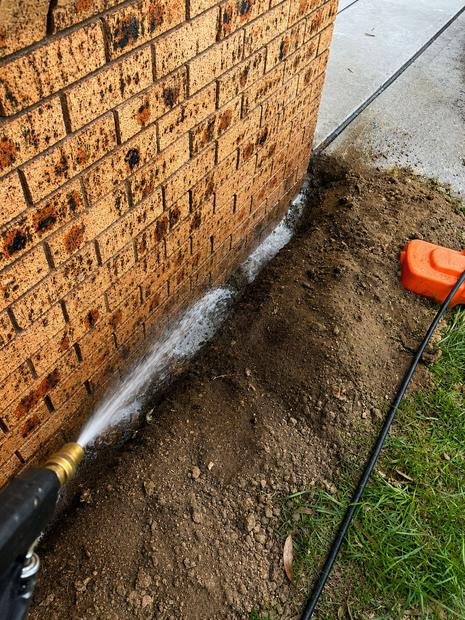
Termiticide applied into a trench along the footings, or injected through drilled holes in paths and slabs, creating a treated zone in the soil around the building.

Suspended floors get the subfloor done too: the soil at the piers and along the walls, because that is where concealed attacks most often begin.

The eaten timber is identified and recorded so a builder can quote. Hold the repairs until the colony is confirmed dead or you may remove what they are feeding on.
What you do in the first day or two affects how quickly the colony can be eliminated.
Surface spray and bombs are the worst thing to use here. The colony retreats from the treated area and you lose the access point we needed.
Tempting as it is, leave the workings whole. A broken tube dries, the termites pull back, and we lose the active site.
If you can, photograph what you found - tubing, damaged timber, flying insects - and tell us where. It shapes how we scope the inspection.
Look around for water - leaks, overflow pipes, the air conditioner drip. Termites want damp soil, and treating without fixing it leaves the attraction in place.
Subterranean termites keep eating while you wait. Same-day and next-day inspections of active termites are available across Sydney.
In a unit or townhouse, activity in one lot often involves common property, so let the strata manager know early.
One call to a licensed Sydney technician gets you straight advice and a fixed quote within 30 minutes.
Both are recognised approaches for existing buildings under AS 3660.2. The right choice depends on your property.
| Consideration | Baiting system | Chemical soil barrier | Combination |
|---|---|---|---|
| What it is for | Destroying the colony that is feeding on your building | Putting a treated zone in the soil, so termites moving through it are affected | Killing the colony that is there and guarding against the next |
| Installation | In-ground stations around the perimeter, with bait fixed to any live workings | A trench along the footings, plus drilling and injection where there is paving or slab | Baiting to start, and the soil work once the colony has gone |
| Disruption to the property | Very little - no paths drilled, no garden beds dug up | Small holes through paving, sealed afterwards, and trenching along garden beds | Shared out over several staged visits |
| Upkeep | Stations checked on a regular schedule and kept as monitoring | Service life depends on the product label and site; can be re-applied | Station checks continue while the barrier works |
| Suits | Active termites, heavily paved sites, or where chemical use needs limiting | Homes with good access to soil around the footings | Heavy activity, repeat attacks or high-risk sites near bushland |
Want more detail? Our guide to chemical, physical and baiting systems compares them side by side.
Termite treatment is a program over several visits, not a one-off spray.
We confirm which termite it is and how far it has gone, following the tubing and checking roof void, subfloor and garden for the nest.
Everything goes in writing before we start - method, treatment areas, products and the follow-up schedule - at a fixed price.
Treatment goes where the termites actually are - bait on the workings or in stations, or termiticide in the travelled soil.
We keep coming back to read the feeding and refill bait until the activity ends. How long that takes depends on the colony and the time of year.
After elimination we advise on protection: a chemical soil barrier, ongoing monitoring through the stations, or a combination of the two.
You get the paperwork - what went where - along with when the next timber pest inspection is due.
Treatment starts from $179. Your fixed quote comes after we've seen the activity.
| Factor | Why it changes the price |
|---|---|
| Extent of the attack | Contained activity in a single frame costs far less than termites spread across the subfloor and wall framing |
| Treatment method | The three approaches - above-ground bait, in-ground stations, full soil barrier - differ in both product and time |
| How big and how reachable | Time goes up with perimeter length, and again with low subfloor clearance or narrow side access |
| Concrete & paving | Paths, patios and garage slabs that must be drilled and injected take longer than open soil |
| How many visits | Baiting continues until elimination, so the colony's size decides how many return visits are needed |
| What sort of property | A strata block, a commercial site or a house with an extension or granny flat is quoted individually |
For typical scenarios, read how much termite treatment costs in Sydney. Warranty terms for termite work are confirmed in writing with your quote.
Hold off on repairs until we confirm the colony is no longer active. Replacing timber too early can remove the bait termites were feeding on. A builder should assess structural members like bearers, studs and roof timbers.
Stations sit level with the soil and lock shut. They must not be moved, mulched over or paved across. If landscaping is coming, let us know first and we will relocate them.
Treated soil works best left undisturbed. New garden beds, pavers or a deck against the house can break the treated zone, so call us before those works.
Inspections at least every 12 months is the AS 3660.2 recommendation, with shorter intervals in high-risk areas. Post-treatment, that is what finds the next colony while it is small.
Treatment removes the colony. These property conditions attract the next one, and most are cheap to fix.
Pre-purchase is when this matters most. A report naming active termites or past damage in a Guildford West house changes the price or the decision - but only if you have it before you sign.
Risk is partly about the street, not just the building. Old stumps, timber fences and untreated structures nearby all sustain colonies within foraging distance of a Guildford West home.
Coptotermes is the species that does most of the structural damage in Sydney, and it can nest inside a tree or a wall cavity as well as in soil. Identifying what is in the workings decides the Guildford West treatment.
NSW licence 5122967. Work on existing buildings is planned against AS 3660.2.
Finding the source comes before picking a treatment. Spraying the visible workers is not a plan.
You get written records of products used, areas treated and visits made, suitable for an insurer or a buyer's inspector.
Return visits are included rather than optional, which is why our baiting programs actually finish.
Everything you need to know before you book. Still unsure? Call us — we're happy to help.
Get a Free QuoteTermite treatment starts from $179 and a full timber pest inspection from $159. We quote on the property rather than the postcode, so a unit in Guildford West and a large house are priced differently. The figure is fixed before any work starts. Treatments carry a 6-month warranty and we re-inspect annually.
Same-day attendance is usually available. Guildford West is about 22.8 km west of the CBD in the Greater Parramatta & Cumberland, and we give you a firm arrival time rather than an all-day window.
Older inner suburbs combine shared structure with ageing drainage, and termites exploit both. Rear courtyards that have been paved over make it worse by trapping damp against the walls.
Terraces and semis that share walls, roof voids and drainage - so we look at what the property adjoins before deciding where product goes.
We do. A lot of our Guildford West work is rentals and strata, so the report, the products used and the areas treated are all recorded in writing for whoever needs them.
Yes. Everything we use is registered for the purpose and applied at label rates, and we place product where people and animals do not go. Tell us about pets, aquariums or anyone with a respiratory condition at booking.
In the great majority of jobs, no. If one area needs to be left for an hour or two we say so before we start rather than after.
Allow one to two hours for a typical Guildford West property. Larger homes, or ones where the problem has spread, take longer and we will say so when we quote.
Treatments carry a 6-month warranty and we re-inspect annually. A return visit inside that period does not cost you anything.
All of them. Guildford West sits alongside Yennora, Merrylands West, Fairfield and Fairfield East in our coverage, and they are serviced on the same schedule.
Photographs from Elite jobs across Sydney — not stock imagery.
Fully insured technicians who turn up when they say they will. Quote within 30 minutes, no obligation.