Budding splits the colony
Argentine ants and a number of house ants carry multiple queens. Spray them with a repellent and a queen plus a few hundred workers simply moves out and starts again nearby.

Ant Control in Mascot 2020 — local technicians, fixed prices and a written report. Ant treatment starts from $89.
Real, verified feedback from people we've helped — straight from Google.
Local technicians, fixed prices and a written report for every job in Mascot.
Mascot is part of the Inner South & City Fringe, 6.9 km or so south of the GPO, and 2020 is a postcode we know well. Our technicians are through Mascot most days, so same-day attendance is usually available.
A lot of our Mascot jobs are in the streets around Mascot station and Robey Street Reserve, and we are out near The Lakes Golf Course regularly enough that the technician usually knows the access before they arrive.
This is the City of Sydney and Bayside area, and our runs here also take in Rosebery, Eastlakes and Botany. Terraces, semis and converted blocks share cavities and risers, which is why a single-unit treatment often does not hold on its own.
Mascot jobs tend to be older semis with a paved rear courtyard and a sub-floor that no longer dries out. Let us know which when you ring and we will plan the visit around it.
Every part of 2020 is covered as standard.
You get a confirmed time, not a window. We plan the 2020 run the day before, and if Rosebery or Eastlakes is on the same round there is often an earlier slot going.
Many ants get most of their sugar from honeydew - the secretion of aphids and scale insects they actively protect on garden plants. A Mascot garden with a scale problem is feeding the ant colony that then comes indoors.
If trails appear in winter, or in a first-floor bathroom with no outdoor route, the nest is probably inside the building.
Ants lay a pheromone trail that other workers follow, which is why the line is so precise and why it reappears in exactly the same place after you wipe it. Cleaning a Mascot kitchen removes the smell for a few hours, not the colony that laid it.
Each of these behaves differently, so the bait and the placement change too. Two photos come from our own jobs.
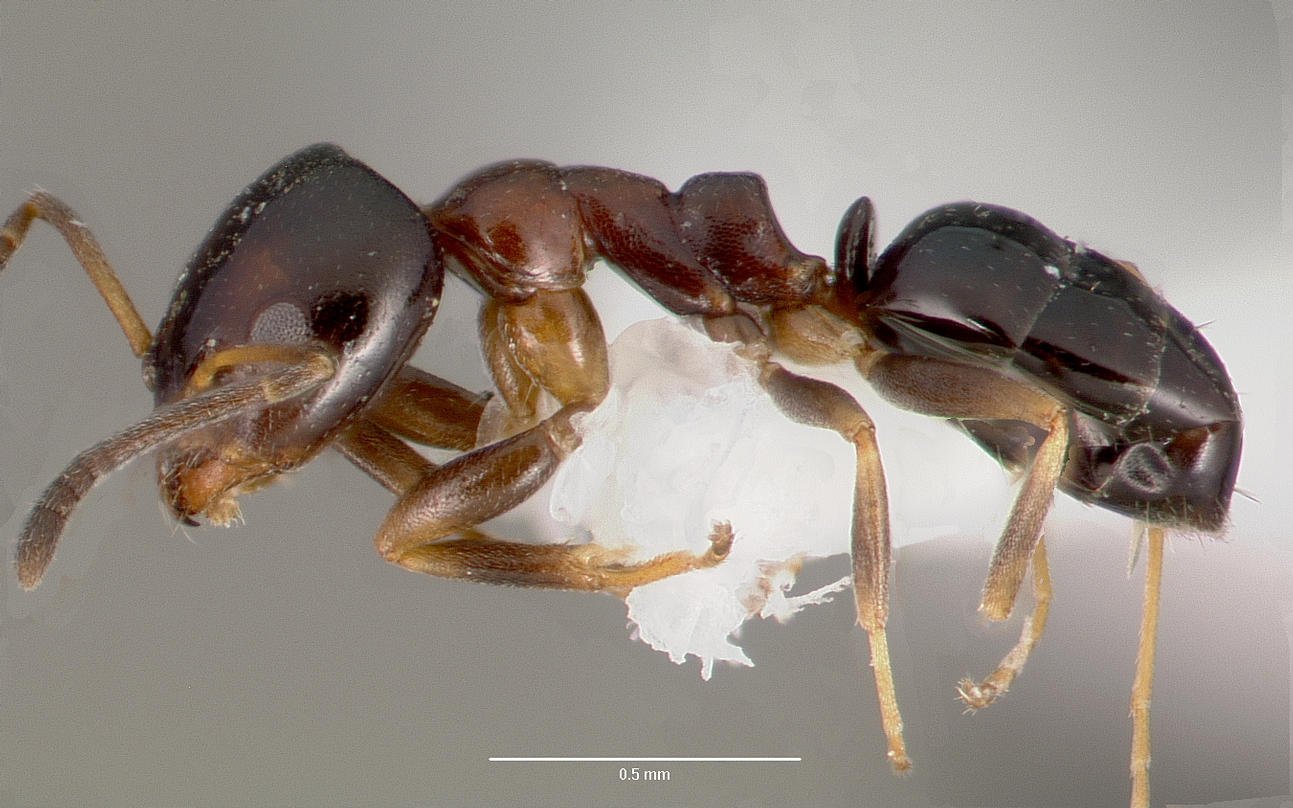
Shiny, black and small - Sydney's most common indoor ant. Trails follow skirting boards, window frames and power cables back to nests in wall voids, roof spaces or garden edges. Sweet baits work well on it.
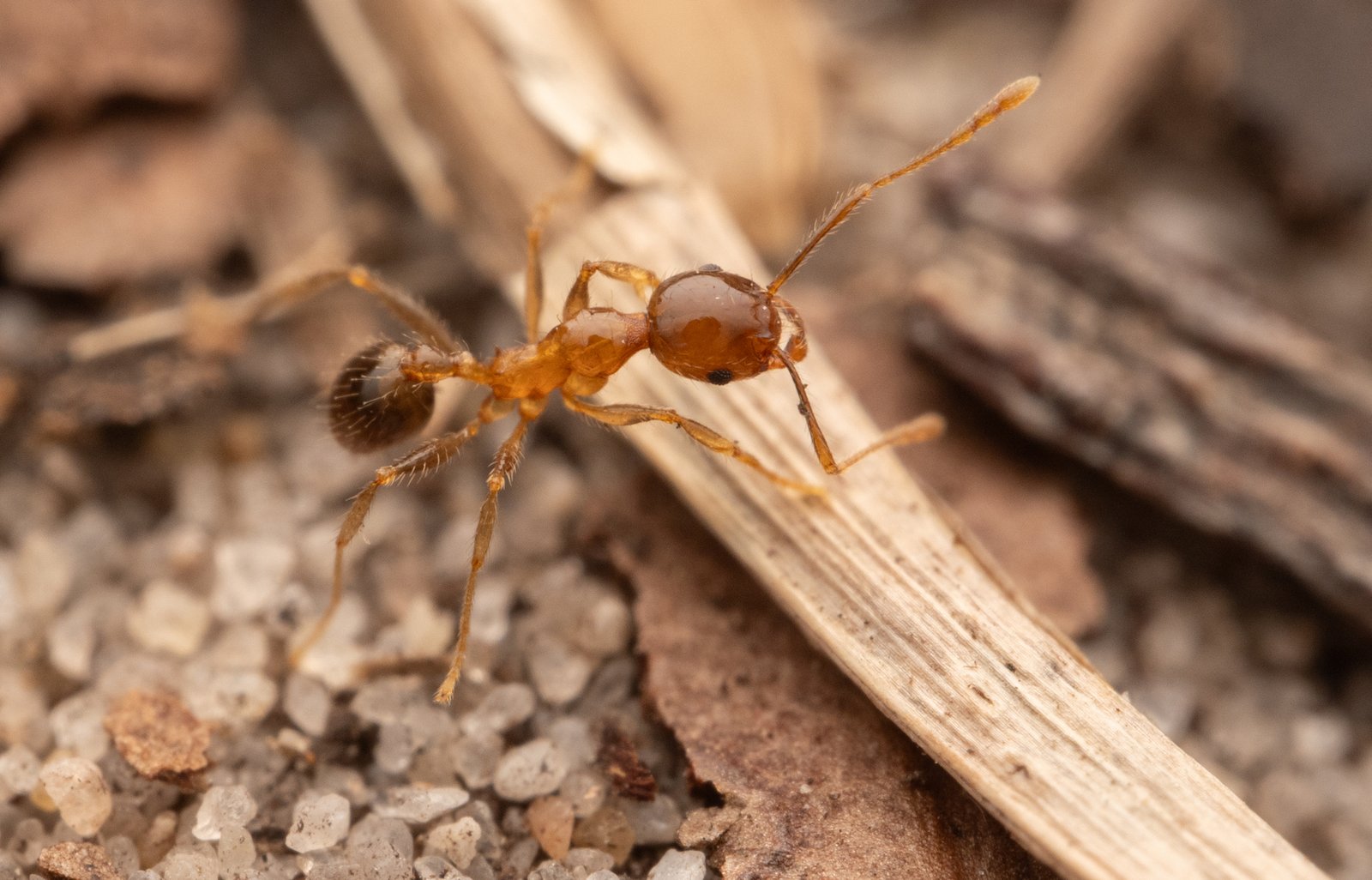
Minute brown ants with larger-headed soldiers among them. Fine sand in paving joints, at slab edges and in grout is the tell. Because a colony holds many nests, oil-based granular baits are the right approach.
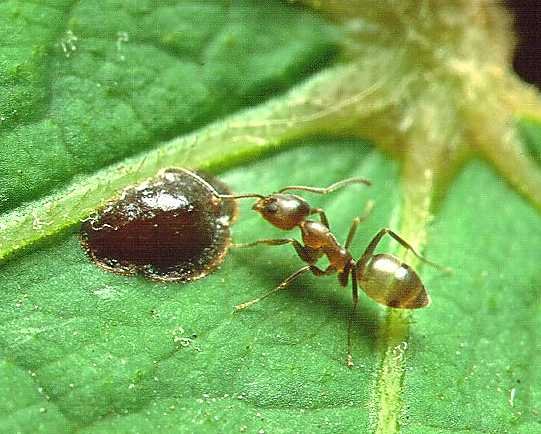
Fast-moving, small and dull brown, in thick trails. Its nests are multi-queen and interconnected with neighbouring nests, so it spreads across properties - and repellent sprays accelerate exactly that.
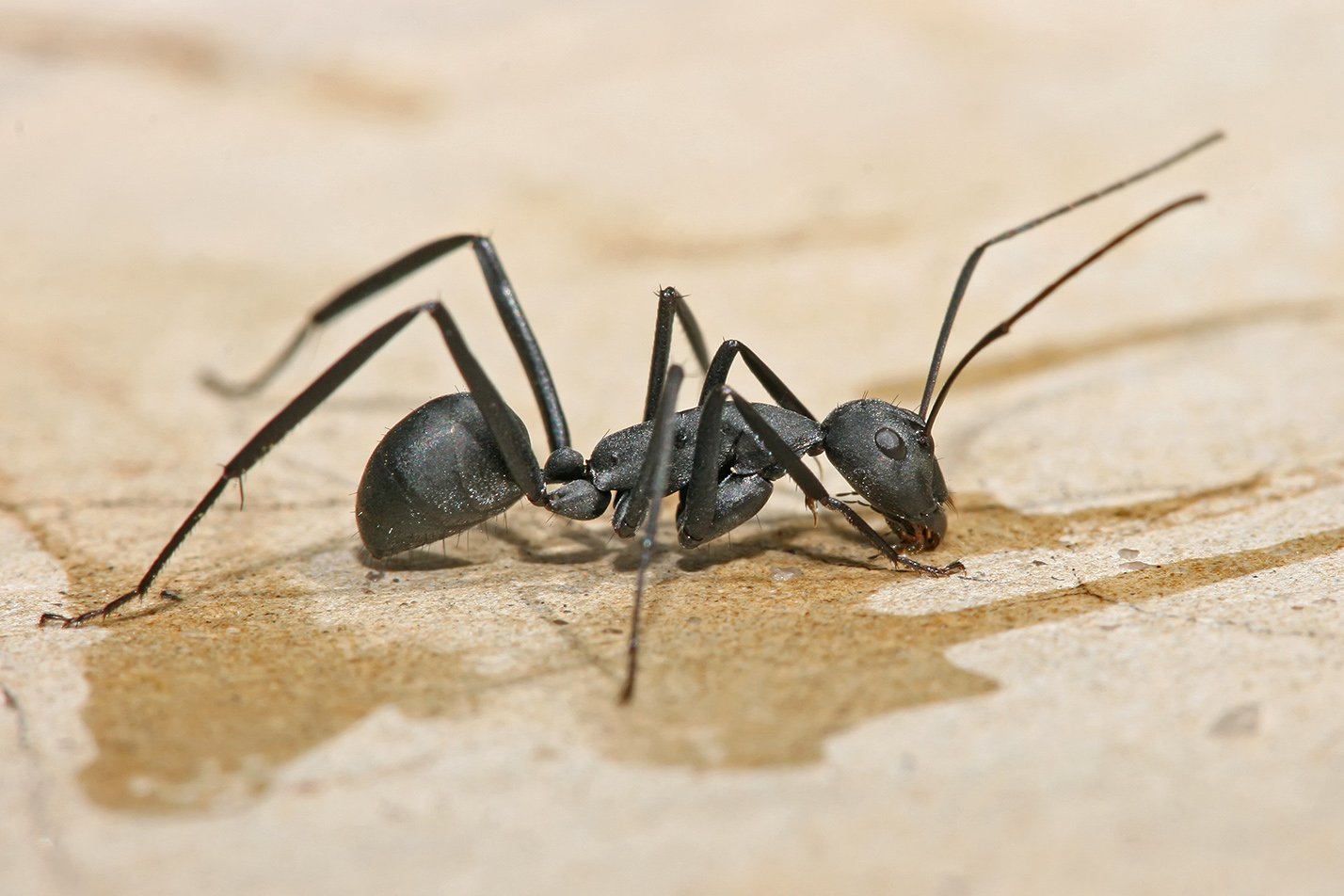
Big ants, usually out after dark, nesting in soil, hollow trees and timber that has gone soft or damp. They are not the structural threat their overseas relatives are, but finding one in a wall usually means there is a leak behind it.
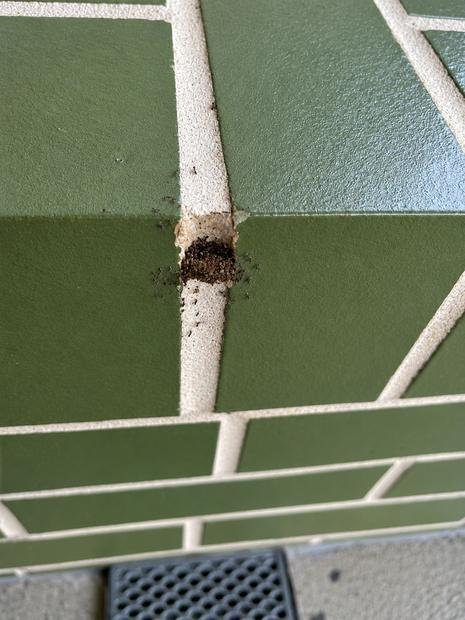
Photo from an Elite job: an ant nest emerging from a mortar joint. Weep holes and cracked mortar lead straight into the wall cavity, which is where many black house ant colonies live.
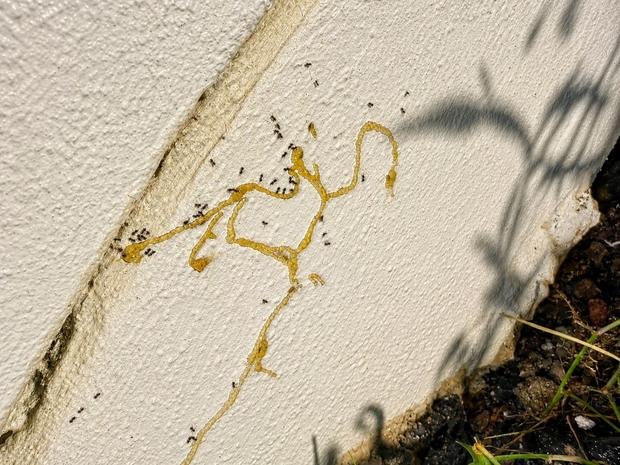
Photo from an Elite job: gel bait placed along an active trail. The ants are left to feed and carry the bait home, so we ask customers not to wipe or spray the trail afterwards.
Where ants appear usually tells us where the nest is and which species we are dealing with.
A trail coming in from the external wall normally means a nest in the cavity or at the garden edge, and that entry point is where the tracing begins.
Loose fine soil along paving, driveway joints and the slab edge means coastal brown ants have nested underneath.
Electrical fittings and switches stay warm, which is why ants nest in them. Do not spray into them; let us know and we will handle it properly.
Mating flights produce the winged swarms you see in spring and summer. Finding them indoors suggests a mature colony inside rather than outside.
Bathroom trails around the shower, basin or toilet normally mean water: damp in the wall cavity, or a slow leak supplying the colony.
These are the bull ants and jumper ants nesting in lawns and beds - a painful sting, and a risk of serious allergic reaction for some.
One call to a licensed Sydney technician gets you straight advice and a fixed quote within 30 minutes.
Argentine ants and a number of house ants carry multiple queens. Spray them with a repellent and a queen plus a few hundred workers simply moves out and starts again nearby.
Retail sprays repel: the ants know they are there and go round. Professional non-repellents do not register, so the foragers deliver the active to the colony for us.
A colony's appetite shifts between sugar and protein with the brood cycle. Bait only works when it matches, which is why we test preferences on site.
Bait takes days to work through a colony. If you spray the trail the day after we leave, you kill the couriers. Our blog explains budding in more detail.
Tracing first, then baits and non-repellent products that do the work after we leave.
Species confirmed, then trails traced to entry points and to the nests - walls, paving, garden edges, roof space.
Small amounts of sweet, protein and oil-based bait show what the colony is feeding on right now.
We run gel along the active trails, window frames and skirting, keeping every placement out of reach of children and animals.
We treat the foundation line, weep holes, door frames and paths with a non-repellent so incoming ants carry it with them.
Under-paver and lawn-edge nests are handled with granular bait, or treated directly where that is better.
A written summary, clear advice on what not to spray afterwards, and a 6-month warranty on the general treatment.
The same bait does not suit every ant. This is how we choose.
| Species | Usually feeding on | Treatment approach | Common mistake |
|---|---|---|---|
| Black house ant | Sugary liquids and honeydew, plus protein when raising brood | Sweet gel bait on trails, non-repellent perimeter at weep holes and frames | Wiping trails with detergent daily, which keeps the colony foraging elsewhere |
| Coastal brown ant | Protein and oils | Oil-based granular bait on paving and lawn edges | Pouring boiling water or insecticide into one pile while dozens of nests remain |
| Argentine ant | Chiefly sugars, with protein at intervals | Slow-release baits plus a non-repellent treatment along the property line | Repellent sprays at the boundary, which make a multi-queen colony bud |
| Sugar ants (Camponotus) | Sweet foods and insects, mostly at night | Night-time trail inspection, bait near the nest, fix moisture in timber | Treating only in daylight when the ants are not active |
| Bull ants and jumper ants | Insects and nectar, always outside | The nest itself is treated directly, in lawn or garden bed | Hand-digging a nest, which reliably ends in stings |
| Time of year | What is happening | What to watch for |
|---|---|---|
| Early spring (Sept to Oct) | Colonies come out of winter and begin raising brood, which pushes protein demand up | The first indoor trails of the season, and sand reappearing between pavers |
| Late spring to summer (Nov to Feb) | The busiest foraging period, with mating flights after warm humid weather | Winged ants on the wing, and thick trails after a storm or a hot spell |
| Autumn (Mar to May) | Colonies reach full size and start stocking up ahead of the cold | Trails heading for the pantry and the pet food bowl |
| Winter (Jun to Aug) | Quiet outside, but colonies in warm wall cavities keep working | Ants around the heater, the hot water unit and the kitchen |
Most failed ant treatments come down to what happens in the week after.
Activity climbs from early spring as colonies start brood-rearing, peaks through the hot months and tails off in autumn. Treating in early spring around Mascot gets ahead of it rather than chasing it.
For a Mascot cafe or kitchen, ants are a compliance finding. We run a documented program with monitoring points and reports your auditor will accept rather than a one-off spray.
Fine soil pushed up along paving joints, path edges and garden edging is excavation - there is a nest directly beneath. Around Mascot that is coastal brown ants more often than not.
Finding the nest is the job - following the trail to it, not treating the visible end of it.
Sweet, protein or oil-based baits chosen for the ant and the season.
We use non-repellents the foragers carry back, not sprays that split the colony up.
General treatments come with 6 months. Ants back within that window means we come back too.
Everything you need to know before you book. Still unsure? Call us — we're happy to help.
Get a Free QuoteAnt treatment starts from $89. There is no call-out charge in Mascot 2020. The final number comes down to the property itself, and it is fixed before we begin. Every general treatment carries a 6-month warranty.
Same-day attendance is usually available. Mascot is about 6.9 km south of the CBD in the Inner South & City Fringe, and we give you a firm arrival time rather than an all-day window.
Two things stack up here: shared structure and old drainage. Either one on its own is manageable; together they are why ants in this kind of housing is a street-level problem.
Terraces and semis that share walls, roof voids and drainage - so we look at what the property adjoins before deciding where product goes.
We do. A lot of our Mascot work is rentals and strata, so the report, the products used and the areas treated are all recorded in writing for whoever needs them.
Yes, applied correctly. Products are registered for this use, placed out of reach rather than across open surfaces, and you will know what to stay off and for how long.
Usually not. Most ant control work is done with you there, and anything that needs the room vacated is for a short period we will tell you about beforehand.
Allow one to two hours for a typical Mascot property. Larger homes, or ones where the problem has spread, take longer and we will say so when we quote.
Every general treatment carries a 6-month warranty. Call us if activity picks up again and we will arrange the return visit.
We do. Mascot and Rosebery, Eastlakes, Botany and Beaconsfield are all on the same route, which helps if you own more than one property in the area.
Photographs from Elite jobs across Sydney — not stock imagery.
Fast and fully insured, with a no-obligation quote back to you within 30 minutes.